Risk Management in Cybersecurity: Ensuring Compliance and Protection
Risk Management in Cybersecurity: Ensuring Compliance and Protection

Healthcare cybersecurity managers face the daily challenge of balancing patient safety with regulatory demands and evolving digital threats. Addressing these risks requires more than technical know-how. A strategic approach that blends risk identification and assessment with real-time monitoring and compliance frameworks like the HIPAA Security Rule is crucial. This article explores practical methods to manage cybersecurity risks, highlights key frameworks such as the NIST Cybersecurity Framework, and offers actionable steps to strengthen data protection and regulatory compliance.
Table of Contents
- Defining Risk Management In Cybersecurity
- Major Risk Management Frameworks And Models
- How Risk Assessments Strengthen Healthcare Security
- Regulatory Compliance: Meeting Hipaa, Pci Dss, And More
- Common Risk Management Pitfalls To Avoid
Key Takeaways
| Point | Details |
|---|---|
| Holistic Approach | Cybersecurity risk management requires integration of technology, policy, and human expertise for effective results. |
| Continuous Process | Risk management is an ongoing cycle of identification, assessment, and adaptation to evolving threats. |
| Framework Utilization | Select and combine various risk management frameworks to align with organizational needs and regulatory compliance. |
| Culture of Security | Cultivating a security-aware culture within the organization enhances overall cybersecurity resilience and effectiveness. |
Defining Risk Management in Cybersecurity
Cybersecurity risk management represents a strategic approach organizations use to understand, address, and mitigate potential digital threats systematically. Risk identification and assessment form the critical foundation for protecting sensitive information and digital infrastructure across enterprise environments.
At its core, risk management in cybersecurity involves several key components that help organizations develop comprehensive defense strategies:
- Threat Identification: Discovering potential vulnerabilities and potential attack vectors
- Risk Assessment: Evaluating the potential impact and likelihood of identified risks
- Mitigation Planning: Developing targeted strategies to reduce or eliminate specific cyber risks
- Continuous Monitoring: Tracking and reassessing risks in real-time
Collaborative risk management requires organizations to understand that cybersecurity is not just a technical challenge, but a complex process involving human factors, technological capabilities, and strategic decision-making. Healthcare organizations must recognize that effective risk management goes beyond simply implementing security tools – it demands a holistic approach that integrates technology, policy, and human expertise.
Understanding the nuanced landscape of cybersecurity risks means recognizing that threats are constantly evolving. Sophisticated cybercriminals continuously develop new attack methods, which means risk management strategies must remain adaptive and proactive.
Risk management is not a one-time event, but a continuous process of identification, assessment, and strategic response.
Pro tip: Develop a dynamic risk management framework that allows for regular reassessment and rapid adaptation to emerging cyber threats.
Major Risk Management Frameworks and Models
Cybersecurity risk management relies on structured frameworks that provide systematic approaches to identifying, assessing, and mitigating digital vulnerabilities. NIST Cybersecurity Framework stands out as a comprehensive model that guides organizations in developing robust risk management strategies.
Key risk management frameworks critical for healthcare and enterprise cybersecurity include:
- NIST Cybersecurity Framework (CSF): A voluntary, globally recognized structure with five core functions
- Identify: Understanding organizational risks and assets
- Protect: Implementing safeguards to limit potential damage
- Detect: Developing capabilities to identify potential security incidents
- Respond: Creating effective incident response protocols
-
Recover: Establishing strategies for system restoration after incidents
-
ISO 27001: An international standard for information security management
-
COBIT: A governance framework for enterprise IT management
-
FAIR (Factor Analysis of Information Risk): A quantitative risk analysis model
Each framework offers unique approaches to understanding and managing cybersecurity risks. Organizations must carefully select and integrate frameworks that align with their specific operational requirements, regulatory environment, and technological infrastructure.
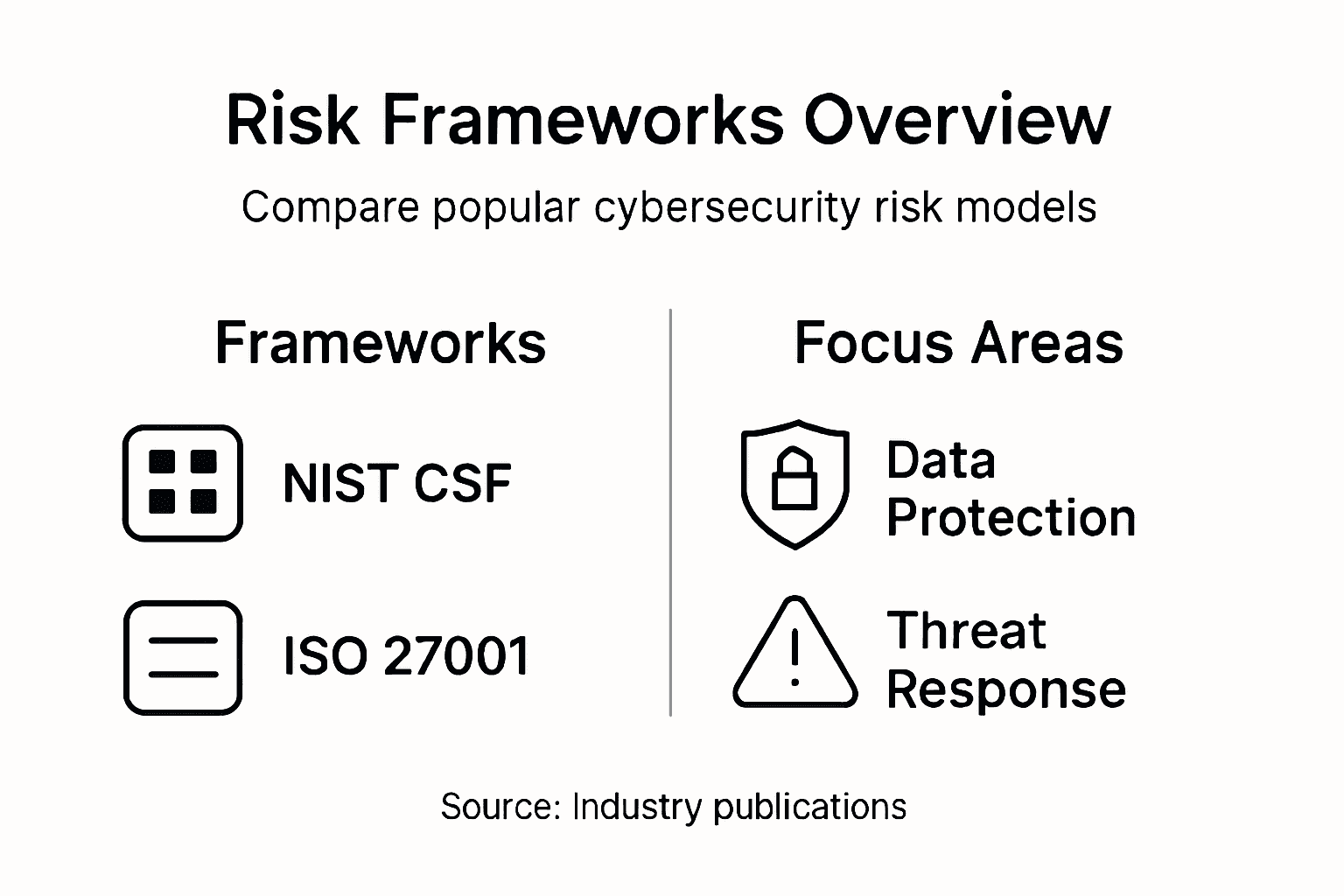
Here's a comparison of major cybersecurity risk management frameworks and their typical use cases:
| Framework | Main Focus | Common Use in Healthcare | Notable Strength |
|---|---|---|---|
| NIST CSF | Comprehensive, flexible guidance | Creating tailored cyber defense programs | Adaptability and wide adoption |
| ISO 27001 | International security standards | Building formal, certifiable ISMS | Audit-ready compliance structure |
| COBIT | IT governance and control | Managing IT operations in large organizations | Emphasis on governance alignment |
| FAIR | Quantitative risk analysis | Measuring financial impact of cyber threats | Data-driven risk prioritization |
Effective risk management is not about achieving perfect security, but about making informed decisions that balance protection with business objectives.
Pro tip: Consider implementing a hybrid risk management approach that combines multiple frameworks to create a comprehensive and adaptable cybersecurity strategy.
How Risk Assessments Strengthen Healthcare Security
Healthcare organizations face increasingly complex cybersecurity challenges that demand comprehensive and proactive risk management strategies. Security Risk Assessment Tools have become critical instruments for identifying and mitigating potential vulnerabilities in healthcare information systems.
Risk assessments in healthcare security encompass multiple critical dimensions:
- Regulatory Compliance: Ensuring adherence to HIPAA and other healthcare privacy regulations
- Vulnerability Detection: Identifying potential weaknesses in technological infrastructure
- Data Protection: Safeguarding sensitive patient health information
- Incident Prevention: Developing proactive strategies to mitigate potential security breaches
Cybersecurity strategies in healthcare must recognize that patient safety extends beyond physical care and now includes robust digital protection mechanisms. Modern risk assessments provide healthcare organizations with a systematic approach to understanding their digital ecosystem, mapping potential threats, and implementing targeted security interventions.
Successful risk assessments require a holistic approach that integrates technological, administrative, and human factors. Organizations must develop comprehensive evaluation frameworks that consider not just technological vulnerabilities, but also human behavior, organizational processes, and potential external threat landscapes.
Effective risk assessments transform cybersecurity from a reactive process to a strategic organizational capability.
Pro tip: Implement a continuous risk assessment model that includes regular vulnerability scanning, employee training, and adaptive security protocols.

Regulatory Compliance: Meeting HIPAA, PCI DSS, and More
Navigating the complex landscape of cybersecurity regulations requires healthcare organizations to implement robust compliance strategies that protect sensitive information and maintain operational integrity. HIPAA Security Rule standards establish critical requirements for safeguarding electronic protected health information across healthcare environments.
Key regulatory compliance dimensions for healthcare organizations include:
- Administrative Safeguards
- Developing comprehensive security management policies
- Implementing workforce security training programs
- Creating clear information access protocols
- Technical Safeguards
- Encryption of sensitive data
- Secure access controls
- Regular system audits and monitoring
- Physical Safeguards
- Controlling physical access to information systems
- Workstation and device security measures
- Equipment inventory and maintenance protocols
Payment card data protection standards extend compliance requirements beyond healthcare, demanding rigorous security practices for organizations handling financial transactions. These regulations create a comprehensive framework that requires continuous adaptation and proactive security management.
Compliance is not a one-time achievement but an ongoing process of assessment, implementation, and continuous improvement. Organizations must develop dynamic strategies that integrate regulatory requirements into their core operational processes, ensuring both legal adherence and robust cybersecurity protection.
Effective regulatory compliance transforms mandatory requirements into strategic organizational capabilities.
Pro tip: Develop a cross-functional compliance team that combines legal, IT, and security expertise to create a holistic approach to regulatory requirements.
Common Risk Management Pitfalls to Avoid
Cybersecurity risk management demands vigilance and strategic thinking to prevent devastating organizational vulnerabilities. Cybersecurity best practices highlight critical areas where organizations frequently stumble in their risk management approaches.
Common risk management pitfalls that organizations must proactively address include:
- Leadership and Strategic Alignment
- Lack of senior leadership engagement
- Insufficient cybersecurity budget allocation
-
Treating security as a purely technical issue
-
Technical Vulnerabilities
- Neglecting software patch management
- Weak password policies
-
Absence of multi-factor authentication
-
Organizational Communication Failures
- Poor cross-departmental risk communication
- Inadequate security awareness training
- Siloed risk management approaches
Enterprise risk management challenges underscore the complexity of creating comprehensive security strategies. Organizations must recognize that effective risk management transcends technical solutions and requires a holistic, integrated approach that involves continuous learning and adaptation.
Successful risk management demands more than implementing tools and policies. It requires building a culture of security awareness where every team member understands their role in protecting organizational assets and maintaining robust cybersecurity defenses.
The table below summarizes common risk management pitfalls and their potential impact:
| Pitfall Category | Example Pitfall | Consequence |
|---|---|---|
| Leadership | Lack of executive buy-in | Insufficient resources for security |
| Technical | Infrequent patching | Increased vulnerability to attack |
| Communication | Isolated IT/security teams | Gaps in risk awareness |
| Culture | Treating security as IT-only | Missed opportunities for staff training |
Risk management is not a destination, but a continuous journey of improvement and vigilance.
Pro tip: Conduct quarterly risk assessment workshops that bring together IT, legal, and operational teams to identify and strategically address emerging vulnerabilities.
Strengthen Your Cybersecurity Risk Management with Expert Solutions
Managing cybersecurity risks while ensuring compliance with standards such as HIPAA, PCI DSS, and NIST is complex and demanding. The article highlights critical challenges like evolving threats, the need for continuous risk assessments, and aligning security strategies with business objectives. If your organization struggles with bridging compliance demands and effective protection, you are not alone. Key pain points include navigating regulatory safeguards, avoiding common risk management pitfalls, and maintaining adaptive defense frameworks.
At Stonos Solutions, we specialize in delivering comprehensive security assessments and customized risk management strategies tailored to your industry’s unique needs. Our expert services cover system design, vulnerability analyses, penetration testing, and compliance support, helping you build resilient defenses against sophisticated cyber threats while meeting rigorous regulatory requirements Discover how our expertise aligns with your risk management goals.
Take control of your cybersecurity posture today. Partner with Stonos Solutions to transform complex risk management challenges into actionable security improvements. Visit Stonos Solutions to learn more and schedule your consultation. Ensure compliance and safeguard your assets now before the next threat emerges.
Frequently Asked Questions
What is risk management in cybersecurity?
Risk management in cybersecurity is a strategic approach that organizations use to identify, assess, and mitigate potential digital threats to protect sensitive information and digital infrastructure.
Why is continuous monitoring important in cybersecurity risk management?
Continuous monitoring is crucial because cybersecurity threats are constantly evolving. It allows organizations to track risks in real-time, ensuring they can adapt their defenses and respond proactively to emerging threats.
How do healthcare organizations integrate risk management frameworks?
Healthcare organizations can integrate risk management frameworks, such as NIST and ISO standards, by aligning their cybersecurity strategies with regulatory requirements and operational needs, ensuring comprehensive protection of sensitive data.
What are common pitfalls in cybersecurity risk management?
Common pitfalls include lack of leadership engagement, neglecting patch management, inadequate security training, and poor communication across departments. Addressing these issues is essential to improve overall cybersecurity effectiveness.
Recommended
- Security Consulting for Integrators: Enabling Resilience - Stonos Solutions Blog
- How to Conduct Security Risk Assessment for HIPAA Compliance - Stonos Solutions Blog
- Services for End Users - Stonos Solutions
- Top 7 Penetration Testing Tools for Small Business 2026 - Stonos Solutions Blog
- Managing Digital Risk: Essential Security for Mid‑Market AI Adoption - BizDev Strategy
- Data Privacy in Email Hosting: Safeguarding Clients and Compliance – Atriomail
- Cloud Security and Compliance for Insurers: Navigating 2025 Risks - Digital Insurance Platform | IBSuite Insurance Software | Modern Insurance System
Louis Romano
Need Security Consulting?
Our expert team is ready to help you enhance your security posture.
Contact Us Today Download Capability StatementRelated Articles
Security gap analysis: steps, benefits, and best practices
Learn how to conduct a security gap analysis to identify hidden risks, close compliance gaps, and build a stronger security posture in regulated industries.
Read MoreEnterprise Security Checklist for Healthcare Compliance Success
Explore an actionable enterprise security checklist tailored for healthcare organizations. Follow a step-by-step process to ensure HIPAA compliance and risk management.
Read More7 Key Types of Cybersecurity Assessments for Healthcare
Learn about 7 essential types of cybersecurity assessments for healthcare organizations and get actionable tips to boost compliance and security.
Read More