Security Consulting for Integrators: Enabling Resilience
Security Consulting for Integrators: Enabling Resilience

Nearly half of all American healthcare and government organizations face unexpected gaps in their risk management strategies each year. For security managers and IT professionals, the stakes could not be higher when sensitive data and critical operations are on the line. Understanding how security consulting can be woven into daily protocols offers fresh pathways to close those gaps, strengthen compliance, and build confidence against growing threats.
Table of Contents
- Security Consulting for Integrators Explained
- Key Service Models and Engagement Types
- Integrating Compliance With Industry Standards
- Impact on Project Outcomes and Risk Reduction
- Common Challenges and Best Practice Solutions
Key Takeaways
| Point | Details |
|---|---|
| Security consulting enhances risk management | It focuses on identifying vulnerabilities and developing tailored defense mechanisms to ensure organizational resilience. |
| Service models provide flexibility | Security consulting includes fixed-price, time and materials, and joint venture models to adapt to various project needs. |
| Compliance is vital in security frameworks | A cohesive approach to multiple regulatory standards strengthens security posture and operational resilience. |
| Continuous monitoring is essential | Implementing systems for ongoing risk assessment and threat intelligence is key to proactive security management. |
Security Consulting for Integrators Explained
Security consulting for integrators represents a sophisticated approach to protecting complex technological infrastructures across sensitive sectors like healthcare and government. Unlike traditional security models, this strategic discipline focuses on comprehensive risk management that goes beyond simple threat detection. Security consultants work closely with system integrators to design resilient defense mechanisms tailored to specific organizational requirements.
The core objective of security consulting involves conducting thorough vulnerability assessments and developing strategic frameworks that address potential systemic weaknesses. These assessments typically include comprehensive security service evaluations that analyze network architecture, access control protocols, and potential breach points. Integrators rely on these detailed analyses to implement robust protective strategies that can adapt to evolving technological landscapes and emerging cybersecurity challenges.
Effective security consulting requires deep technical expertise and an understanding of industry-specific regulatory environments. Professionals in this field must navigate complex compliance requirements across sectors like healthcare, where HIPAA regulations mandate stringent data protection protocols, and government agencies with their multilayered security clearance standards. By providing customized guidance, security consultants help integrators transform potential vulnerabilities into strategic opportunities for enhanced organizational resilience.
Pro tip: Always conduct a comprehensive risk assessment before implementing any new security infrastructure to identify potential blind spots and ensure alignment with your organization's specific operational requirements.
Key Service Models and Engagement Types
Security consulting service models represent sophisticated frameworks designed to address complex technological challenges across different organizational contexts. These models range from flexible engagement approaches to structured project delivery methodologies that enable integrators to provide comprehensive cybersecurity solutions. Engagement types vary significantly depending on project requirements, client needs, and risk management strategies.
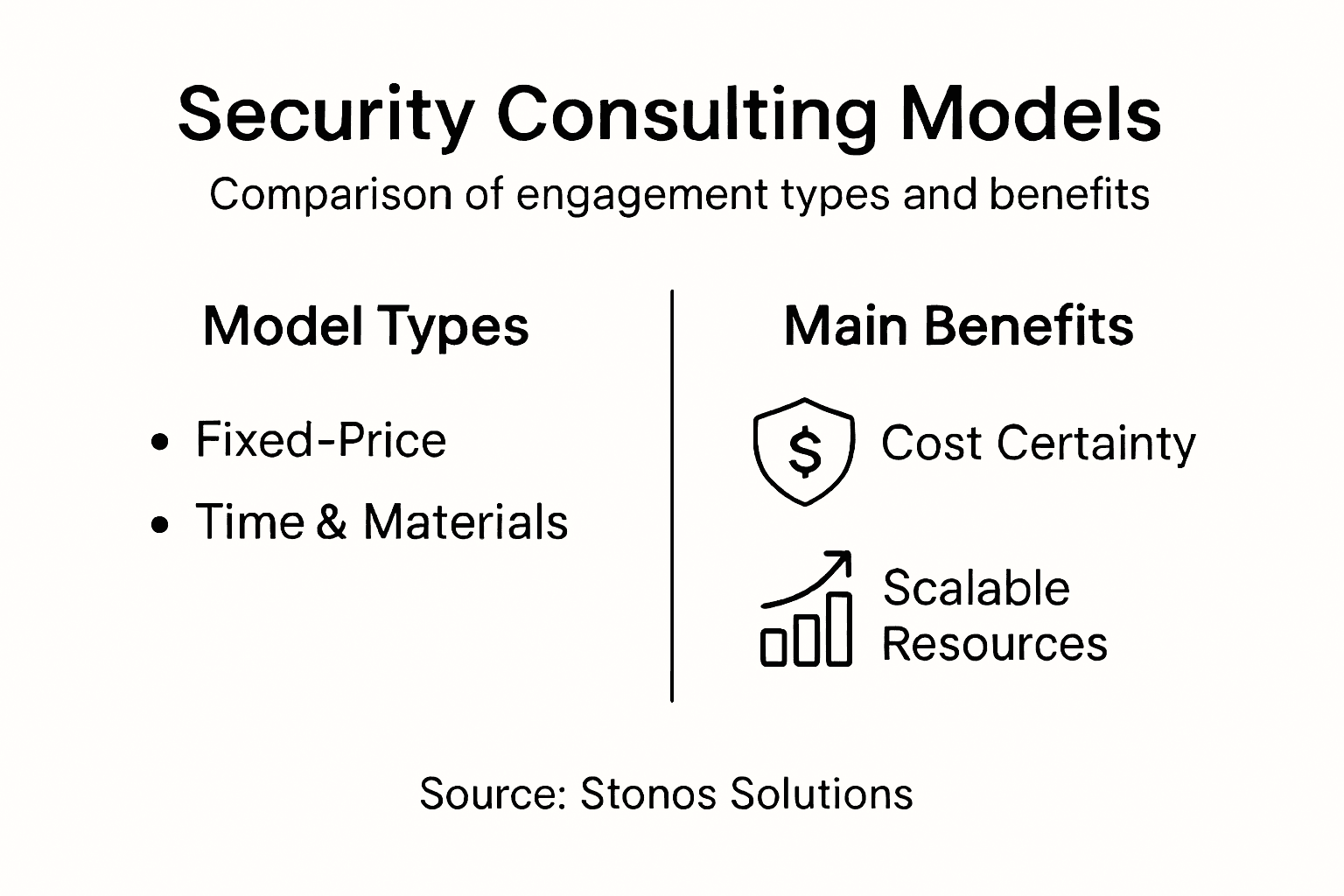
The primary service models include fixed-price projects, time and materials (T&M), and joint venture arrangements. Fixed-price engagements are ideal for well-defined scopes with clear deliverables, providing clients with predictable cost structures. Time and materials models offer greater flexibility, allowing integrators to adapt to evolving project requirements by charging based on actual resources consumed. Joint venture models represent more collaborative approaches where both parties share investment risks and potential revenue opportunities.
Here's a summary of the main service engagement models in security consulting:
| Model Type | Best Fit Scenario | Cost Structure | Main Advantage |
|---|---|---|---|
| Fixed-Price | Clear requirements and scope | Predetermined total | Predictable budgeting and scope |
| Time & Materials | Changing or flexible needs | Actual resource usage | Adaptable to evolving projects |
| Joint Venture | Strategic, shared-risk projects | Shared investment | Mutual benefit and risk sharing |
Professional security consulting increasingly emphasizes comprehensive cybersecurity service frameworks that integrate advisory, implementation, and ongoing operational support. These integrated models typically encompass strategic advisory services, technology assessments, architecture design, program transformation, and managed security services. By leveraging standardized frameworks and domain-specific risk assessment techniques, integrators can deliver more predictable and measurable outcomes across diverse technological environments.
Pro tip: Always conduct a thorough initial assessment of your project's complexity and risk profile to select the most appropriate service engagement model that aligns with your specific organizational objectives.
Integrating Compliance With Industry Standards
Navigating the complex landscape of regulatory compliance requires a strategic approach to implementing comprehensive security frameworks across diverse organizational environments. Regulatory security compliance demands a sophisticated understanding of multiple global standards, including ISO 27001, NIST, PCI DSS, HIPAA, and GDPR. Successful integration involves creating a cohesive information security management system (ISMS) that addresses the unique requirements of different regulatory domains.
The core challenge for integrators lies in developing a unified compliance strategy that harmonizes multiple industry standards. Compliance frameworks typically encompass critical domains such as risk management, data protection, governance, and audit readiness. Organizations must systematically map their existing security controls against multiple regulatory requirements, identifying overlapping provisions and eliminating redundant processes. This approach not only simplifies compliance efforts but also creates a more robust and comprehensive security infrastructure.
Comprehensive security frameworks enable organizations to transform compliance from a bureaucratic exercise into a strategic advantage. By adopting a holistic approach that goes beyond mere checkbox compliance, integrators can develop adaptive security models that respond dynamically to evolving regulatory landscapes. The most effective strategies involve continuous monitoring, regular risk assessments, and flexible control mechanisms that can be quickly adjusted to meet changing regulatory requirements and emerging technological challenges.
Pro tip: Develop a centralized compliance tracking system that maps regulatory requirements across different standards, enabling real-time visibility and streamlined audit preparation.
Impact on Project Outcomes and Risk Reduction
Security consulting fundamentally transforms project risk management by introducing systematic approaches to identifying and mitigating potential organizational vulnerabilities. Project risk management strategies demonstrate a direct correlation between proactive risk identification and improved project performance metrics. These strategies encompass comprehensive assessments that address scope, schedule adherence, cost control, and overall quality, enabling organizations to anticipate and neutralize potential disruptions before they escalate.

The strategic integration of security consulting expertise creates a robust framework for comprehensive risk reduction. By leveraging dedicated risk professionals with advanced analytical skills, organizations can develop more resilient project management approaches. Systematic risk assessment involves multiple layers of analysis, including threat identification, vulnerability mapping, and developing adaptive mitigation strategies that can respond dynamically to emerging challenges.
Strategic security risk management plays a crucial role in aligning security efforts with broader business objectives. This approach goes beyond traditional defensive mechanisms, transforming risk management from a reactive process to a strategic organizational capability. By increasing the influence of security professionals in strategic decision making, organizations can create more nuanced and effective approaches to protecting critical assets and maintaining operational continuity.
Pro tip: Implement a continuous risk monitoring system that integrates real-time threat intelligence with your existing project management frameworks to enable proactive risk mitigation.
Common Challenges and Best Practice Solutions
Security consulting challenges represent complex intersections of technological, regulatory, and operational dynamics that demand sophisticated mitigation strategies. Organizations frequently encounter multifaceted obstacles including fragmented regulatory environments, rapidly evolving cyber threats, and resource constraints that complicate comprehensive security implementation. Compliance complexity emerges as a primary challenge, requiring integrators to develop adaptive approaches that can navigate intricate regulatory landscapes while maintaining robust protective mechanisms.
The human factor represents another critical dimension of security consulting challenges. Integrators must address potential vulnerabilities arising from workforce behaviors, technological skill gaps, and inconsistent security awareness. Systematic training programs become essential in creating a culture of security consciousness, enabling organizations to transform potential weak points into proactive defense mechanisms. These programs should focus not just on technical skills but on developing a holistic understanding of security risks and mitigation strategies across all organizational levels.
Cybersecurity consulting best practices emphasize a layered, dynamic approach to security management. Key strategies include implementing comprehensive risk assessment frameworks, embedding security considerations into initial system design, and maintaining continuous monitoring capabilities. By leveraging advanced threat intelligence and developing flexible incident response protocols, organizations can create resilient security infrastructures that can adapt to emerging technological and threat landscapes. The most effective approaches integrate technological solutions with strategic governance and ongoing workforce education.
The table below contrasts common security consulting challenges with recommended best practice solutions:
| Key Challenge | Impact on Integrators | Best Practice Solution |
|---|---|---|
| Compliance complexity | Increased effort, risk of gaps | Unified frameworks, mapping controls |
| Evolving cyber threats | Hard to maintain protection | Continuous threat monitoring |
| Human factors | Skill gaps, risky behaviors | Ongoing staff training and awareness |
| Resource constraints | Delayed or incomplete measures | Prioritized risk management strategies |
Pro tip: Develop a cross-functional security governance committee that meets quarterly to review emerging threats, assess current vulnerabilities, and align security strategies with evolving organizational objectives.
Strengthen Your Security Consulting Strategy with Proven Expertise
The article highlights crucial challenges integrators face such as compliance complexity, evolving cyber threats, and the need for comprehensive risk management frameworks. Organizations aiming to transform their security posture must address these pain points by conducting thorough vulnerability assessments and aligning with multi-industry standards like HIPAA and PCI DSS. Stonos Solutions specializes in partnering with system integrators to deliver customized cybersecurity consulting that turns these challenges into strategic advantages.
Empower your organization with proven services including penetration testing, regulatory compliance support, and tailored risk management strategies designed to protect critical assets and enhance operational resilience. Discover how we help healthcare, government, industrial, and enterprise clients navigate complex security environments through expert guidance and robust security frameworks. Explore how our certified professionals leverage advanced methodologies that comply with stringent standards such as NIST and FISMA to safeguard your systems.
Ready to elevate your security consulting impact Explore our comprehensive security services and find out why organizations trust us for critical protective strategies.
Take the next step toward resilient security infrastructure today by visiting Stonos Solutions and partner with experts who deliver real security results tailored to your unique risks and regulatory demands.
Frequently Asked Questions
What is security consulting for integrators?
Security consulting for integrators is a strategic discipline focused on protecting complex technological infrastructures by providing comprehensive risk management and tailored defense mechanisms for organizations.
How do security consultants help with compliance in industry standards?
Security consultants assist by developing unified compliance strategies that address multiple regulatory standards, ensuring organizations meet requirements such as HIPAA, NIST, and GDPR while creating a robust security framework.
What are common engagement types in security consulting?
Common engagement types include fixed-price projects for well-defined scopes, time and materials agreements for flexible project needs, and joint ventures that promote collaborative approaches and shared risks between parties.
How can organizations mitigate common challenges in security consulting?
Organizations can mitigate challenges such as compliance complexity and human factors by implementing unified frameworks, continuous threat monitoring, and ongoing staff training to enhance security awareness across all levels.
Recommended
Louis Romano
Need Security Consulting?
Our expert team is ready to help you enhance your security posture.
Contact Us Today Download Capability StatementRelated Articles
How to Conduct Security Risk Assessment for HIPAA Compliance
How to Conduct Security Risk Assessment for HIPAA Compliance ! Officer reviewing HIPAA risk assessment checklists Nearly every American healthcare organization faces the growing challenge of safeguarding patient data as cyber threats rise each year.
Read MoreTop 7 Penetration Testing Tools for Small Business 2026
Top 7 Penetration Testing Tools for Small Business 2026 ! Small business IT team meeting for penetration testing Small businesses face new cyber risks every year and smart protection becomes more important with each challenge.
Read More