What Is Security Assessment and Its Impact on Compliance
What Is Security Assessment and Its Impact on Compliance

Mistaking security assessment for a one-time checklist can leave even the most regulated organizations exposed. For American healthcare and government sectors, the growing complexity of software systems and threats demands constant, adaptive evaluation. Understanding the core concepts and misconceptions of security assessment reveals why ongoing analysis is essential for both compliance and real-world protection. This article helps professionals sharpen their assessments and tackle persistent misunderstandings that undermine true organizational security.
Table of Contents
- Security Assessment—Core Concepts And Misconceptions
- Types Of Security Assessments Explained
- How Security Assessments Work In Practice
- Regulatory Frameworks And Compliance Standards
- Risks, Costs, And Common Assessment Pitfalls
Key Takeaways
| Point | Details |
|---|---|
| Ongoing Process | Security assessment should be viewed as a continuous, dynamic initiative rather than a one-time event. |
| Diverse Methodologies | Organizations must employ various types of security assessments tailored to their specific needs and regulatory requirements. |
| Holistic Approach | Practical implementations should combine technical analysis with strategic decision-making to address organizational nuances. |
| Regulatory Compliance | Achieving compliance requires an integrated strategy that aligns technical controls with overarching security objectives for continuous improvement. |
Security Assessment—Core Concepts and Misconceptions
Security assessment represents a critical intersection between information security and system evaluation, focusing on identifying and mitigating potential vulnerabilities within organizational infrastructure. At its core, this process involves comprehensive analysis and systematic examination of an organization's digital and physical security landscape to detect potential weaknesses before they can be exploited.
The fundamental components of security assessment include:
- Vulnerability scanning to identify system weaknesses
- Risk identification and prioritization
- Threat modeling to anticipate potential attack vectors
- Comprehensive reporting of discovered security gaps
- Recommendations for remediation strategies
Organizations frequently misunderstand security assessment as a one-time event, when in reality, it should be viewed as a continuous, dynamic process. Security assessment research highlights the evolving complexity of software systems and emerging threats, underscoring the need for ongoing, adaptive security evaluations.
Most organizations encounter several common misconceptions about security assessments. They often believe that passing a single assessment guarantees long-term security, which is fundamentally incorrect. Security is not a static state but a continuously shifting landscape requiring persistent vigilance, regular updates, and proactive threat monitoring.
Pro Tip: Treat security assessment as an ongoing strategic initiative, not a compliance checkbox.
Types of Security Assessments Explained
Security assessments are not a one-size-fits-all approach but a diverse set of methodologies designed to address different organizational security needs. Comprehensive risk assessment frameworks demonstrate the complexity and variety of evaluation techniques used across industries.
The primary types of security assessments include:
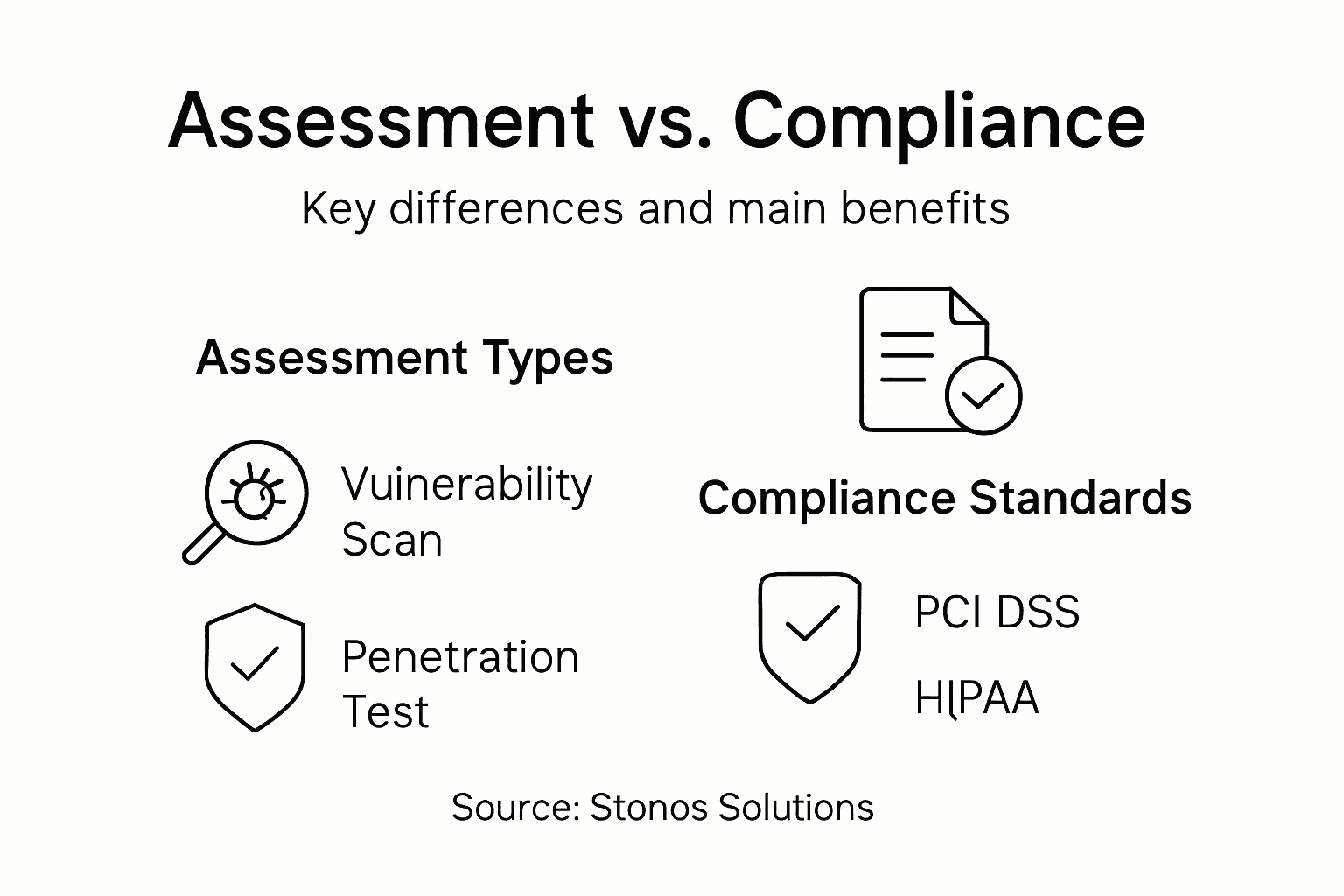
- Vulnerability Assessment: Systematic review of potential weaknesses in systems and networks
- Penetration Testing: Simulated cyber attacks to identify exploitable vulnerabilities
- Risk Assessment: Comprehensive evaluation of potential threats and their potential impact
- Compliance Assessment: Verification of adherence to specific regulatory standards
- Threat Modeling: Proactive identification and analysis of potential security threats
Each assessment type serves a distinct purpose and provides unique insights into an organization's security posture. Qualitative assessments focus on descriptive analysis, while quantitative methods use numerical metrics to evaluate risks. Hybrid approaches combine both methodologies to provide a more comprehensive security evaluation.
Organizations must strategically select assessment types based on their specific industry, regulatory requirements, and technological infrastructure. The goal is not just to identify vulnerabilities but to develop a nuanced understanding of potential security risks and create targeted mitigation strategies.
Here's how common security assessment types differ in focus and benefit:
| Assessment Type | Main Focus | Key Business Benefit |
|---|---|---|
| Vulnerability Assessment | Discover system weaknesses | Reduce risk of exploitable gaps |
| Penetration Testing | Simulate real-world attacks | Test defenses under safe conditions |
| Risk Assessment | Evaluate threat likelihood and impact | Prioritize high-risk exposures |
| Compliance Assessment | Verify regulatory adherence | Avoid fines and penalties |
| Threat Modeling | Anticipate attacker methods | Enhance proactive defenses |
Pro Tip: Rotate between different assessment types to maintain a comprehensive and dynamic security perspective.
How Security Assessments Work in Practice
Operational security risk assessment methods reveal a complex process that combines technical analysis with strategic decision-making. Security professionals must navigate multiple layers of investigation, blending quantitative data collection with qualitative insights to create a comprehensive security evaluation.
The practical implementation of security assessments typically involves several critical stages:
- Initial Scoping: Defining assessment boundaries and objectives
- Data Collection: Gathering technical and contextual information
- Vulnerability Identification: Systematically discovering potential weaknesses
- Risk Prioritization: Ranking vulnerabilities based on potential impact
- Mitigation Strategy Development: Creating targeted remediation plans
- Reporting and Recommendations: Documenting findings and suggesting improvements
Technical teams employ a variety of sophisticated tools and methodologies during these assessments. Advanced scanning technologies, network monitoring systems, and probabilistic modeling help transform raw data into actionable security insights. The process requires a blend of automated tools and expert human interpretation to accurately assess an organization's true security posture.

Contextual understanding plays a crucial role in practical security assessments. Security professionals must consider organizational nuances, including technological infrastructure, industry regulations, and specific operational environments. This holistic approach ensures that assessments are not just technical exercises but strategic initiatives designed to protect an organization's critical assets.
Pro Tip: Develop a repeatable assessment framework that can be consistently applied while remaining flexible enough to adapt to unique organizational challenges.
Regulatory Frameworks and Compliance Standards
Information security management systems represent the critical backbone of organizational cybersecurity strategies, providing comprehensive guidelines for protecting sensitive information and maintaining robust security infrastructures. These frameworks establish standardized approaches that help organizations systematically manage and mitigate potential security risks.
Key regulatory frameworks and compliance standards include:
- ISO/IEC 27001: Global standard for information security management
- HIPAA: Healthcare information privacy and security regulations
- PCI DSS: Payment card industry data security standards
- NIST Cybersecurity Framework: Comprehensive guidelines for cyber risk management
- FISMA: Federal information security management requirements
Each compliance standard addresses unique industry requirements while sharing fundamental principles of risk assessment, vulnerability management, and continuous improvement. Healthcare organizations, financial institutions, and government agencies must navigate these complex regulatory landscapes, implementing specific controls and documentation processes to demonstrate adherence and protect critical information assets.
Successful compliance requires more than simple checklist completion. Organizations must develop integrated approaches that align technical controls with strategic objectives, ensuring that security measures are not just implemented but effectively maintained and continuously updated. This demands a proactive stance that views regulatory compliance as an ongoing process of risk management and organizational resilience.
See how top regulatory frameworks address industry needs:
| Framework/Standard | Sector Focus | Main Coverage Area |
|---|---|---|
| ISO/IEC 27001 | All industries | Information security systems |
| HIPAA | Healthcare | Patient privacy and security |
| PCI DSS | Payment Card | Cardholder data protection |
| NIST CSF | Government/Private | Cyber risk management |
| FISMA | Federal agencies | Federal data security |
Pro Tip: Develop a centralized compliance tracking system that maps regulatory requirements to specific security controls and assessment activities.
Risks, Costs, and Common Assessment Pitfalls
Information security risk assessment methods reveal complex challenges that organizations must navigate carefully to maintain effective security strategies. Understanding potential pitfalls is crucial for developing robust and cost-effective security assessment approaches that truly protect organizational assets.
Common risks and assessment challenges include:
- Incomplete Risk Identification: Failing to capture all potential vulnerabilities
- Quantitative Bias: Overrelying on numerical metrics
- Stakeholder Misalignment: Inadequate engagement with key organizational teams
- Resource Constraints: Limited budget and expertise for comprehensive assessments
- Outdated Methodologies: Using static approaches in dynamic threat landscapes
Financial implications of security assessments extend far beyond direct assessment costs. Organizations must consider potential operational disruptions, compliance penalties, and the significant economic impact of unmitigated security risks. The cost of a comprehensive assessment pales in comparison to the potential financial devastation caused by a major security breach.
Effective risk management requires a holistic approach that balances technical analysis with strategic thinking. Security professionals must develop adaptive assessment frameworks that can quickly evolve with changing technological landscapes and emerging threat vectors. This means moving beyond checklist compliance to create dynamic, intelligence-driven security strategies.
Pro Tip: Implement a continuous assessment model that treats security evaluation as an ongoing process, not a periodic event.
Strengthen Your Security Assessment and Compliance Strategy Today
Security assessments are essential for identifying vulnerabilities before they become breaches. The challenges highlighted in the article, including continuous risk management, regulatory compliance like HIPAA and PCI DSS, and developing adaptive security frameworks, reflect the realities many organizations face. If you want to move beyond a one-time checklist and build resilient defenses tailored to your industry, expert guidance is critical.
At Stonos Solutions, we specialize in comprehensive security assessments, penetration testing, and regulatory compliance support designed to meet the complex needs of healthcare, government, industrial, and enterprise sectors. Our certified experts help you prioritize risks, align technical controls with business objectives, and maintain compliance with frameworks like NIST and FISMA.
Unlock proactive, dynamic security with Stonos Solutions and gain peace of mind knowing your organizational assets are safeguarded.
Take control of your cybersecurity today
Partner with a trusted veteran-owned firm that delivers end-to-end security consulting and risk management. Visit Stonos Solutions to learn how our tailored assessments and compliance services protect your critical systems and ensure you stay ahead of evolving threats.
Frequently Asked Questions
What is a security assessment?
A security assessment is a systematic evaluation aimed at identifying and mitigating potential vulnerabilities within an organization's digital and physical infrastructure.
Why is security assessment important for compliance?
Security assessments help organizations ensure adherence to regulatory standards by identifying security gaps that could lead to non-compliance and associated penalties.
How often should security assessments be conducted?
Security assessments should be treated as an ongoing process, not a one-time event. Regular and dynamic evaluations are essential to adapt to emerging threats and changes in the organizational landscape.
What are the main types of security assessments?
The primary types of security assessments include vulnerability assessments, penetration testing, risk assessments, compliance assessments, and threat modeling, each serving a unique purpose in evaluating an organization's security posture.
Recommended
Louis Romano
Need Security Consulting?
Our expert team is ready to help you enhance your security posture.
Contact Us Today Download Capability StatementRelated Articles
Security gap analysis: steps, benefits, and best practices
Learn how to conduct a security gap analysis to identify hidden risks, close compliance gaps, and build a stronger security posture in regulated industries.
Read MoreEnterprise Security Checklist for Healthcare Compliance Success
Explore an actionable enterprise security checklist tailored for healthcare organizations. Follow a step-by-step process to ensure HIPAA compliance and risk management.
Read More7 Key Types of Cybersecurity Assessments for Healthcare
Learn about 7 essential types of cybersecurity assessments for healthcare organizations and get actionable tips to boost compliance and security.
Read More