Penetration Testing: Securing Healthcare Data Compliance
Penetration Testing: Securing Healthcare Data Compliance

Healthcare cybersecurity managers often face the challenge of determining whether their current defenses can truly withstand real-world cyberattacks. Protecting patient data and meeting HIPAA requirements means going beyond basic scans to uncover hidden vulnerabilities that automated tools might miss. Penetration testing offers an in-depth view by simulating attacks to expose practical security gaps in your systems and networks, giving you the actionable insights needed to strengthen compliance and keep sensitive information safe from evolving threats.
Table of Contents
- What Is Penetration Testing In Cybersecurity
- Common Types Of Penetration Testing Explained
- Typical Stages Of A Penetration Test Process
- HIPAA Compliance And Legal Considerations
- Managing Risks And Maximizing Security Value
Key Takeaways
| Point | Details |
|---|---|
| Importance of Penetration Testing | It simulates real cyberattacks to uncover vulnerabilities, providing deeper insights than standard vulnerability scans. |
| Types of Testing | Healthcare environments require tailored approaches like network, web application, social engineering, and cloud penetration tests to cover distinct vulnerabilities. |
| Compliance Significance | Engaging in penetration testing helps healthcare organizations meet HIPAA compliance requirements and demonstrates proactive security management. |
| Risk Management Integration | Penetration testing results should inform a comprehensive risk management strategy, prioritizing remediation efforts based on potential business impact. |
What Is Penetration Testing in Cybersecurity
Penetration testing is a controlled, authorized security assessment where trained professionals simulate real cyberattacks against your healthcare organization's systems, networks, and applications. Unlike passive vulnerability scanning, penetration testing goes deeper by actually exploiting discovered vulnerabilities to understand their true impact on your organization. Think of it like hiring a locksmith to try breaking into your own building before a criminal does, then reporting exactly how they got in and what they accessed once inside.
For healthcare cybersecurity managers, this distinction matters significantly. A vulnerability scan might flag that a particular server has outdated software, which is useful information. Penetration testing takes that finding further by actually attempting to compromise the server, determining whether it provides access to patient data, electronic health records, or other protected health information. This practical, hands-on approach reveals what attackers could realistically accomplish. Testers use both manual techniques and automated tools to identify gaps in your security operations, system design, and implementation. They document each vulnerability's severity, exploitability, and potential business impact in terms that matter to your compliance and operational teams.
What makes penetration testing particularly valuable for HIPAA compliance is that it addresses regulatory requirements at a fundamental level. Regulators and auditors recognize that simulated cyberattacks help organizations prevent and detect breaches by uncovering security weaknesses before malicious actors do. Healthcare organizations conducting regular penetration tests demonstrate to auditors, patients, and business partners that they take data protection seriously. The testing generates detailed reports showing your organization understands its risk profile, has taken corrective action on identified vulnerabilities, and maintains an active security posture rather than a passive one.
The process typically involves reconnaissance (gathering information about your systems), scanning (identifying open ports and services), enumeration (pinpointing specific vulnerabilities), exploitation (attempting to gain unauthorized access), and reporting (documenting findings with remediation recommendations). Penetration testers working with Stonos Solutions bring healthcare-specific expertise, understanding which systems and data require the highest protection levels and which attack vectors are most likely to target medical organizations.
Pro tip: Start with a scoped penetration test focusing on your highest-risk systems like patient portals, electronic health record systems, or VPN access points rather than attempting to test your entire infrastructure at once, allowing your team to prioritize remediation efforts where they matter most.
Common Types of Penetration Testing Explained
Penetration testing isn't a one-size-fits-all process. Your healthcare organization's network spans multiple environments, each with different vulnerabilities and attack surfaces. That's why testers employ various penetration testing methodologies depending on what you're trying to protect and what level of inside information testers have before starting. The three core approaches are black-box testing (simulating an external attacker with no prior knowledge), white-box testing (giving testers full system access and documentation), and gray-box testing (providing limited insider information, which mirrors many real-world breach scenarios).

Within these approaches, specific testing types target your organization's distinct vulnerabilities. Network penetration testing probes your external perimeter, internal systems, and wireless networks for weaknesses. Web application testing focuses on patient portals, prescription systems, and any custom healthcare software that collects or processes patient data. Social engineering testing attempts to manipulate staff into revealing credentials or access information, which is critical in healthcare where employees often handle sensitive data. Physical penetration testing checks whether attackers can gain unauthorized access to server rooms, data centers, or facilities housing critical systems. Cloud penetration testing evaluates the security of hosted electronic health records, backup systems, or any data stored with third-party providers. Each type requires tailored approaches and specific tools to identify risks effectively across your diverse attack surfaces.
For healthcare cybersecurity managers, the choice of testing types directly impacts HIPAA compliance demonstrations. Regulators expect you to understand your attack surface comprehensively, which means your penetration testing program should cover multiple domains rather than focusing exclusively on one area. A hospital might prioritize network testing initially to secure its perimeter, then add application testing after securing external access, followed by social engineering assessments to strengthen human security layers. This staged approach allows your team to allocate resources strategically while building evidence of continuous security improvement. Stonos Solutions professionals understand which testing combinations address healthcare-specific threats, such as ransomware targeting backup systems or phishing campaigns designed to compromise physician credentials.
Here's a comparison of the main penetration testing approaches to help you determine which fits your organization's needs:
| Approach | Tester Knowledge Level | Realism of Attack Simulation | Typical Use Case |
|---|---|---|---|
| Black-box | No prior system knowledge | Simulates outsider, real-world attacks | Testing external threats and perimeter |
| Gray-box | Limited insider knowledge | Reflects insider + outsider scenarios | Validating threats from partly informed users |
| White-box | Full access and info | Comprehensive, internal vulnerabilities | In-depth evaluation of internal controls |
Pro tip: Combine network and social engineering penetration testing in the same engagement, as attackers often use employee manipulation to bypass even robust technical defenses, giving you a more realistic assessment of your organization's true security posture.
Typical Stages of a Penetration Test Process
A structured penetration test follows a methodical approach rather than a chaotic attempt to break everything at once. Understanding these stages helps healthcare managers set realistic expectations, allocate resources appropriately, and understand what testers are actually doing during the engagement. The process typically unfolds in five distinct phases that build upon one another, starting with information gathering and culminating in a comprehensive report you can act upon.
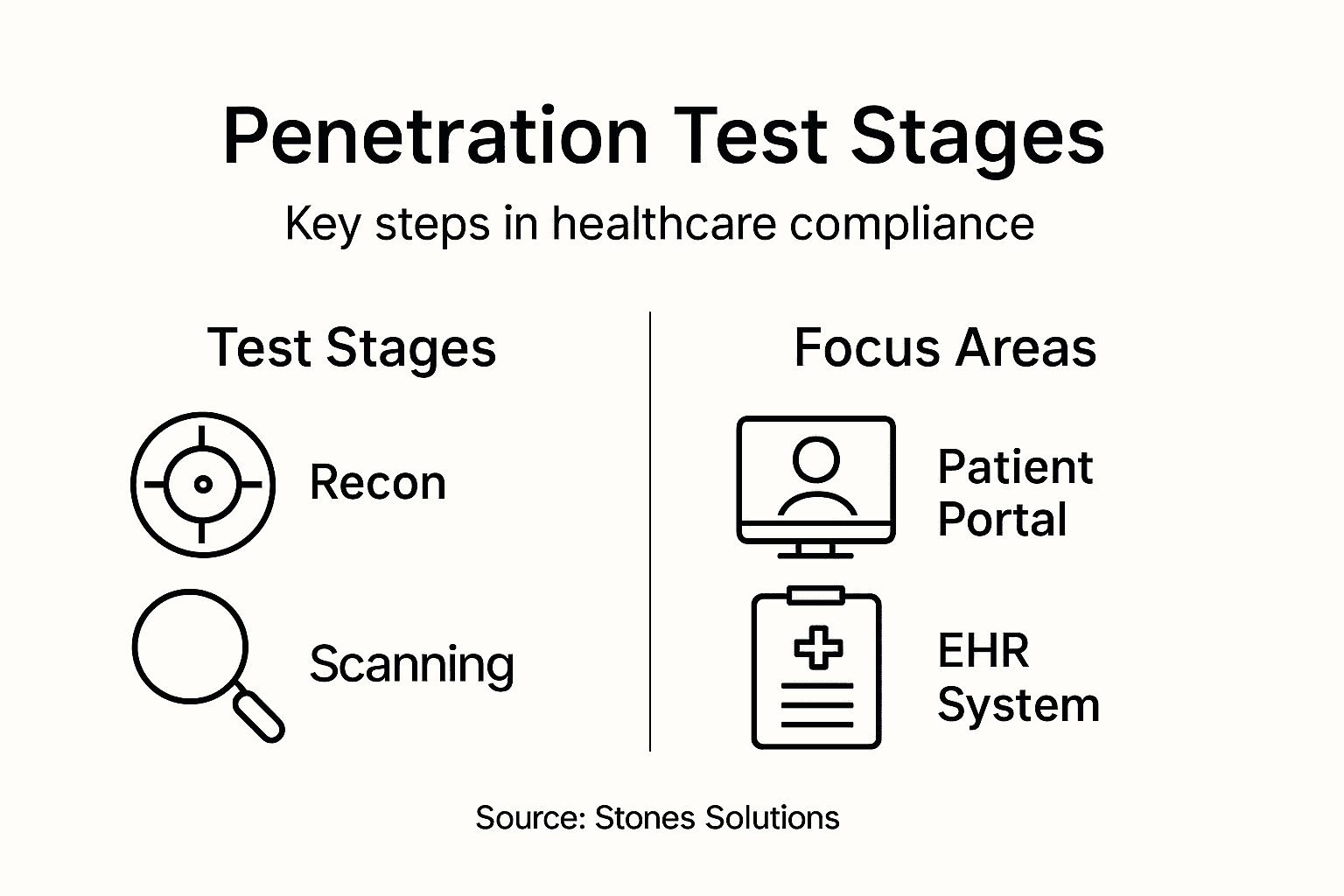
The first stage is reconnaissance, where testers gather intelligence about your organization's systems without actively attacking anything. This includes researching your public web presence, DNS records, network architecture details published online, and any information available through social media or job postings that might reveal technology choices. The second stage is scanning, where testers identify active systems, open ports, running services, and potential entry points. The third stage involves vulnerability assessment, where testers analyze the scan results to identify specific weaknesses and prioritize them by severity and exploitability. At this point, testers haven't attempted any actual compromise yet. They're mapping your risk landscape.
The fourth stage is where things get serious. Exploitation is when testers actually attempt to leverage the vulnerabilities they've identified to gain unauthorized access, escalate privileges, or move laterally through your network. This is the hands-on validation of whether vulnerabilities are truly exploitable and what damage an attacker could realistically accomplish. This phase directly demonstrates compliance gaps to auditors because it shows whether patient data, electronic health records, or backup systems are actually protected or merely appear protected. The final stage is comprehensive reporting, where testers document every finding, its severity, business impact, and specific remediation steps your organization can take. A strong penetration test report becomes your roadmap for security improvements and serves as evidence to regulators that you understand your vulnerabilities and are taking corrective action.
For healthcare organizations, the value lies not just in completing these stages but in how you respond to them. Each phase produces deliverables that inform the next phase and, ultimately, your compliance posture. Testers with healthcare expertise understand which systems require the highest scrutiny and which findings regulators will expect you to address immediately versus those you might reasonably remediate over time.
Below is a summary of the five key penetration test stages and what each delivers to healthcare security management:
| Stage | Main Activity | Key Output for Management |
|---|---|---|
| Reconnaissance | Gather system intelligence | List of publicly available information |
| Scanning | Identify open ports/services | Map of live systems and potential entry |
| Vulnerability Assessment | Analyze weaknesses | Prioritized list of vulnerabilities |
| Exploitation | Attempt attacks | Proof of exploitability, impact analysis |
| Reporting | Document findings/remediation | Actionable roadmap and compliance evidence |
Pro tip: Request a staged report after the vulnerability assessment phase so your team can review findings and prepare systems before the exploitation phase occurs, reducing operational disruption and giving you time to decide which vulnerabilities warrant active testing.
HIPAA Compliance and Legal Considerations
HIPAA doesn't explicitly mandate penetration testing in its regulatory language, but this absence creates a dangerous misconception among some healthcare organizations. The regulation requires you to identify and mitigate vulnerabilities in your security posture, and regulatory guidance increasingly emphasizes that penetration testing is the most practical way to demonstrate this due diligence. When the Department of Health and Human Services audits your organization or investigates a breach, they examine whether you conducted reasonable security assessments. A healthcare organization that never performed penetration testing struggles to defend itself against allegations that it failed to identify exploitable vulnerabilities. Conversely, an organization with documented, professional penetration testing has clear evidence of proactive security management aligned with HIPAA expectations.
Legal considerations around penetration testing require careful attention. You must obtain explicit written authorization from leadership before any testing begins, clearly defining the scope of systems to be tested, the timeframe for testing, and specific rules of engagement that protect patient data and minimize operational disruption. HIPAA mandates safeguarding patient data through administrative, technical, and physical controls, and your penetration testing must reinforce rather than compromise these protections. Testers must sign business associate agreements if they're external consultants, and your testing rules must explicitly prohibit unauthorized access to actual patient data. A penetration test where testers accidentally expose or exfiltrate real protected health information violates HIPAA, potentially triggering breach notification requirements and regulatory penalties. This is why engaging experienced healthcare penetration testers matters profoundly. They understand the legal boundaries and know how to conduct thorough testing without crossing into prohibited territory.
Recent regulatory proposals suggest mandatory annual penetration testing for healthcare organizations, which means waiting for explicit legal requirements before starting your program puts you behind the compliance curve. Organizations should obtain documented approvals and ensure testing adheres to healthcare privacy and security policies to avoid regulatory liabilities. The most compliant approach involves developing a penetration testing program aligned with NIST Cybersecurity Framework guidelines, which auditors and regulators recognize as industry best practice. Your testing should occur annually at minimum, with additional unscheduled testing after significant system changes or following any security incidents. Document every engagement, finding, and remediation step. This documentation becomes your evidence of compliance during audits and your shield in breach investigations.
Pro tip: Retain a compliance attorney to review your penetration testing scope and rules of engagement before engaging testers, ensuring your testing program produces defensible compliance evidence while staying within legal boundaries.
Managing Risks and Maximizing Security Value
Penetration testing isn't a compliance checkbox. It's a risk management investment that pays dividends across your entire security program. Healthcare organizations face relentless threats. Ransomware gangs specifically target hospitals because they know that disrupting patient care creates urgency around ransom payment. Data breach operations extract patient records for sale on dark web marketplaces. Insider threats range from disgruntled employees stealing data to supply chain partners with network access selling information. Traditional vulnerability scanning identifies some of these risks, but it can't tell you which vulnerabilities actually matter in real attack scenarios. Penetration testing bridges that gap by showing you exactly which security weaknesses an attacker could chain together to compromise your systems and data.
The real value emerges when you treat penetration testing results as input into a comprehensive risk management strategy rather than as isolated findings to fix and forget. Healthcare organizations should implement structured remediation plans based on test results to enhance security posture and minimize risk exposure. This means prioritizing remediation based on exploitability and business impact rather than treating all findings equally. A critical vulnerability in your patient portal affecting thousands of users requires immediate action. A medium-severity weakness in a legacy system used by five people in radiology might be addressed through compensating controls like network segmentation while you plan a longer-term system upgrade. Your remediation plan becomes your risk management roadmap, allocating security resources where they deliver maximum protection.
Penetration testing integrates into broader risk management frameworks through frequent testing aligned with regulatory requirements and continuous security improvement cycles. Annual testing provides baseline assessment. Testing after system changes ensures new configurations don't introduce vulnerabilities. Unscheduled testing following security incidents validates that remediation actually worked. This approach creates organizational resilience because your security posture continuously evolves rather than degrading over time. Each penetration test validates your existing controls, identifying which defensive measures actually work and which provide only the illusion of security. This evidence directly informs budget decisions. Rather than requesting funding for unproven security initiatives, you're requesting resources to fix specific vulnerabilities that professional testers confirmed are exploitable and pose genuine risk to patient data.
Maximizing value also means using penetration testing findings to strengthen your security culture. Share anonymized results with relevant teams to demonstrate why their security practices matter. Show network administrators the lateral movement paths testers discovered. Show developers the application vulnerabilities that exposed data. Show employees the social engineering tactics that worked against them. This educational value transforms penetration testing from a threat assessment into a learning opportunity that builds organizational security awareness.
Pro tip: Create a quarterly security metrics dashboard tracking penetration testing findings by severity, remediation rates, and time to remediation so leadership understands your security program's evolution and can justify continued security investments.
Strengthen Your Healthcare Security with Expert Penetration Testing
Healthcare organizations face real dangers from exploitable vulnerabilities that threaten patient data and HIPAA compliance. This article highlights critical challenges like managing risk from social engineering, network weaknesses, and application flaws that only hands-on penetration testing can uncover. If you are responsible for protecting sensitive health information, you understand how important it is to prove you can identify and remediate these threats before attackers do.
At Stonos Solutions, we specialize in delivering comprehensive penetration testing services designed specifically for healthcare environments. Our expert team helps you simulate realistic cyberattacks while adhering to legal and regulatory requirements so you can confidently protect electronic health records and critical systems.
Don’t wait until a breach exposes your organization to costly penalties or patient trust loss. Take control today with customized penetration testing and vulnerability assessments tailored to your highest-risk assets. Learn how our risk management strategies and compliance support can transform your security posture and demonstrate due diligence to auditors and regulators. Contact us now at Stonos Solutions to schedule your first step toward lasting healthcare data security.
Frequently Asked Questions
What is penetration testing in healthcare cybersecurity?
Penetration testing is an authorized simulation of cyberattacks against healthcare organizations to uncover vulnerabilities by exploiting them. It helps assess the actual impact of security weaknesses on patient data and compliance.
How does penetration testing help with HIPAA compliance?
Penetration testing addresses important security assessments required under HIPAA by identifying vulnerabilities before malicious actors can exploit them. It demonstrates proactive security management and helps organizations maintain compliance.
What are the main stages of a penetration test?
The typical stages of a penetration test include reconnaissance, scanning, vulnerability assessment, exploitation, and reporting. Each stage builds upon the previous one to identify vulnerabilities and document findings for remediation.
How often should healthcare organizations conduct penetration testing?
Healthcare organizations should aim for annual penetration testing, with additional unscheduled tests after significant system changes or security incidents, to continuously validate their security posture and compliance efforts.
Recommended
Louis Romano
Need Security Consulting?
Our expert team is ready to help you enhance your security posture.
Contact Us Today Download Capability StatementRelated Articles
Enterprise Security Checklist for Healthcare Compliance Success
Explore an actionable enterprise security checklist tailored for healthcare organizations. Follow a step-by-step process to ensure HIPAA compliance and risk management.
Read MoreHow to protect patient data in 2026: 50% fewer breaches with MFA
Discover how healthcare IT can protect patient data in 2026 with MFA, encryption, HIPAA compliance, and staff training to reduce breaches by 50%.
Read MoreRole of Penetration Testing in Industry Security
Role of penetration testing in industry security—discover core principles, testing types, compliance mandates, real-world value, and common pitfalls.
Read More