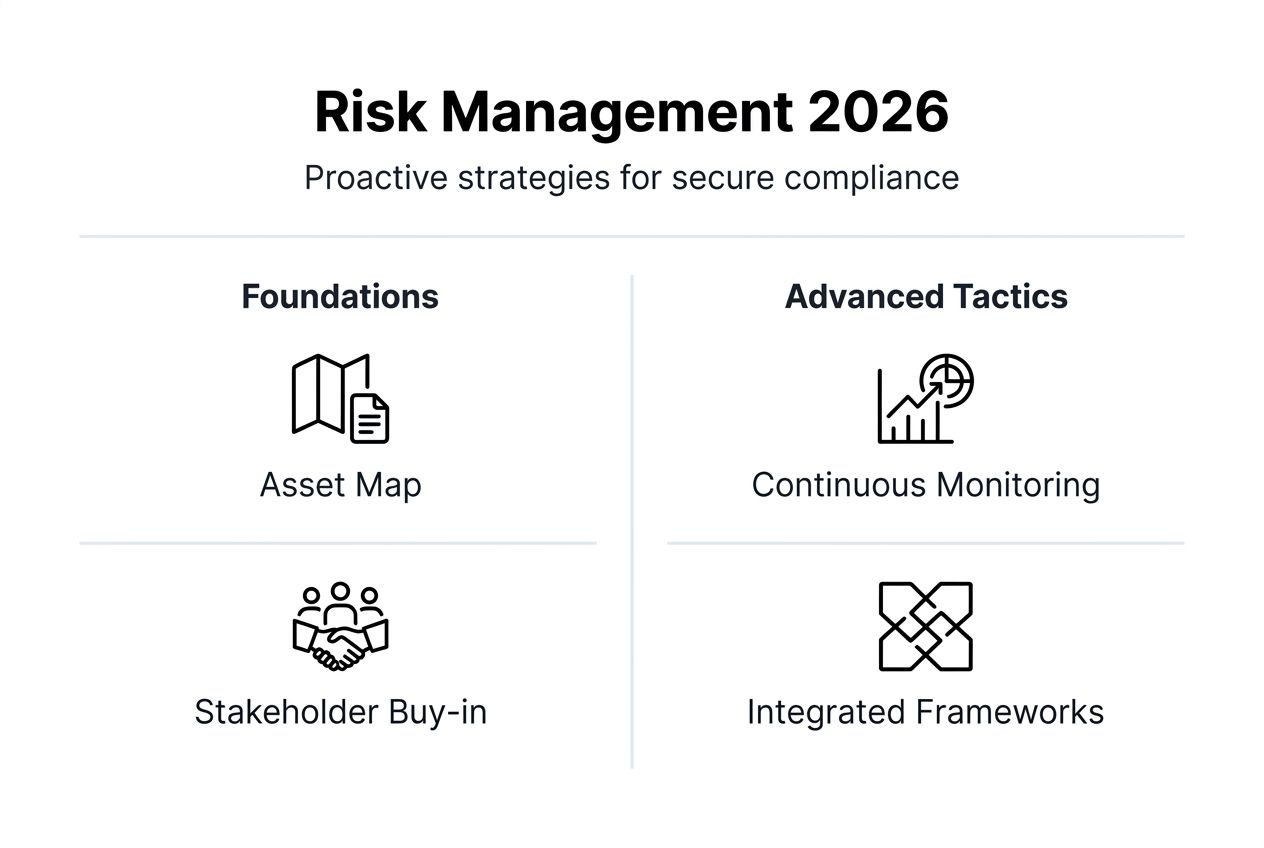
Risk management strategy guide 2026: advanced tactics
Risk management strategy guide 2026: advanced tactics

Risk management failures cost organizations millions annually, yet many professionals struggle with fragmented compliance efforts and reactive security postures. This guide delivers advanced, integrated strategies specifically designed for healthcare, government, and industrial sectors navigating complex regulatory environments like HIPAA, NIST, FISMA, and PCI DSS. You'll learn how to build proactive risk management programs that eliminate vulnerabilities, streamline compliance, and protect organizational assets through systematic frameworks backed by measurable outcomes.
Table of Contents
- Introduction To Risk Management Strategy In Regulated Sectors
- Prerequisites And Preparation For Strategy Development
- Conducting Comprehensive Risk Assessments
- Establish Governance And Culture
- Implement Integrated Compliance Frameworks And Technologies
- Develop Risk Management Training Programs
- Leverage Risk Intelligence And Continuous Monitoring
- Common Mistakes And Troubleshooting Risk Management Strategies
- Measuring Success And Expected Outcomes
- Explore Stonos Solutions' Integrated Security Services
- Frequently Asked Questions
Key takeaways
| Point | Details |
|---|---|
| Integrated strategies reduce incidents | Unified risk management combining compliance, governance, and intelligence lowers security failures and operational inefficiencies. |
| Leadership engagement is foundational | Executive commitment ensures resource allocation, accountability, and sustainable compliance culture across the organization. |
| Comprehensive assessments drive action | Evaluating clinical, IT, operational, and vendor risks enables prioritized, targeted mitigation aligned with regulatory requirements. |
| Unified frameworks enhance efficiency | Consolidating overlapping regulations into cohesive frameworks reduces redundancy and improves compliance management by up to 45%. |
| Continuous monitoring sustains posture | Proactive risk intelligence and real-time monitoring detect emerging threats early, maintaining regulatory adherence and security resilience. |
Introduction to risk management strategy in regulated sectors
Regulated industries face a unique challenge: managing security while navigating overlapping compliance requirements. Healthcare organizations must balance HIPAA privacy rules with operational demands. Government entities juggle FISMA controls alongside mission-critical services. Industrial facilities coordinate PCI DSS standards with NIST cybersecurity frameworks.
Fragmented risk management creates dangerous gaps. When security teams operate separately from compliance officers, vulnerabilities slip through unnoticed. A security risk assessment for HIPAA might identify technical weaknesses while missing procedural compliance failures. Meanwhile, audit teams document policy violations without addressing underlying security architecture flaws.
The consequences are severe. Data breaches expose sensitive patient records or classified information. Regulatory penalties drain budgets. Operational disruptions halt critical services. These failures share a common root: siloed approaches that treat security and compliance as separate functions instead of integrated components of organizational risk management.
Effective strategies recognize that regulatory environments like HIPAA, NIST, FISMA, and PCI DSS overlap significantly. Controls addressing one standard often satisfy requirements in others. Technical safeguards protecting healthcare data also support government information security. Physical security measures required for industrial facilities align with compliance documentation standards.
An integrated approach delivers multiple benefits:
- Reduced redundancy across compliance programs
- Unified visibility into organizational risk posture
- Coordinated response to emerging threats
- Streamlined audit preparation and reporting
- Better resource allocation across security initiatives
Success requires shifting from reactive compliance checking to proactive risk intelligence. Instead of scrambling before audits, organizations build continuous monitoring systems. Rather than treating regulations as checklists, they develop governance frameworks that embed compliance into daily operations. This foundation supports advanced tactics that transform risk management from a cost center into a strategic advantage.
Prerequisites and preparation for strategy development
Before implementing advanced risk management tactics, your organization needs solid foundations. Jumping into technical controls without these prerequisites wastes resources and creates false security.
Start with executive sponsorship. Leadership must visibly commit to compliance as a strategic priority, not a checkbox exercise. This means allocating adequate budget, assigning clear accountability, and participating in governance meetings. When executives treat risk management as someone else's problem, programs fail regardless of technical sophistication.
Next, establish baseline data. You cannot protect what you don't know exists. Inventory all assets: information systems, data repositories, physical facilities, and vendor relationships. Document data flows showing how sensitive information moves through your organization. Identify crown jewel assets requiring the highest protection levels.
Regulatory knowledge comes third. Your team must understand which standards apply and how requirements overlap. Map obligations across HIPAA, NIST, FISMA, PCI DSS, or industry-specific regulations. This mapping reveals opportunities to consolidate controls and eliminate duplicate efforts.
Cross-functional collaboration proves essential. Risk management cannot succeed as an IT-only initiative. Include representatives from:
- Clinical or operations teams who understand workflow impacts
- Legal and compliance officers who interpret regulatory requirements
- Finance leaders who control budgets and resource allocation
- Human resources for training and culture development
- Vendor management for third-party risk oversight
These stakeholders provide diverse perspectives that identify blind spots. A security control that seems reasonable to IT might disrupt critical clinical workflows. Compliance documentation that satisfies legal teams might prove impractical for frontline staff.
Technology readiness matters too. Assess your current tools for compliance tracking, security monitoring, and risk analytics. Identify gaps where manual processes create bottlenecks or errors. Consider custom development and automation opportunities that streamline repetitive compliance tasks, freeing staff to focus on strategic risk initiatives.
Finally, secure sufficient resources. Effective risk management requires sustained investment in technology, training, and personnel. Underfunded programs produce superficial compliance that crumbles under audit scrutiny or actual incidents. Build realistic budgets covering initial implementation plus ongoing operations.
With these foundations established, you're ready to develop comprehensive strategies that deliver measurable security and compliance outcomes.
Conducting comprehensive risk assessments
Risk assessment forms the cornerstone of effective strategy development. Superficial evaluations miss critical vulnerabilities, while thorough assessments reveal exactly where to focus mitigation efforts.
Start by expanding beyond traditional IT security. Comprehensive risk assessments across clinical, IT, vendor, and operational domains enable targeted mitigation that closes compliance gaps. Each dimension presents unique challenges:
- Clinical or operational risks involve workflow disruptions, service delivery failures, and safety incidents affecting core mission delivery.
- IT and cybersecurity risks encompass technical vulnerabilities, configuration weaknesses, and infrastructure failures exposing data or systems.
- Vendor and third-party risks arise from suppliers, contractors, or partners who access your systems or handle sensitive information.
- Compliance and regulatory risks include documentation gaps, policy violations, and audit findings that trigger penalties.
For each category, identify specific vulnerabilities. Use vulnerability scanners, penetration tests, and penetration testing tools for small business environments to uncover technical weaknesses. Review policies against regulatory requirements to find documentation gaps. Interview staff to understand operational challenges that might create security shortcuts.
| Risk Category | Assessment Method | Common Vulnerabilities |
|---|---|---|
| Clinical/Operational | Process mapping, staff interviews, incident review | Workflow workarounds, inadequate training, emergency procedure gaps |
| IT/Cybersecurity | Vulnerability scanning, penetration testing, architecture review | Unpatched systems, weak authentication, misconfigured controls |
| Vendor/Third-Party | Contract review, security questionnaires, site visits | Inadequate agreements, poor oversight, subcontractor risks |
| Compliance/Regulatory | Policy audits, control testing, documentation review | Missing policies, incomplete records, inconsistent enforcement |
Prioritization determines where to focus limited resources. Not all vulnerabilities warrant immediate attention. Evaluate each risk using two dimensions: likelihood of occurrence and potential impact if realized. High likelihood plus high impact demands urgent action. Low likelihood with minimal impact might warrant acceptance rather than expensive mitigation.
Create a risk register documenting each identified vulnerability, its assessment scores, and proposed mitigation. This living document guides resource allocation and tracks progress over time. Update it regularly as you close gaps and new threats emerge.
Translate assessments into actionable plans. Generic recommendations like "improve security" provide no value. Specific, measurable actions like "implement multi-factor authentication on all administrative accounts by Q2" enable execution and accountability.
Pro Tip: Schedule reassessments every six months rather than annual reviews. Threat landscapes evolve rapidly, and annual cycles leave you exposed to emerging risks for months before detection. Quarterly or semi-annual assessments catch changes early when mitigation remains manageable and cost-effective.
Establish governance and culture
Technology and processes fail without the right organizational culture. Sustainable risk management requires governance structures that embed compliance into daily operations and leadership that models the behaviors they expect.

Governance starts with clear accountability. Designate a risk management committee with executive representation and cross-functional membership. This committee oversees strategy development, reviews risk assessments, approves mitigation plans, and tracks key performance indicators. Regular meetings ensure risk management receives ongoing attention rather than sporadic focus during audit cycles.
Document your governance framework in written policies accessible to all staff. These policies should define:
- Roles and responsibilities for risk management activities
- Decision-making authority for various risk scenarios
- Escalation procedures when issues exceed delegated authority
- Reporting requirements and communication channels
- Review cycles for policy updates and improvements
Culture proves harder to build than policies. It requires sustained leadership commitment demonstrated through visible actions, not just words. When executives prioritize compliance in resource allocation, staff recognize its importance. When leaders acknowledge security concerns raised by frontline workers, employees feel empowered to report issues rather than hide them.
Training reinforces culture. Develop role-specific programs that show staff how compliance affects their daily work. Generic annual training videos produce minimal behavior change. Targeted sessions addressing real scenarios from each department create lasting impact.
Organizations with strong governance and culture supported by leadership reduce compliance incidents by up to 34% compared to those relying solely on technical controls.
This statistic underscores a critical truth: people matter more than technology. Advanced security tools cannot compensate for staff who view compliance as bureaucratic overhead rather than essential protection. Building a culture where employees understand why controls exist and how they prevent real harm transforms compliance from burden to shared responsibility.
Recognize and reward compliance behaviors. When staff identify vulnerabilities, thank them publicly. When teams successfully complete complex audits, celebrate their achievement. Positive reinforcement builds momentum far more effectively than punishment after failures.
For specialized guidance on building governance structures, consider security consulting for integrators who can help design frameworks tailored to your industry and organizational size.
Effective governance and culture create the environment where technical controls and compliance frameworks deliver their full potential.
Implement integrated compliance frameworks and technologies
Fragmented compliance efforts waste resources and create gaps. Different teams track separate regulations using incompatible systems, duplicating work while missing overlaps. Integrated frameworks solve this problem by consolidating requirements into unified programs supported by appropriate technologies.
Begin by mapping all applicable regulations. For most organizations, this includes multiple standards with significant overlap. HIPAA's administrative safeguards align closely with NIST access controls. FISMA's continuous monitoring requirements support PCI DSS vulnerability management. Rather than treating these as separate compliance programs, identify common controls that satisfy multiple standards simultaneously.
Develop a master control catalog showing each requirement, the regulations it addresses, and current implementation status. This catalog becomes your single source of truth, eliminating confusion about what controls exist and which regulations they support. It also reveals gaps where requirements lack adequate controls.
Integrated compliance frameworks improve operational efficiency by up to 45% compared to siloed approaches. This efficiency gain comes from eliminating redundant documentation, consolidating audit evidence, and streamlining reporting across multiple standards.
| Approach | Characteristics | Efficiency Impact |
|---|---|---|
| Siloed Compliance | Separate programs per regulation, duplicate documentation, inconsistent controls | Low efficiency, high resource demands, frequent gaps |
| Integrated Framework | Unified control catalog, consolidated evidence, coordinated audits | High efficiency, optimal resource use, comprehensive coverage |
Technology amplifies framework effectiveness. Governance, Risk and Compliance (GRC) platforms centralize compliance tracking, automate evidence collection, and generate reports across multiple standards. These systems map controls to requirements, track remediation progress, and alert stakeholders to emerging issues.
When selecting GRC platforms, prioritize:
- Regulatory content libraries covering your applicable standards
- Workflow automation for routine compliance tasks
- Integration capabilities with existing security tools
- Customizable dashboards showing risk posture at various organizational levels
- Audit trail functionality documenting all compliance activities
For organizations requiring customized solutions beyond commercial platforms, AI-enabled compliance frameworks offer advanced automation and intelligent risk scoring. These systems learn from your historical data to predict future compliance challenges and recommend proactive interventions.
Implementation follows a phased approach. Start with one high-priority regulation, build your integrated framework around it, then systematically incorporate additional standards. This incremental method delivers early wins while building toward comprehensive coverage.
Documentation remains critical throughout implementation. Your HIPAA security risk assessment guide and similar resources should integrate seamlessly with your framework, providing evidence of systematic compliance efforts that auditors expect to see.
Pro Tip: Choose platforms with strong user interfaces and intuitive workflows. The most powerful GRC system fails if staff find it too complex to use consistently. Scalable, user-friendly tools encourage adoption and ensure compliance activities actually happen rather than existing only on paper.
Develop risk management training programs
Even perfect frameworks fail when staff lack knowledge to execute them properly. Comprehensive training programs bridge the gap between written policies and actual behavior, ensuring everyone understands their role in maintaining security and compliance.
Effective training starts with role-based customization. Generic programs bore technical staff with basic concepts while overwhelming non-technical employees with jargon. Tailor content to specific job functions:
- Executive briefings focus on strategic risk decisions and resource allocation
- IT staff receive technical training on security controls and system hardening
- Clinical or operational teams learn workflow-specific compliance requirements
- Administrative personnel understand data handling and privacy obligations
- Vendor managers study third-party risk assessment and contract requirements
Frequency matters as much as content. Annual training quickly becomes outdated as regulations evolve and threats emerge. Risk training deficits correlate with up to 25% higher compliance failures, underscoring the need for continuous education rather than once-yearly events.
Implement a blended learning model combining multiple formats:
- Quarterly online modules covering regulatory updates and emerging threats
- Monthly team meetings discussing recent incidents and lessons learned
- Annual in-person sessions for comprehensive policy reviews
- Just-in-time training triggered by role changes or new system implementations
- Simulated phishing campaigns and incident response exercises
Measure training effectiveness through knowledge assessments and behavioral metrics. Pre- and post-training tests show immediate learning gains. Ongoing compliance metrics reveal whether training translates into sustained behavior change. High test scores mean little if staff still fall for phishing attacks or violate data handling procedures.
Incorporate real-world scenarios relevant to your organization. Case studies from your industry resonate more powerfully than generic examples. When healthcare staff see how a privacy breach affected a similar hospital, they understand the stakes. When government employees learn about actual FISMA violations and their consequences, compliance becomes concrete rather than abstract.
For specialized sectors requiring advanced security knowledge, partner with experts who provide security consulting for integrators and can deliver customized training programs addressing your unique risk profile.
Pro Tip: Use microlearning modules delivering focused content in five to ten minute sessions. Staff retain information better from brief, targeted lessons than from hour-long presentations. Microlearning also fits more easily into busy schedules, increasing completion rates and reducing training backlogs.
Leverage risk intelligence and continuous monitoring
Reactive risk management always arrives too late. By the time you discover a vulnerability through an audit or incident, damage has occurred. Proactive risk intelligence flips this model, detecting threats before they materialize into actual breaches or compliance failures.
Risk intelligence programs combine multiple data sources into unified visibility. Security logs reveal suspicious access patterns. Vulnerability scans identify unpatched systems. Compliance tracking highlights approaching deadlines. Threat intelligence feeds warn about attack campaigns targeting your industry. Synthesizing these streams creates actionable insights impossible to derive from any single source.
Data analytics enhance data security and compliance by improving visibility and streamlining audit preparation. Analytics platforms correlate disparate events to detect patterns humans miss. Machine learning algorithms establish baselines for normal behavior, flagging anomalies that might indicate incidents or control failures.
Building an effective monitoring program requires systematic implementation:
- Define monitoring objectives aligned with your highest priority risks and most critical compliance requirements.
- Identify data sources providing relevant information, including security tools, compliance systems, and business applications.
- Establish collection mechanisms that aggregate data into centralized repositories enabling cross-source analysis.
- Configure analytics rules that detect specific conditions warranting investigation or immediate response.
- Create alerting workflows that notify appropriate personnel when rules trigger, with escalation for unacknowledged alerts.
- Develop response procedures specifying exactly what actions to take for each alert type.
- Tune rules continuously based on false positive rates and missed detections to improve accuracy over time.
Continuous monitoring extends beyond technical systems. Track compliance metrics like policy acknowledgment rates, training completion percentages, and audit finding remediation timelines. These operational indicators often predict compliance failures before technical controls detect them.
Integration proves essential. Monitoring systems should feed your IT security risk management strategies 2026 framework, automatically updating risk registers when new vulnerabilities emerge. They should populate your GRC platform with evidence for audits. They should trigger training assignments when staff behaviors suggest knowledge gaps.
For organizations lacking internal analytics expertise, security consulting for integrators can design monitoring programs tailored to your threat landscape and compliance obligations, ensuring you detect relevant issues without drowning in false alerts.
Proactive intelligence transforms risk management from firefighting to strategic planning. Instead of reacting to incidents, you prevent them. Instead of scrambling before audits, you maintain continuous compliance. This shift delivers measurable improvements in security posture and operational efficiency.
Common mistakes and troubleshooting risk management strategies
Even well-intentioned programs stumble over predictable pitfalls. Recognizing these common mistakes helps you avoid them or quickly correct course when they appear.
Fragmented efforts and lack of leadership are major causes of compliance failures. When executives treat risk management as an IT problem rather than organizational priority, programs receive inadequate resources and attention. When different departments pursue disconnected compliance initiatives, gaps emerge at the interfaces.
Common failures include:
- Insufficient executive engagement resulting in budget constraints, delayed decisions, and lack of accountability across the organization
- Siloed compliance programs where teams duplicate efforts, miss overlapping requirements, and create inconsistent control implementations
- Inadequate training investments leaving staff unprepared to execute security procedures or recognize compliance violations in daily work
- Reactive monitoring approaches that discover vulnerabilities only during audits or after incidents rather than through proactive detection
- Poor vendor oversight failing to assess third-party risks adequately or enforce contractual security requirements
- Documentation gaps where policies exist but lack supporting procedures, evidence, or regular updates reflecting current operations
Troubleshooting starts with honest assessment. When compliance metrics deteriorate or audit findings increase, resist the temptation to blame external factors. Instead, systematically evaluate your program against best practices:
Secure renewed executive sponsorship by presenting business cases showing risk management ROI. Quantify costs of past incidents, potential penalties for violations, and efficiency gains from integrated approaches. Executives respond to financial impacts more readily than abstract security arguments.
Break down silos through formal governance structures requiring cross-functional collaboration. Establish a risk management committee with representatives from all key departments. Give this committee authority to make decisions and allocate resources across organizational boundaries.
Increase training frequency and relevance. Replace annual generic sessions with continuous role-specific programs addressing real scenarios from your environment. Measure effectiveness through behavioral metrics, not just completion rates.
Implement the HIPAA security risk assessment and monitoring frameworks described earlier. Shift from periodic snapshots to continuous visibility enabling proactive intervention before issues escalate.
For complex troubleshooting beyond internal capabilities, risk management troubleshooting methodologies from adjacent industries often provide applicable insights. While financial trading contexts differ from healthcare or government, core principles about systematic risk evaluation and mitigation transfer across domains.
Regular program reviews catch drift before it becomes crisis. Quarterly assessments comparing actual performance against planned objectives reveal where adjustments are needed. Annual comprehensive reviews ensure your strategy evolves with changing threats and regulations.
Measuring success and expected outcomes
Objective metrics separate effective programs from compliance theater. Without measurement, you cannot prove value, justify budgets, or identify improvement opportunities. Robust measurement frameworks track both lagging indicators showing past results and leading indicators predicting future performance.
Key performance indicators span multiple dimensions:
Security metrics quantify your defensive posture. Track vulnerability counts by severity, time-to-patch averages, and penetration test findings over time. Declining trends demonstrate improving security. Also monitor incident frequency, breach containment time, and recovery durations. Lower numbers and faster response indicate maturing capabilities.
Compliance metrics measure adherence to regulatory requirements. Count audit findings by severity and track remediation timelines. Monitor policy acknowledgment rates and training completion percentages. Measure documentation completeness and currency. Higher compliance scores and faster remediation show program effectiveness.
Efficiency metrics reveal resource optimization. Calculate staff hours spent on compliance activities, audit preparation time, and reporting effort across multiple standards. Integrated frameworks should reduce these numbers while maintaining or improving compliance levels.
Cultural metrics assess organizational risk awareness. Survey staff about security and compliance knowledge. Measure voluntary incident reporting rates and near-miss disclosures. Higher engagement indicates stronger culture.
| Metric Category | Measurement Method | Target Benchmark |
|---|---|---|
| Vulnerability Management | Average days from identification to remediation | Under 30 days for critical, under 90 for high severity |
| Audit Performance | Findings per audit cycle, remediation completion rate | Declining findings, 100% remediation within agreed timelines |
| Training Effectiveness | Completion rates, knowledge assessment scores, simulated attack success rates | 95%+ completion, 85%+ passing scores, declining phishing click rates |
| Operational Efficiency | Hours spent on compliance documentation and reporting | 20-30% reduction after framework integration |
| Incident Response | Time from detection to containment, business impact duration | Under 4 hours containment for major incidents, minimal operational disruption |
Establish baselines before implementing new strategies. Measure current performance, then track changes over subsequent quarters. Improvements validate your approach while stagnation or decline signals needed adjustments.
Benchmarking against industry peers provides context. A 25% reduction in audit findings sounds impressive until you learn competitors achieved 40% reductions. Professional associations and regulatory bodies often publish anonymized benchmark data enabling comparison.
Communicate metrics to stakeholders regularly. Executive dashboards should show high-level trends and key indicators. Technical teams need detailed metrics guiding daily prioritization. Board reports require strategic context linking risk management to business objectives.
Expected outcomes from mature programs include measurably fewer security incidents, reduced compliance violations, improved audit results, and demonstrable efficiency gains. These tangible benefits justify continued investment and build organizational commitment to sustained risk management excellence.
Explore Stonos Solutions' integrated security services
Implementing the strategies outlined in this guide requires specialized expertise and proven methodologies. Stonos Solutions delivers comprehensive security and compliance services designed specifically for healthcare, government, and industrial sectors navigating complex regulatory requirements.
Our penetration testing services identify vulnerabilities before attackers exploit them. We conduct thorough assessments across networks, applications, and physical facilities, providing actionable remediation guidance aligned with your compliance obligations. Our certified professionals bring real-world experience testing defenses for organizations like yours.
When commercial platforms fall short, our custom development and automation capabilities build tailored solutions addressing your unique requirements. We design compliance tracking systems, risk analytics platforms, and automated monitoring tools that integrate seamlessly with your existing infrastructure. These customized solutions eliminate manual processes that create bottlenecks and errors.
Comprehensive security services span the entire risk management lifecycle. From initial assessments through framework development, technology implementation, staff training, and ongoing monitoring, we partner with you to build sustainable programs delivering measurable security and compliance outcomes. Our SDVOSB certification and industry certifications including CISSP, RCDD, PSP, and PMP demonstrate our commitment to excellence and veteran-owned business standards.
Frequently asked questions
What are the first steps to develop a risk management strategy in regulated sectors?
Begin by securing visible executive sponsorship and commitment to allocate necessary resources and authority. Conduct comprehensive asset inventories identifying all systems, data, and facilities requiring protection. Map applicable regulatory requirements across HIPAA, NIST, FISMA, PCI DSS, and industry-specific standards to understand your full compliance obligation landscape.
How often should risk management training be conducted?
At minimum, conduct formal training annually with quarterly updates covering regulatory changes and emerging threats. High-risk roles require more frequent training, potentially monthly for staff handling sensitive data or critical systems. Supplement scheduled training with just-in-time sessions triggered by role changes, new system deployments, or observed compliance gaps.
What technologies support integrated compliance frameworks effectively?
Governance, Risk and Compliance (GRC) platforms centralize regulatory requirements, automate evidence collection, and generate reports across multiple standards simultaneously. Security Information and Event Management (SIEM) systems provide continuous monitoring and threat detection. Vulnerability management platforms identify and prioritize technical weaknesses. Together, these technologies create unified visibility and streamline compliance operations.
How can organizations measure the success of their risk management strategies?
Track quantitative metrics including reductions in compliance incidents, audit findings, and vulnerability counts over time. Monitor operational efficiency through decreased hours spent on compliance documentation and audit preparation. Measure training effectiveness via completion rates and knowledge assessments. Survey staff to assess cultural improvements in risk awareness and voluntary reporting behaviors.
Recommended
- Top risk management strategies for IT security 2026 - Stonos Solutions Blog
- Security Consulting for Integrators: Enabling Resilience - Stonos Solutions Blog
- How to Conduct Security Risk Assessment for HIPAA Compliance - Stonos Solutions Blog
- Top 7 Penetration Testing Tools for Small Business 2026 - Stonos Solutions Blog
- Why traders need professional risk management in 2026 – DayProp Funding
- Master Risk Management In Automated Trading MT4 MT5
Louis Romano
Need Security Consulting?
Our expert team is ready to help you enhance your security posture.
Contact Us Today Download Capability StatementRelated Articles
Enterprise Security Checklist for Healthcare Compliance Success
Explore an actionable enterprise security checklist tailored for healthcare organizations. Follow a step-by-step process to ensure HIPAA compliance and risk management.
Read More7 Key Types of Cybersecurity Assessments for Healthcare
Learn about 7 essential types of cybersecurity assessments for healthcare organizations and get actionable tips to boost compliance and security.
Read More7 Key Benefits of Penetration Testing for Healthcare IT
Discover 7 essential benefits of penetration testing for healthcare IT security managers and learn actionable strategies to protect data and ensure compliance.
Read More