Why risk management matters: 2026 guide for resilient strategy
Why risk management matters: 2026 guide for resilient strategy

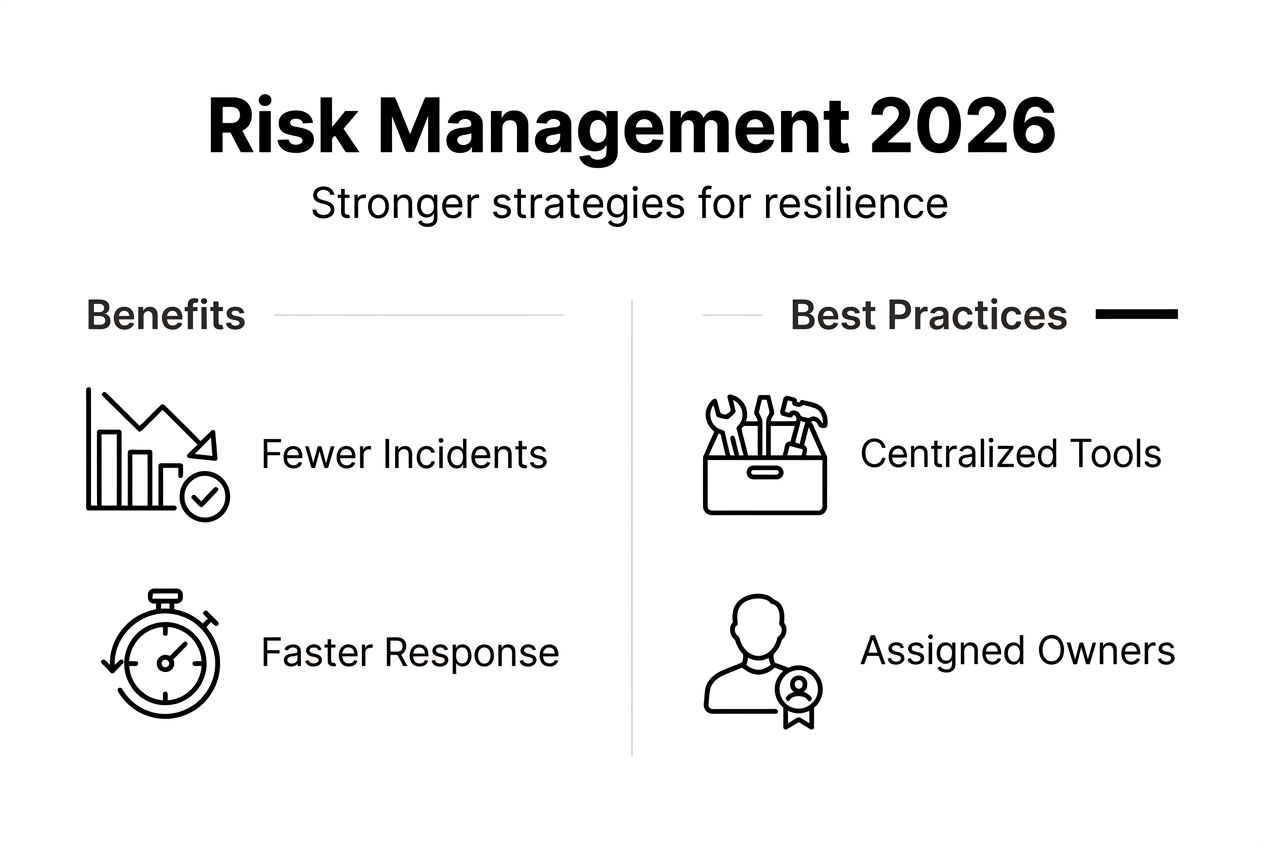
A single data breach can cost healthcare organizations over $10 million, yet many still fail to implement proper risk analysis. Government agencies face public trust erosion from preventable cyberattacks, while industrial firms lose millions to avoidable accidents. This guide reveals why risk management is essential for organizational success, examining proven strategies that reduce breaches, enhance compliance, and build resilience across healthcare, government, and industrial sectors in 2026.
Table of Contents
- The Critical Role Of Risk Management In Organizational Success
- Sector-Specific Benefits: Healthcare, Government, And Industrial Risk Management
- Consequences Of Inadequate Risk Management And Common Failure Modes
- Practical Strategies For Implementing Effective Risk Management In 2026
- Explore Stonos Solutions For Advanced Risk And Security Services
- FAQ
Key takeaways
| Point | Details | |-------|---------|| | Centralized risk management | Improves incident reporting speed and reduces compliance management time by over 60%. | | Strategic integration | Embedding risk into organizational culture boosts agility, compliance, and decision quality. | | Sector-specific impacts | Healthcare sees 20-25% fewer adverse events, government improves cyber response 15-20%, industry cuts accidents 20-30%. | | Common failure costs | Inadequate risk analysis leads to fines exceeding $200,000 and breaches affecting hundreds of thousands. | | Digital transformation | Modern platforms enable real-time monitoring and proactive risk mitigation across all sectors. |
The critical role of risk management in organizational success
Risk management directly shapes your ability to achieve strategic goals. It's not a checkbox exercise but a dynamic process that enhances strategic planning and response agility across every level of your organization. When you embed risk thinking into decision making, you transform uncertainty from a threat into a competitive advantage.
Healthcare, government, and industrial sectors face unique operational challenges. A risk management strategy guide 2026 advanced tactics approach recognizes these differences while applying universal principles. You need frameworks that balance risk with opportunity, viewing challenges as catalysts for innovation rather than obstacles to avoid.
Core components of effective risk management include:
- Alignment with strategic objectives and organizational priorities
- Integration across all departments and operational levels
- Regular assessment cycles that adapt to emerging threats
- Clear governance structures with defined accountability
- Cultural embedding that makes risk awareness automatic
Treating risk management as a standalone function creates dangerous gaps. When IT handles cyber risks separately from operations managing physical security, you get fragmented controls that attackers exploit. Unified governance prevents these silos by establishing clear ownership and communication channels.
"Risk management succeeds when it becomes invisible, woven so deeply into daily operations that every decision naturally considers potential consequences and mitigation strategies."
Your organization's resilience depends on this integration. Strategic planning sessions should automatically include risk assessments. Budget discussions must weigh risk mitigation costs against potential losses. Performance reviews should evaluate how well teams identify and address emerging threats.
The government's management principles emphasize viewing risk through multiple lenses. Financial risks differ from reputational ones, yet both impact your bottom line. Regulatory compliance risks carry legal weight, while operational risks threaten service delivery. Mature organizations assess all dimensions simultaneously, understanding how risks interact and compound.
Sector-specific benefits: healthcare, government, and industrial risk management
Healthcare organizations integrating comprehensive risk programs reduce adverse drug events by 20-25%, directly improving patient outcomes and reducing liability exposure. These improvements stem from systematic identification of medication errors, workflow bottlenecks, and communication breakdowns that traditional quality programs miss. When you apply how to conduct security risk assessment methodologies to clinical operations, you uncover vulnerabilities before they harm patients.
Government agencies adopting proactive frameworks improve cyberattack response by 15-20%, enhancing public trust and service continuity. Citizens expect uninterrupted access to essential services. A well-designed risk program identifies critical systems, prioritizes protection efforts, and establishes recovery protocols that minimize downtime during incidents.
Industrial sectors implementing robust programs see 20-30% fewer workplace accidents and decreased operational disruptions. Manufacturing facilities face unique hazards from heavy machinery, hazardous materials, and complex supply chains. Proactive risk identification prevents injuries, reduces insurance premiums, and maintains production schedules.

| Sector | Primary Risk Focus | Key Metrics Improved | Compliance Framework |
|---|---|---|---|
| Healthcare | Patient safety, data privacy | 20-25% reduction in adverse events, breach prevention | HIPAA, state regulations |
| Government | Cybersecurity, service continuity | 15-20% faster incident response, public trust | NIST, FISMA, CISA guidelines |
| Industrial | Workplace safety, operational continuity | 20-30% fewer accidents, reduced downtime | OSHA, industry standards |
Each sector gains distinct advantages:
- Healthcare reduces malpractice claims and regulatory penalties through systematic error prevention
- Government agencies protect sensitive citizen data while maintaining transparent operations
- Industrial firms lower insurance costs and improve employee morale through safer workplaces
These benefits compound over time. Initial risk assessments reveal quick wins that build momentum for broader cultural change. As staff recognize how risk management protects their interests alongside organizational goals, participation increases and reporting improves.
Pro Tip: Match your risk assessment frequency to your sector's pace of change. Healthcare should reassess quarterly due to regulatory updates and technology adoption, while industrial settings may focus on annual comprehensive reviews with monthly targeted checks of high-risk areas.
The evidence shows measurable ROI across all sectors. Every dollar invested in proactive risk management saves three to seven dollars in avoided incidents, regulatory penalties, and operational disruptions. This return accelerates as programs mature and organizations move from reactive firefighting to strategic prevention.
Consequences of inadequate risk management and common failure modes
Deer Oaks faced a $225,000 fine after failing proper HIPAA risk analysis, affecting 171,871 individuals whose protected health information was compromised. This wasn't a sophisticated cyberattack but a basic failure to identify and address known vulnerabilities. The organization knew risk analysis was required, yet treated it as a paperwork exercise rather than a genuine security practice.
Citibank's wiring error of $900 million demonstrated how poor software controls amplify human mistakes into catastrophic losses. The bank's systems lacked adequate safeguards to prevent unauthorized transactions. When an employee made an input error, inadequate verification protocols allowed the mistake to execute, triggering a legal battle to recover the funds.
These failures share common patterns you must recognize and prevent:
- Siloed risk functions that operate independently without cross-departmental coordination
- Unclear ownership of regulatory requirements leading to gaps in compliance coverage
- Paper-based processes that delay incident detection and response
- Risk assessments conducted once and filed away instead of regularly updated
- Technical solutions implemented without addressing underlying cultural issues
- Leadership viewing risk management as a cost center rather than strategic investment
The human factor undermines even sophisticated technical controls. Your staff needs clear procedures, regular training, and psychological safety to report concerns without fear of blame. Technical barriers fail when users find workarounds to meet deadlines or simplify workflows.
"Organizations that blame individuals for risk failures miss the systemic issues that allowed those failures. Effective risk management redesigns processes to make the right choice the easy choice."
Regulatory penalties represent only direct costs. Indirect consequences include reputational damage, customer attrition, increased insurance premiums, and diverted management attention. Healthcare providers lose patient trust after breaches. Government agencies face public scrutiny and political pressure. Industrial firms see talent recruitment challenges after safety incidents.
You can avoid these outcomes by learning from others' mistakes. Top risk management strategies for it security 2026 addresses technical vulnerabilities while the broader program ensures organizational readiness. Integration across technical and operational domains creates resilience that isolated efforts cannot achieve.
The pattern is clear: organizations that treat risk management as compliance theater rather than genuine protection inevitably face consequences. Those that embed risk thinking into culture and operations build resilience that withstands both known threats and unexpected challenges.
Practical strategies for implementing effective risk management in 2026
Transitioning from paper to centralized digital platforms transforms risk management effectiveness. Centralized compliance platforms reduce management time by over 60% while improving incident reporting accuracy and speed. You gain real-time visibility into risk status across locations, enabling faster response and better resource allocation.
| Traditional Approach | Modern Risk Management | Key Benefit |
|---|---|---|
| Annual paper assessments filed and forgotten | Continuous digital monitoring with automated alerts | Identifies emerging threats before they materialize |
| Siloed department ownership | Cross-functional teams with shared dashboards | Prevents gaps and redundancies in coverage |
| Reactive incident response | Proactive scenario planning and simulation | Reduces response time during actual incidents |
| Compliance checkbox mentality | Integrated strategic decision support | Aligns risk mitigation with business objectives |
Implement a resilience-based framework through these steps:
- Awareness: Train all staff to recognize and report potential risks in their areas
- Preparedness: Develop response protocols and conduct regular drills
- Response: Establish clear communication channels and decision authority
- Recovery: Document lessons learned and update procedures accordingly
- Adaptation: Continuously refine based on new threats and organizational changes
Embedding risk management into culture requires leadership commitment beyond policy statements. When executives regularly discuss risk in strategy meetings, staff understand its importance. When managers reward employees who identify potential issues, reporting increases. When budgets allocate resources for risk mitigation without requiring crises to justify spending, you build true resilience.
Security consulting for integrators helps organizations navigate complex implementation challenges. External expertise accelerates program maturity by bringing proven frameworks and avoiding common pitfalls. The investment pays returns through faster deployment and better outcomes.
Your risk management strategy guide 2026 advanced tactics should address both immediate vulnerabilities and long-term strategic positioning. Quick wins build momentum: fix obvious gaps, implement basic monitoring, establish clear reporting channels. These visible improvements demonstrate value and secure ongoing support.
Pro Tip: Assign explicit ownership for each regulatory requirement to specific individuals with clear accountability. This traceability eliminates the diffusion of responsibility that allows compliance gaps to persist unnoticed until audits or incidents expose them.
Successful programs balance standardization with flexibility. Core processes should follow established frameworks like NIST or ISO standards, providing consistency and credibility. Application of these frameworks must adapt to your specific context, considering organizational size, sector requirements, and risk appetite.
Measure program effectiveness through leading indicators like assessment completion rates, training participation, and near-miss reporting frequency, not just lagging indicators like incident counts. Leading metrics let you adjust course before problems occur, while lagging metrics only confirm what already happened.
Explore Stonos Solutions for advanced risk and security services
Your risk management program needs more than frameworks and policies. It requires expert validation through rigorous testing and ongoing optimization. Stonos Solutions delivers comprehensive security assessments that identify vulnerabilities before attackers exploit them, giving you the intelligence needed for truly informed risk decisions.
Our penetration testing services simulate real-world attack scenarios across your infrastructure, applications, and processes. You discover exactly where defenses fall short and receive prioritized remediation guidance. This testing validates your risk assessments with empirical evidence, not theoretical assumptions.
Custom development solutions streamline your risk and compliance workflows through tailored platforms that match your operational reality. Generic tools force you to adapt processes to software limitations. Custom solutions adapt to your needs, improving adoption and effectiveness.
Our comprehensive security services support every aspect of organizational resilience, from initial assessments through ongoing monitoring and optimization. Whether you need HIPAA compliance support, NIST framework implementation, or industrial security enhancement, our certified experts bring proven methodologies refined across healthcare, government, and industrial sectors.
Pro Tip: Partner with experienced consultants who understand your sector's unique challenges. Generic cybersecurity firms lack the specialized knowledge of healthcare workflows, government procurement constraints, or industrial operational requirements that determine whether security measures succeed or fail in practice.
FAQ
Why is risk management essential in healthcare, government, and industry?
Risk management protects organizational assets, ensures regulatory compliance, and maintains operational continuity. Healthcare organizations prevent patient harm and data breaches. Government agencies maintain public trust and service delivery. Industrial firms reduce accidents and production disruptions. These sectors face unique challenges requiring tailored approaches that balance security with operational efficiency.
How can healthcare organizations reduce data breaches through risk management?
Conduct regular risk assessments for HIPAA compliance integrated into clinical workflows. Implement centralized incident tracking that captures and analyzes patterns across departments. Train staff consistently on compliance requirements and monitor data access through automated controls that flag anomalies without disrupting legitimate work.
What are the most common risk management failures and how can they be avoided?
Failures stem from siloed processes, unclear ownership, and poor cultural integration. Organizations treat risk as an IT problem rather than an organizational responsibility. Avoid these by embedding top risk management strategies for it security 2026 into daily operations and establishing clear accountability at every level. Make risk discussions routine in all decision-making forums.
How does digital transformation impact risk management effectiveness?
Digital platforms enable centralized compliance management and real-time risk monitoring. You reduce time spent on manual tracking by over 60% while improving incident detection speed. Security consulting for integrators helps navigate implementation challenges. Modern tools provide analytics that identify patterns and predict emerging threats, transforming reactive processes into proactive protection.
Recommended
- Risk management strategy guide 2026: advanced tactics - Stonos Solutions Blog
- Top risk management strategies for IT security 2026 - Stonos Solutions Blog
- Security Consulting for Integrators: Enabling Resilience - Stonos Solutions Blog
- How to Conduct Security Risk Assessment for HIPAA Compliance - Stonos Solutions Blog
- Why traders need professional risk management in 2026 – DayProp Funding
- Supply Chain Risk Management: Safeguarding Global Trade - Worldwide Express, Inc.
Louis Romano
Need Security Consulting?
Our expert team is ready to help you enhance your security posture.
Contact Us Today Download Capability StatementRelated Articles
ConnectWise PSA for Security Integrators: Setup and Optimization Guide
Maximize your security business with ConnectWise PSA. Complete guide covering setup, optimization, and best practices for security contractors.
Read MoreMastering regulatory compliance: key steps for 2026 success
Prepare your organization for 2026 regulatory changes with this step-by-step compliance guide covering risk assessments, controls, vendor management, and monitoring strategies.
Read MoreTop 7 Security Compliance Platforms for Government 2026
Explore 7 leading security compliance platforms for government, comparing their features to enhance your agency's cybersecurity readiness.
Read More