Mastering regulatory compliance: key steps for 2026 success
Mastering regulatory compliance: key steps for 2026 success

TL;DR:
- Federal deregulation increases complexity at the state level, requiring organizations to monitor diverse requirements.
- Continuous risk assessments, automated controls, and leadership involvement are key to effective 2026 compliance.
- Using automation, maturity models, and tailored GRC strategies helps justify compliance budgets and reduce risks.
The U.S. regulatory environment is shifting faster than most compliance programs can absorb. Federal deregulation is not simplifying the landscape; instead, it is pushing complexity down to the state level, where new laws are multiplying and diverging from federal standards. For compliance officers and security managers in regulated industries, the stakes are high. Missed deadlines, unaddressed gaps, and outdated controls can trigger audits, fines, and reputational damage that take years to recover from. This guide walks through the critical steps to identify, assess, implement, and monitor compliance requirements for 2026, giving your organization a practical roadmap to stay ahead of what is coming.
Table of Contents
- Identifying regulations and requirements for 2026
- Conducting risk assessments and gap analyses
- Implementing controls, training, and monitoring
- Managing vendors, new technologies, and edge cases
- What most compliance guides miss about 2026
- Expert solutions for your 2026 compliance challenges
- Frequently asked questions
Key Takeaways
| Point | Details |
|---|---|
| Track regulatory changes | Stay current with new federal, state, and industry rules affecting your business in 2026. |
| Prioritize risk assessment | Use technology and proven frameworks to identify compliance gaps and reduce vulnerabilities. |
| Automate monitoring processes | AI and GRC platforms enable continuous compliance and minimize human error. |
| Address vendor risk | Evaluate third-party outcomes, not just policies, to prevent compliance failures. |
| Benchmark and justify spend | Measure compliance maturity to guide improvements and support budget allocation. |
Identifying regulations and requirements for 2026
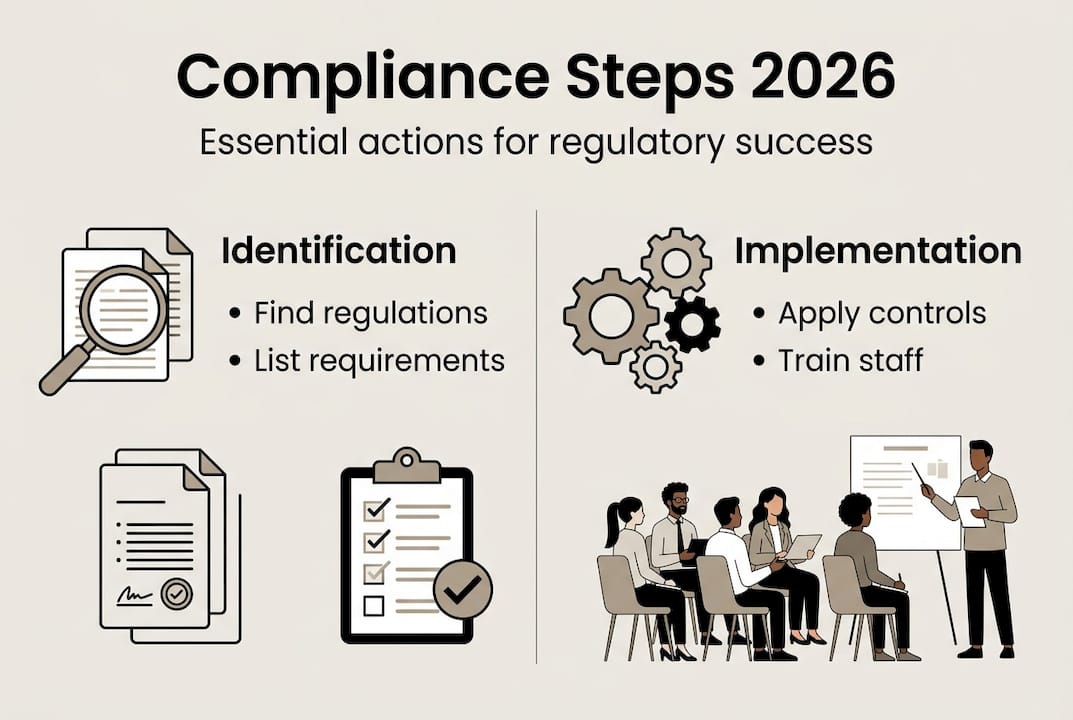
The first challenge is knowing exactly which rules apply to your organization. That sounds straightforward, but the reality is that the regulatory map for 2026 looks different depending on your industry, the states where you operate, and the federal frameworks that govern your sector. Federal deregulation is increasing state-level complexity, meaning organizations that operate across multiple states now face a patchwork of requirements that do not always align.
Core compliance program steps begin with identifying applicable regulations such as HIPAA for healthcare, SOX for public companies, CMMC for defense contractors, and FedRAMP for cloud service providers working with federal agencies. Each framework carries distinct requirements, timelines, and enforcement mechanisms. Mapping these to your specific business operations is not optional. It is the foundation everything else is built on.
Here is a comparison of regulatory frameworks relevant to common regulated industries in 2026:
| Framework | Primary sector | Key 2026 focus area |
|---|---|---|
| HIPAA | Healthcare | AI use, vendor oversight, training |
| CMMC | Defense contractors | Certification enforcement |
| FedRAMP | Government cloud | Authorization updates |
| SOX | Public companies | Cybersecurity disclosures |
| PCI DSS v4.0 | Financial/retail | Authentication, monitoring |
Key regulatory updates compliance teams should track for 2026:
- State privacy laws: Multiple states have enacted or are enforcing new consumer data privacy laws with varying opt-out and data minimization requirements.
- CMMC 2.0 enforcement: The Department of Defense is actively requiring CMMC certification for contractors at various maturity levels.
- HIPAA updates: Expanded enforcement focus on AI tools, business associate agreements, and workforce training.
- SEC cybersecurity rules: Public companies face stricter incident disclosure timelines and board-level oversight requirements.
- PFAS and EPR laws: Environmental and product regulations are expanding at the state level, affecting manufacturing and industrial sectors.
To stay current, build a regulatory calendar using 2026 compliance deadlines as a starting point, then layer in your sector-specific frameworks. Pair this with strong risk management strategies to ensure your tracking process feeds directly into your risk posture.
Conducting risk assessments and gap analyses
Once the regulatory landscape is clear, the next step is to assess where your organization stands in relation to these new requirements. A gap analysis compares your current controls and practices against what each applicable regulation demands. Without this step, implementation efforts are guesswork.

Risk assessments, gap analyses, and tool-enabled compliance are foundational to any effective compliance management system. GRC (Governance, Risk, and Compliance) platforms can automate much of this work, but the process still requires human judgment to interpret findings and prioritize remediation.
Here is a simplified risk scoring reference for gap analysis:
| Gap type | Risk level | Typical remediation timeline |
|---|---|---|
| Missing policy documentation | Low to medium | 30 to 60 days |
| Inadequate access controls | High | Immediate to 30 days |
| Unvetted third-party vendors | High | 30 to 90 days |
| Outdated incident response plan | Medium | 60 days |
| No employee training records | Medium to high | 30 days |
A structured risk assessment process for 2026 should follow these steps:
- Define scope: Identify all systems, data types, and processes subject to applicable regulations.
- Inventory assets: Catalog hardware, software, data flows, and third-party integrations.
- Map controls: Document existing controls and align them to regulatory requirements.
- Score gaps: Assign risk scores based on likelihood and impact of non-compliance.
- Prioritize remediation: Address high-risk gaps first, with clear ownership and deadlines.
- Document findings: Maintain audit-ready records of every assessment step.
Tech-enabled audits and common controls frameworks are now standard practice for organizations managing multiple regulatory obligations. Using a single controls framework that maps to several regulations simultaneously reduces duplication and saves time.
Pro Tip: Automate your gap analysis using AI-driven GRC tools to flag configuration changes in real time. This reduces human error and gives your team a live view of your compliance posture rather than a snapshot from the last audit cycle. Explore risk assessment tactics and how to apply them to a HIPAA risk assessment or security in manufacturing environments.
Implementing controls, training, and monitoring
With risks addressed, your focus shifts to practical implementation and ongoing monitoring that supports sustainable compliance. Identifying gaps is only useful if you act on them systematically.
Implementation includes training, monitoring, auditing, and remediation, with board and management oversight playing a critical role. Compliance is no longer just an IT or legal function. Executives and board members are now expected to understand the organization's risk posture and approve remediation priorities.
Effective monitoring and auditing methods for 2026 include:
- Continuous control monitoring (CCM): Automated tools that check configuration states and flag deviations in real time.
- Scheduled internal audits: Quarterly or semi-annual reviews aligned to regulatory cycles.
- Third-party audits: Independent assessments that validate internal findings and satisfy regulator expectations.
- Penetration testing: Simulated attacks that reveal exploitable weaknesses before real adversaries find them.
- Log management and SIEM integration: Centralized logging with security information and event management tools for anomaly detection.
Training remains a persistent weak point. 82% of configuration drift incidents are caused by human error, and HIPAA enforcement data shows that inadequate training is a leading cause of violations. Role-based training, delivered at onboarding and refreshed annually at minimum, is not a checkbox. It is a control.
"Data over-retention costs organizations between $1 million and $5 million per year in storage, legal exposure, and audit remediation. Failing to enforce retention policies is one of the most overlooked compliance risks in regulated industries."
Pro Tip: Use automation to detect configuration drift before your next audit. Tools that continuously scan for unauthorized changes to system settings or access permissions give you time to remediate before regulators or auditors find the issue first. Review security compliance tips and consider how pen testing tools fit into your ongoing monitoring strategy.
Managing vendors, new technologies, and edge cases
Now, let's look beyond internal controls to the risks and solutions involved in working with vendors and applying new technology. Third-party risk is one of the most underestimated compliance challenges in regulated industries, and the consequences of getting it wrong are significant.
Vendor risk management should focus on real outcomes, not just policy checklists. Requiring a vendor to sign a business associate agreement or a data processing addendum is a starting point, not a finish line. You need to verify that vendors actually implement the controls they claim to have. Vendor risk outcomes over policies is the standard that regulators are increasingly applying during enforcement actions.
AI and automation best practices for compliance monitoring in 2026:
- Apply the minimum necessary principle when deploying AI tools that access sensitive data.
- Conduct bias testing on AI-driven decision systems, particularly in healthcare and financial services.
- Use automation to flag configuration drift and unauthorized access changes in real time.
- Integrate AI outputs into your GRC platform so findings are documented and traceable.
- Validate AI tools against applicable regulations before deployment, not after.
"Configuration drift, caused by human error in 82% of cases, is one of the fastest paths to a compliance failure. Organizations that rely on periodic manual reviews will miss changes that automated tools catch within hours."
Edge cases require specific attention. State-federal divergence is growing as federal agencies pull back and states fill the gap. An organization compliant with federal HIPAA standards may still be out of compliance with a state-specific health data law. 34% of organizations still use spreadsheets for third-party risk management (TPRM), which creates version control problems, audit gaps, and significant manual error risk. Replacing spreadsheets with purpose-built TPRM tools is one of the highest-impact changes a compliance team can make. For organizations working with system integrators, consulting for integrators provides additional guidance on managing vendor relationships within a compliance framework.
What most compliance guides miss about 2026
Most compliance guides focus on rules. They tell you what regulations exist and what controls are required. What they rarely address is the gap between checking boxes and actually reducing risk. That gap is where organizations get into trouble.
Board and leadership involvement is no longer optional. 58% of organizations plan to increase GRC spending in the near term, and the ones justifying those budgets successfully are using maturity models and benchmarking to demonstrate measurable progress. Compliance needs to be framed as a business outcome, not a cost center.
Continuous compliance is replacing the annual audit model. Organizations that treat compliance as a periodic event are always behind. The ones that build compliance into daily operations, using automated monitoring, real-time dashboards, and defined escalation paths, are the ones that pass audits without scrambling.
38% of HIPAA investigations cite inadequate training as a contributing factor. That statistic has not changed significantly in years, which tells you that most organizations are still treating training as a formality. Vendor risk and over-reliance on spreadsheets compound this problem. The organizations that will succeed in 2026 are the ones investing in custom development and automation to build compliance into their workflows rather than layering it on top.
Expert solutions for your 2026 compliance challenges
Ready to enhance your compliance strategy? Stonos Solutions works with compliance officers and security managers across regulated industries to close gaps, validate controls, and prepare for audits before regulators arrive.
Our penetration testing services help you identify exploitable weaknesses that internal reviews often miss, giving you documented evidence of due diligence. For organizations looking to automate compliance workflows and reduce manual error, our custom development and automation solutions are built to integrate with your existing GRC environment. Whether you are preparing for CMMC certification, a HIPAA audit, or a FedRAMP authorization, our certified team provides the technical depth and regulatory knowledge to move your program forward with confidence.
Frequently asked questions
Which regulations will affect compliance strategies in 2026?
Major regulations include updated HIPAA rules, CMMC and FedRAMP enforcement, new state-level privacy and environmental laws, and SEC cybersecurity and AI mandates. The specific mix depends on your industry and the states where you operate.
What is the best way to automate compliance monitoring?
GRC platforms combined with AI-driven tools can automate risk scoring, control testing, and continuous monitoring. Tech-enabled audits and continuous monitoring are now standard practice for organizations managing multiple regulatory frameworks simultaneously.
How often should risk assessments be conducted?
97% of organizations conduct two or more audits per year, with large enterprises averaging four or more. Continuous monitoring between formal assessments is increasingly expected by regulators.
What are common mistakes in 2026 compliance programs?
The most frequent errors include ignoring state-level requirements that diverge from federal standards, underestimating vendor risk, and relying on spreadsheets for TPRM. 34% of organizations still use spreadsheets for third-party risk management, creating significant audit exposure.
How can organizations justify compliance budgets in 2026?
Maturity models, benchmarking against industry peers, and quantified risk reduction metrics are the most effective tools for demonstrating ROI. Continuous compliance and maturity benchmarking give leadership the data they need to approve increased GRC investment.
Recommended
- Top 7 security compliance tips for 2026 success - Stonos Solutions Blog
- Risk management strategy guide 2026: advanced tactics - Stonos Solutions Blog
- Top risk management strategies for IT security 2026 - Stonos Solutions Blog
- Security Consulting for Integrators: Enabling Resilience - Stonos Solutions Blog
- How to Ensure Data Compliance in 2025 | Re-Solution UK
Louis Romano
Need Security Consulting?
Our expert team is ready to help you enhance your security posture.
Contact Us Today Download Capability StatementRelated Articles
ConnectWise PSA for Security Integrators: Setup and Optimization Guide
Maximize your security business with ConnectWise PSA. Complete guide covering setup, optimization, and best practices for security contractors.
Read MoreWhy risk management matters: 2026 guide for resilient strategy
Discover why risk management is essential for organizational success in 2026. Learn proven strategies that reduce breaches, enhance compliance, and build resilience across healthcare, government, and industrial sectors.
Read MoreTop 7 Security Compliance Platforms for Government 2026
Explore 7 leading security compliance platforms for government, comparing their features to enhance your agency's cybersecurity readiness.
Read More