Custom development security: 5 proven compliance strategies
Custom development security: 5 proven compliance strategies

TL;DR:
- Meeting compliance checklists does not guarantee software security in regulated sectors.
- Integrating security practices throughout SDLC and using frameworks like NIST SSDF and OWASP improves protection.
- Continuous monitoring, layered defenses, and expert support are essential for effective custom development security.
Regulated organizations in healthcare, government, and manufacturing often assume that meeting a compliance checklist means their custom software is secure. That assumption is costly. Security practices integrated throughout the SDLC are what actually mitigate vulnerabilities and protect sensitive data under frameworks like HIPAA, CMMC, and ITAR. Passing an audit and stopping a breach are two very different outcomes. This guide walks security and IT managers through the core principles, emerging threats, and implementation steps that define real custom development security in high-stakes environments.
Table of Contents
- Why custom development security matters in regulated sectors
- Core principles and frameworks: Secure SDLC, NIST SSDF, and OWASP
- Addressing modern threats and edge cases: Third-party, AI, and multistage attacks
- Best practices for implementation: Shift-left, automation, and shared responsibility
- The uncomfortable truth: Why layered security and real metrics matter more than any checklist
- Enhance your custom development security with expert support
- Frequently asked questions
Key Takeaways
| Point | Details |
|---|---|
| Security goes beyond compliance | True custom development security protects sensitive data and meets regulations by embedding strong practices early and often. |
| Frameworks guide, but adaptation wins | Adopt NIST SSDF and OWASP principles, but update your approach for real-world threats like supply chain and AI-based attacks. |
| Layered defenses are essential | Combine shift-left testing, runtime monitoring, and SBOMs to defend against complex, modern threats. |
| Success requires shared ownership | Developers, security, and compliance teams must all contribute to effective custom development security. |
Why custom development security matters in regulated sectors
Healthcare, government, and manufacturing operate under some of the most demanding regulatory environments in the country. Each sector carries its own compliance burden, and custom-built software sits at the intersection of operational necessity and regulatory risk. A vulnerability in a patient records system, a government procurement platform, or an industrial control interface is not just a technical problem. It is a legal, financial, and reputational crisis.
The regulatory landscape varies significantly by sector. Here is a quick overview:
| Sector | Key Frameworks | Primary Risk |
|---|---|---|
| Healthcare | HIPAA, HITECH | Patient data exposure, ransomware |
| Government | CMMC, NIST 800-171, FISMA | Classified data breach, supply chain |
| Manufacturing | ITAR, DFARS | Export control violations, IP theft |
The threats targeting these sectors are not generic. The most common attack vectors include:
- Ransomware: Ransomware targets healthcare systems with increasing frequency, encrypting records and demanding payment.
- Multistage attacks: Attackers chain malware delivery to credential theft, moving laterally through networks before triggering the final payload.
- Supply chain risks: Third-party components embedded in custom software introduce vulnerabilities that developers may not even know exist.
- Insider threats: Privileged access misuse remains a persistent concern in government and manufacturing environments.
"80% of applications contain security flaws, according to recent industry analysis, underscoring that out-of-the-box compliance tools alone cannot secure mission-critical custom software."
The healthcare security overview from Microsoft reinforces this point: regulated industries face threats that evolve faster than static compliance frameworks can track. Organizations that rely on annual audits without continuous security integration are operating with a false sense of protection. Understanding security in manufacturing and how security consulting for integrators applies to custom development environments is a critical first step toward closing that gap.
Core principles and frameworks: Secure SDLC, NIST SSDF, and OWASP
The Software Development Lifecycle (SDLC) is the process every development team follows, from planning through deployment. A traditional SDLC treats security as a final-stage gate. A Secure SDLC (SSDLC) integrates security at every phase. That distinction is what separates organizations that pass audits from those that actually stop attacks.
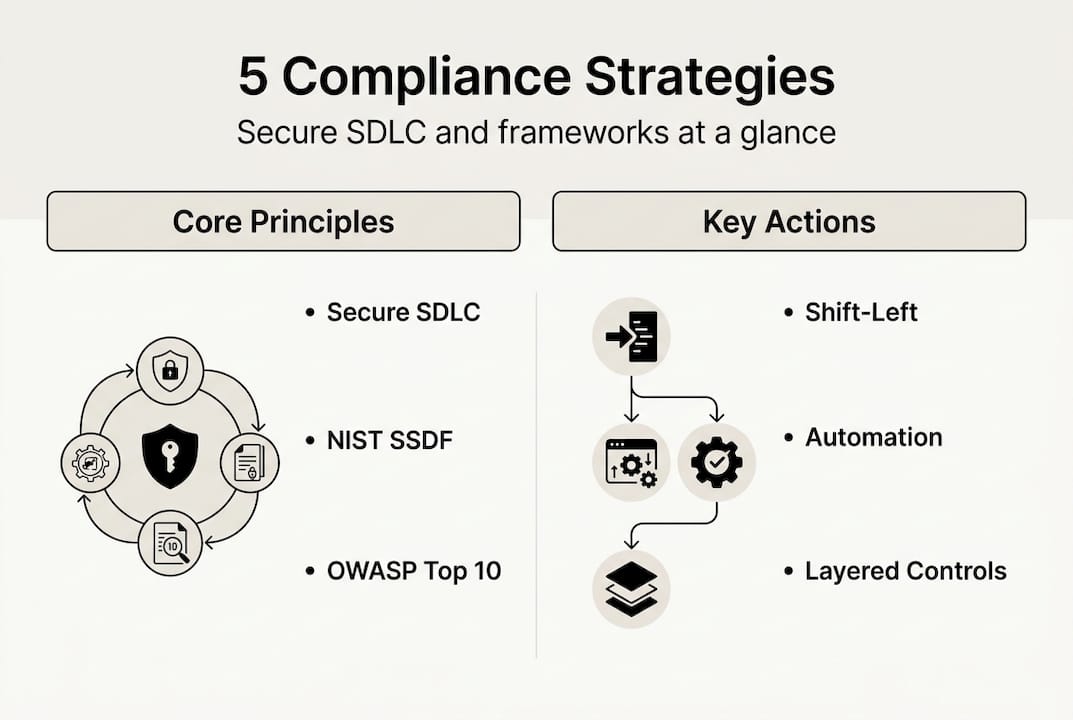
Three frameworks form the backbone of modern custom development security:
| Framework | Focus Area | Best For |
|---|---|---|
| Secure SDLC | End-to-end security integration | All regulated sectors |
| NIST SSDF | Structured software development practices | Government, healthcare |
| OWASP Secure Coding | Application-layer vulnerability prevention | Any custom application |
The NIST SSDF organizes secure development into 4 practice groups, 19 practices, and 42 tasks covering preparation, protection, production, and response. It is not a checkbox exercise. It is a structured operating model. Core SSDLC methodologies include threat modeling, automated testing through SAST, DAST, and SCA tools, and Secure by Design principles that bake protection into architecture before a single line of code is written.
OWASP secure coding practices focus on input validation, encryption, and access control at the application layer, addressing the vulnerabilities most commonly exploited in the wild.
Here is a practical sequence for integrating these frameworks into your custom development methodologies:
- Threat modeling at design phase: Identify attack surfaces before writing code.
- Secure coding standards: Apply OWASP guidelines during development sprints.
- Automated SAST/DAST scanning: Run static and dynamic analysis on every build.
- Third-party component review: Audit all libraries and dependencies before integration.
- Penetration testing pre-deployment: Simulate real attacks on staging environments.
- Runtime monitoring post-launch: Detect and respond to threats in production.
Pro Tip: Build compliance verification checklists tied to each SDLC phase and automate them within your CI/CD pipeline. This turns security from a manual review into a continuous, measurable process that supports security integration in SDLC at scale.
Addressing modern threats and edge cases: Third-party, AI, and multistage attacks
The threat landscape for custom development has shifted significantly. Three categories of risk now demand specific attention from security and IT managers in regulated sectors.
The most pressing edge cases include:
- AI and LLM prompt injection: Attackers manipulate AI features embedded in custom applications to extract sensitive data or bypass access controls.
- Supply chain vulnerabilities: Malicious or outdated third-party packages embedded in custom builds create hidden attack paths.
- Multistage breach sequences: Initial malware delivery leads to credential harvesting, then lateral movement, then data exfiltration, all before detection.
- API exposure risks: Custom integrations between internal systems and external services create poorly documented attack surfaces.
The numbers here are striking. Third-party integrations drive 70% of security debt in custom software environments. That means most of the vulnerabilities your team is carrying were introduced by components you did not write. Separately, 95% of custom AI/LLM applications lack basic protections against prompt leakage and roleplay exploits.

Key statistic: 80% of applications have flaws, and the OWASP Top 10 pass rate sits at just 52%, according to Veracode's 2025 State of Software Security report. That means roughly half of all custom applications fail the most fundamental security benchmarks.
The industry-specific security data from Microsoft confirms that healthcare and government environments face compounding risk when AI features are added to custom platforms without proper security review.
Pro Tip: Maintain a Software Bill of Materials (SBOM) for every custom application. An SBOM catalogs every component, library, and dependency, giving your team visibility into supply chain risk. For AI features, monitor for prompt leakage by logging and reviewing model inputs and outputs regularly. Review SBOMs for supply chain management and connect this practice to your broader IT risk management tips strategy.
Best practices for implementation: Shift-left, automation, and shared responsibility
Knowing the frameworks and threats is only useful if you can translate them into consistent practice. Implementation is where most organizations struggle, not because they lack intent, but because they lack structure.
Here is a step-by-step implementation sequence aligned with NIST SSDF guidance:
- Start with threat modeling: Map data flows, trust boundaries, and potential attack vectors before development begins.
- Adopt shift-left testing: Integrate SAST tools directly into developer IDEs so flaws surface during coding, not after.
- Automate dependency scanning: Use SCA tools to flag vulnerable third-party packages on every commit.
- Establish secure code review gates: Require peer review with a security checklist before any code merges to production branches.
- Run DAST in staging: Test running applications for runtime vulnerabilities before release.
- Deploy runtime application self-protection (RASP): Add in-application monitoring to detect and block attacks in production.
- Track metrics continuously: Measure flaw prevalence, fix velocity, and OWASP pass rates as operational KPIs.
Shared responsibility is equally important. Security in custom development is not a developer-only concern. Roles must be clearly defined:
- Developers: Responsible for writing secure code, applying OWASP standards, and resolving flagged vulnerabilities promptly.
- Security teams: Own threat modeling, penetration testing, and runtime monitoring.
- Compliance officers: Govern policy alignment with HIPAA, CMMC, ITAR, and other applicable frameworks.
- Leadership: Allocate resources and enforce accountability across all three groups.
"Measure both OWASP pass rates and exploit attempts stopped as your primary security ROI indicators. High-maturity programs show low flaw prevalence and fast fix cycles, which directly correlate with reduced breach risk."
The CISA Secure by Design guidance reinforces this: security must be a design requirement, not an afterthought. Review your custom development security practices against these steps and use security compliance tips to close any remaining gaps.
The uncomfortable truth: Why layered security and real metrics matter more than any checklist
Most organizations that experience a breach were technically compliant at the time of the incident. That fact should reset how you think about custom development security. Compliance frameworks are necessary. They are not sufficient.
The organizations that consistently avoid serious breaches share one trait: they treat security as an ongoing operational discipline, not a periodic audit exercise. They measure exploit attempts stopped, not just vulnerabilities patched. They track flaw reduction rates over time, not just point-in-time scan results. They layer runtime monitoring on top of shift-left testing because they understand that no automated tool catches everything.
Checklists and frameworks give you structure. Metrics give you evidence. Layered controls give you resilience. Without all three working together, your security posture has gaps that a motivated attacker will find before you do.
Pro Tip: Go beyond compliance by establishing quarterly security reviews that examine real attack data from your environment. Organizations that regularly revisit their advanced risk strategies and update controls based on actual threat intelligence are the ones that stop advanced attacks before they escalate.
Enhance your custom development security with expert support
Applying these principles across a regulated organization requires more than internal effort. It requires a partner with deep expertise in Secure SDLC implementation, penetration testing, compliance automation, and supply chain security.
Stonos Solutions works with healthcare, government, and manufacturing organizations to build security into custom development from the ground up. From threat modeling and automated testing integration to SBOM management and regulatory compliance support, our team provides the structure and expertise your program needs. Explore our custom development services to see how we tailor solutions to your environment, review our penetration testing support capabilities, or browse our full security offerings to schedule an assessment today.
Frequently asked questions
What is the Secure Software Development Framework (SSDF), and why does it matter?
The NIST SSDF organizes secure development into 4 groups, 19 practices, and 42 tasks that help organizations meet regulatory demands and systematically reduce software vulnerabilities. It is especially critical for healthcare and government contractors who must demonstrate structured security practices to maintain compliance.
How do third-party integrations impact custom development security?
Third-party components can account for 70% of security debt in custom applications, meaning most inherited vulnerabilities come from libraries and dependencies your team did not write. Tracking all components with an SBOM and verifying supply chain security before integration are essential controls.
What does 'shift-left' mean in software security?
Shift-left means moving security activities earlier in the development process, catching and fixing vulnerabilities during coding and design rather than after deployment. Automating shift-left testing while layering runtime monitoring ensures both early detection and ongoing protection.
Are AI features in custom applications a security risk?
Yes. Studies show 95% of custom AI/LLM applications lack basic protections, making prompt leakage and roleplay exploits common and serious concerns for regulated organizations.
How can organizations prove custom development security ROI?
Track OWASP pass rates and exploit attempts stopped as primary indicators, alongside flaw reduction velocity over time. These metrics connect security investment directly to measurable risk reduction.
Recommended
- Top 7 security compliance tips for 2026 success - Stonos Solutions Blog
- Security Consulting for Integrators: Enabling Resilience - Stonos Solutions Blog
- Custom Development & Automation - Stonos Solutions
- Role of security in manufacturing: protect assets now - Stonos Solutions Blog
- Essential custom software development steps for startups
Louis Romano
Need Security Consulting?
Our expert team is ready to help you enhance your security posture.
Contact Us Today Download Capability StatementRelated Articles
Security gap analysis: steps, benefits, and best practices
Learn how to conduct a security gap analysis to identify hidden risks, close compliance gaps, and build a stronger security posture in regulated industries.
Read MoreEnterprise Security Checklist for Healthcare Compliance Success
Explore an actionable enterprise security checklist tailored for healthcare organizations. Follow a step-by-step process to ensure HIPAA compliance and risk management.
Read More7 Key Types of Cybersecurity Assessments for Healthcare
Learn about 7 essential types of cybersecurity assessments for healthcare organizations and get actionable tips to boost compliance and security.
Read More