PCI DSS Compliance: Why It Matters for Retailers
PCI DSS Compliance: Why It Matters for Retailers

Credit card transactions power the heartbeat of North American retail, but every swipe brings a new layer of risk. For compliance officers and IT security professionals, safeguarding payment data is not just a technical challenge, it is a business imperative with high stakes. PCI DSS requirements mean you need more than just technology—you need ongoing vigilance, strong policies, and a culture of security to keep your customers' trust and protect your business from costly fines.
Table of Contents
- PCI DSS Compliance Defined and Debunked
- Key Requirements for North American Retailers
- Validation Levels and Compliance Processes
- Penalties and Risks of Non-Compliance
- Best Practices for Sustainable Adherence
Key Takeaways
| Point | Details |
|---|---|
| Importance of PCI DSS Compliance | Organizations must adhere to PCI DSS to ensure the security of payment card information and avoid severe penalties. |
| Consequences of Non-Compliance | Non-compliance can lead to financial penalties, operational disruptions, and reputational damage, emphasizing the need for proactive management. |
| Validation Levels | Merchants are categorized into four levels based on transaction volumes, which dictate their compliance validation processes. |
| Best Practices for Compliance | Implement continuous monitoring, thorough security policies, and employee training to enhance PCI DSS adherence and mitigate risks. |
PCI DSS Compliance Defined and Debunked
The Payment Card Industry Data Security Standard (PCI DSS) represents a critical framework for protecting sensitive payment card information across global financial ecosystems. Payment card security standards mandate stringent requirements that organizations must meet to process credit and debit card transactions safely.
At its core, PCI DSS provides a comprehensive set of technical and operational guidelines designed to prevent data breaches and secure cardholder information. The standard encompasses multiple critical security domains:
- Maintaining robust firewall configurations
- Implementing strong encryption protocols
- Developing secure system and application development practices
- Restricting access to cardholder data
- Monitoring and testing network security
- Maintaining comprehensive security policies
Organizations handling payment card data must validate their compliance either annually or quarterly, depending on transaction volume. Global data security compliance involves multiple validation methods, including self-assessments and independent third-party audits conducted by qualified security assessors.
The consequences of non-compliance can be severe. Retailers and financial institutions face potential penalties including substantial monetary fines, potential loss of payment processing privileges, and significant reputational damage. These penalties underscore the critical importance of maintaining rigorous security standards in an increasingly digital transaction landscape.
Pro tip: Conduct regular internal security assessments and maintain comprehensive documentation to streamline your PCI DSS compliance verification process.
Key Requirements for North American Retailers
North American retailers face stringent PCI DSS compliance obligations that demand comprehensive security measures across their payment processing infrastructure. These requirements are designed to protect sensitive cardholder data and prevent potential security breaches that could compromise customer financial information.
The compliance framework encompasses twelve critical security domains that retailers must systematically address:
- Install and Maintain Firewall Configurations: Establish robust network security perimeters
- Protect Stored Cardholder Data: Implement strong encryption and data protection mechanisms
- Encrypt Data Transmission: Secure all payment card data during electronic transfers
- Use Updated Anti-Virus Software: Maintain current malware protection across systems
- Develop Secure Systems and Applications: Implement secure coding practices
- Restrict Data Access: Control system and data access based on business requirements
- Assign Unique User IDs: Ensure individual accountability for system access
- Restrict Physical Data Access: Control physical entry to cardholder data environments
- Track and Monitor System Access: Implement comprehensive logging mechanisms
- Regularly Test Security Systems: Conduct periodic vulnerability assessments
- Develop Information Security Policies: Create comprehensive security documentation
- Implement Access Control Measures: Develop robust authentication protocols
North American payment security requirements vary based on transaction volume, with larger retailers typically facing more rigorous validation processes. Smaller merchants might qualify for simplified self-assessment questionnaires, while larger organizations often require comprehensive third-party audits conducted by qualified security assessors.
Companies that fail to meet these requirements risk significant financial penalties, potential loss of payment processing capabilities, and substantial reputational damage. Proactive compliance is not just a regulatory requirement but a critical component of maintaining customer trust and protecting organizational reputation.

Pro tip: Conduct quarterly internal security assessments and maintain detailed documentation to demonstrate ongoing PCI DSS compliance readiness.
Validation Levels and Compliance Processes
PCI DSS establishes a comprehensive compliance validation framework that categorizes merchants into four distinct levels based on annual transaction volumes. This stratified approach ensures that security requirements are proportionate to the organization's potential risk exposure.
The compliance levels are structured as follows:
Here's a summary of PCI DSS merchant validation levels and what each entails:
| Merchant Level | Annual Transactions | Validation Method | Example Organization |
|---|---|---|---|
| Level 1 | Over 6 million | Third-party on-site audit | National retail chain |
| Level 2 | 1 to 6 million | Annual self-assessment & scans | Large online retailer |
| Level 3 | 20,000 to 1 million | Simplified self-assessment | Regional e-commerce store |
| Level 4 | Under 20,000 | Simplified self-assessment | Small boutique shop |
- Level 1 Merchants: Organizations processing over six million transactions annually
- Require annual on-site audits by Qualified Security Assessors (QSAs)
- Most stringent validation requirements
-
Mandatory comprehensive security assessment
-
Level 2 Merchants: Companies processing 1 to 6 million transactions annually
- Annual Self-Assessment Questionnaire (SAQ) required
-
Periodic vulnerability scanning by Approved Scanning Vendors (ASVs)
-
Level 3 Merchants: Retailers processing 20,000 to 1 million transactions annually
- Simplified compliance validation process
-
Annual SAQ with less intensive requirements
-
Level 4 Merchants: Organizations processing fewer than 20,000 transactions
- Least complex compliance validation
- Typically use simplified SAQ formats
Each validation level involves specific documentation and assessment processes. Merchants must submit an Attestation of Compliance to their acquiring bank, demonstrating their adherence to PCI DSS standards. This documentation serves as critical evidence of the organization's commitment to protecting cardholder data and maintaining robust security practices.
The validation process is not a one-time event but a continuous commitment. Retailers must maintain ongoing security measures, conduct regular vulnerability assessments, and stay current with evolving PCI DSS requirements to ensure comprehensive protection of sensitive financial information.
Pro tip: Develop a comprehensive compliance calendar that tracks your specific validation requirements, assessment deadlines, and periodic security review schedules.
Penalties and Risks of Non-Compliance
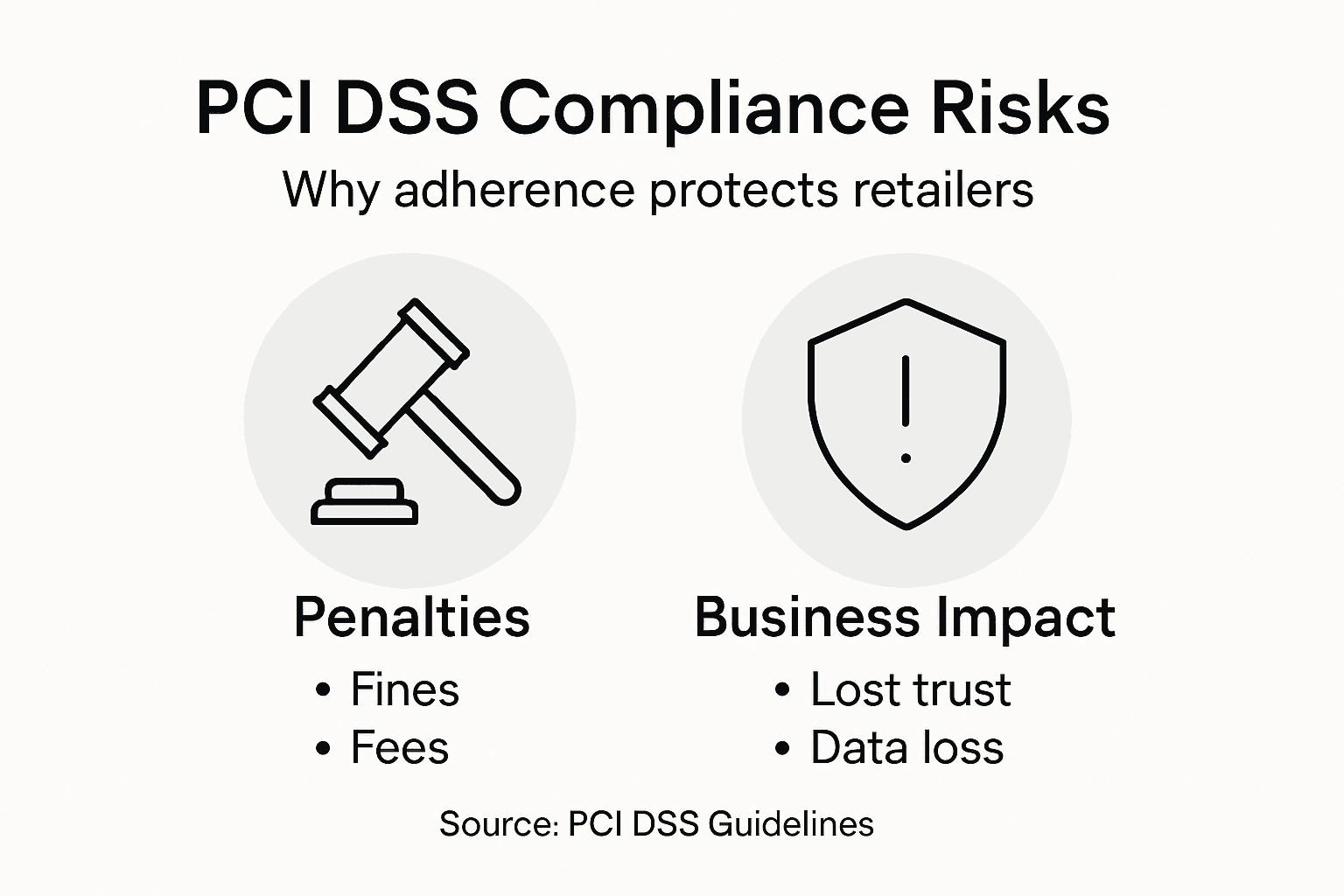
Retailers face substantial consequences when failing to comply with PCI DSS standards, with financial penalties escalating rapidly for organizations that neglect their data security obligations. These penalties extend far beyond simple monetary fines, potentially threatening an organization's entire operational infrastructure.
The comprehensive risks of non-compliance include:
- Immediate Financial Penalties
- Monthly fines ranging from $5,000 to $100,000
- Escalating penalties for prolonged non-compliance
-
Potential suspension of payment processing capabilities
-
Operational Disruptions
- Potential immediate termination of merchant accounts
- Increased transaction processing fees
-
Mandatory expensive security infrastructure upgrades
-
Legal and Reputational Consequences
- Potential class-action lawsuits from affected customers
- Significant brand reputation damage
-
Loss of consumer trust and confidence
-
Breach-Related Expenses
- Forensic investigation costs
- Mandatory customer notification expenses
- Credit monitoring services for impacted individuals
- Potential regulatory fines beyond PCI DSS penalties
Breach Aftermath Costs can be particularly devastating. Organizations may face extensive financial burdens, including forensic investigations, legal expenses, and potential settlements. Non-compliance risks demonstrate that the cost of preventing a data breach is dramatically lower than managing its consequences.
Moreover, the long-term reputational damage can far exceed immediate financial penalties. Customer trust, once lost, is extremely difficult to rebuild. A single data breach can erode years of brand reputation, potentially causing lasting harm to the organization's market position and customer relationships.
Pro tip: Implement a proactive compliance management system that continuously monitors and updates your security infrastructure to prevent costly non-compliance scenarios.
Best Practices for Sustainable Adherence
Maintaining consistent PCI DSS compliance requires a holistic, strategic approach that integrates security practices into the organization's daily operations. Successful retailers view compliance not as a periodic checklist but as an ongoing, dynamic process of risk management and continuous improvement.
Key strategies for sustainable PCI DSS adherence include:
- Develop Comprehensive Security Policies
- Create clear, detailed documentation
- Define specific roles and responsibilities
- Establish precise security protocols
-
Regularly review and update policies
-
Implement Continuous Monitoring
- Deploy real-time security monitoring systems
- Conduct periodic vulnerability assessments
- Track and log all system access
-
Implement automated security alerts
-
Prioritize Employee Training
- Conduct regular cybersecurity awareness programs
- Create role-specific security training modules
- Test employee understanding through simulated scenarios
-
Establish clear consequences for security policy violations
-
Manage Third-Party Risk
- Thoroughly vet all service providers
- Require vendors to demonstrate PCI DSS compliance
- Establish contractual security requirements
- Conduct periodic vendor security assessments
Successful compliance demands a proactive, multidimensional approach. Organizations must move beyond viewing PCI DSS as a mere regulatory requirement and instead integrate security practices into their core operational DNA. This means fostering a culture of security awareness, investing in robust technological infrastructure, and maintaining constant vigilance against emerging threats.
Technological solutions play a critical role, but human factors are equally important. Creating a security-conscious organizational culture where every employee understands their role in protecting sensitive data is paramount to achieving sustainable PCI DSS compliance.
The table below highlights the differences between proactive and reactive PCI DSS approaches:
| Approach | Description | Typical Outcome |
|---|---|---|
| Proactive | Ongoing monitoring and regular assessments | Fewer risks, smooth audits |
| Reactive | Addressing problems after incidents | Greater cost, reputational impact |
Pro tip: Establish a dedicated compliance team with cross-functional representation to ensure comprehensive and consistent security oversight.
Strengthen Your PCI DSS Compliance with Expert Cybersecurity Support
Meeting stringent PCI DSS requirements is essential for retailers who want to avoid costly penalties and protect their customers' payment data. As the article explains, challenges like maintaining robust firewall configurations, encrypting stored data, and managing consistent validation processes can feel overwhelming. Without a strong security strategy, your business risks severe financial fines, operational disruptions, and lasting reputational harm.
Stonos Solutions specializes in helping organizations like yours tackle these exact challenges. Our comprehensive cybersecurity assessments, vulnerability analyses, and compliance support services are designed to align with PCI DSS standards and ensure your payment systems remain secure. Whether you need penetration testing, risk management strategies, or assistance developing security policies that facilitate ongoing compliance, we provide tailored solutions backed by industry certifications and proven expertise.

Take control of your data security today and avoid the costly consequences of non-compliance. Visit our website at Stonos Solutions to learn how our specialized security consulting services can protect your retail operations and keep you ahead of evolving PCI DSS mandates. Don’t wait until a breach happens. Partner with us now to safeguard your business and earn lasting customer trust.
Explore our comprehensive services and start your journey to full PCI DSS compliance by visiting https://stonossolutions.com.
Frequently Asked Questions
What is PCI DSS compliance?
PCI DSS compliance refers to the Payment Card Industry Data Security Standard, a set of guidelines established to protect sensitive payment card information during transactions. Organizations must meet these standards to ensure data security and minimize the risk of data breaches.
Why is PCI DSS compliance important for retailers?
PCI DSS compliance is crucial for retailers because it helps safeguard customer payment information, thus preventing data breaches. Non-compliance can lead to severe penalties, reputational damage, and loss of customer trust, which can significantly harm a retailer’s business.
How can retailers ensure they stay compliant with PCI DSS?
Retailers can maintain PCI DSS compliance by regularly conducting internal security assessments, implementing robust security measures, and keeping compliance documentation up to date. Additionally, they should provide ongoing training for employees regarding data security best practices.
What are the consequences of non-compliance with PCI DSS?
Consequences of non-compliance include financial penalties ranging from $5,000 to $100,000 per month, suspension of payment processing capabilities, operational disruptions, legal liabilities, and significant reputational damage that can lead to lost customer trust.
Recommended
- How to Conduct Security Risk Assessment for HIPAA Compliance - Stonos Solutions Blog
- Security Consulting for Integrators: Enabling Resilience - Stonos Solutions Blog
- Services for End Users - Stonos Solutions
- Top 7 Penetration Testing Tools for Small Business 2026 - Stonos Solutions Blog
- Why Secure Connectivity Matters
- Understanding the HIPAA Security Rule for Businesses
Louis Romano
Need Security Consulting?
Our expert team is ready to help you enhance your security posture.
Contact Us Today Download Capability StatementRelated Articles
Security gap analysis: steps, benefits, and best practices
Learn how to conduct a security gap analysis to identify hidden risks, close compliance gaps, and build a stronger security posture in regulated industries.
Read MoreEnterprise Security Checklist for Healthcare Compliance Success
Explore an actionable enterprise security checklist tailored for healthcare organizations. Follow a step-by-step process to ensure HIPAA compliance and risk management.
Read More7 Key Types of Cybersecurity Assessments for Healthcare
Learn about 7 essential types of cybersecurity assessments for healthcare organizations and get actionable tips to boost compliance and security.
Read More