Security system optimization: boost compliance by 54%
Security system optimization: boost compliance by 54%

TL;DR:
- Security system optimization involves ongoing enhancement of controls, processes, and automation for better risk reduction.
- Automation and continuous monitoring improve compliance efficiency, reduce audit time, and strengthen security posture.
- Moving from compliance-focused to resilience-driven approaches reduces vulnerabilities and operational costs significantly.
Security system optimization is one of the most underutilized levers available to IT and security managers in regulated industries. Most organizations assume optimization means buying new equipment or patching software. In reality, it means systematically improving how your existing controls, processes, and automation work together to reduce risk, satisfy regulators, and cut operational overhead. Organizations that commit to structured optimization programs have reported substantial ROI quickly, including lower cyber insurance premiums and sharply reduced audit preparation hours. This article breaks down exactly what optimization means, how to apply it, and why it matters more than ever in 2026.
Table of Contents
- Defining security system optimization: Beyond the basics
- Frameworks and controls: Building blocks of optimization
- From compliance to resilience: Automation and benchmarking
- Compliance-centric vs. Security by Design: Moving the needle
- Our take: Optimization is iterative, not a one-off checklist
- Ready to optimize? How Stonos Solutions can help
- Frequently asked questions
Key Takeaways
| Point | Details |
|---|---|
| Optimization boosts resilience | Enhancing security systems through well-chosen frameworks greatly improves risk posture and compliance. |
| Automation drives efficiency | Implementing automation cuts audit time, reduces errors, and saves costs in regulated IT environments. |
| Continuous improvement is vital | Ongoing review and benchmarking, not one-off projects, deliver lasting optimization benefits. |
| Security by Design wins | Proactive, risk-based strategies outperform checklist compliance in both security and operational savings. |
Defining security system optimization: Beyond the basics
Let's begin by clarifying exactly what security system optimization means in today's regulated enterprise landscape. Optimization is not a one-time upgrade cycle or a routine maintenance pass. It is the deliberate, ongoing process of enhancing your security system's performance, compliance posture, and operational resilience through structured analysis and improvement.
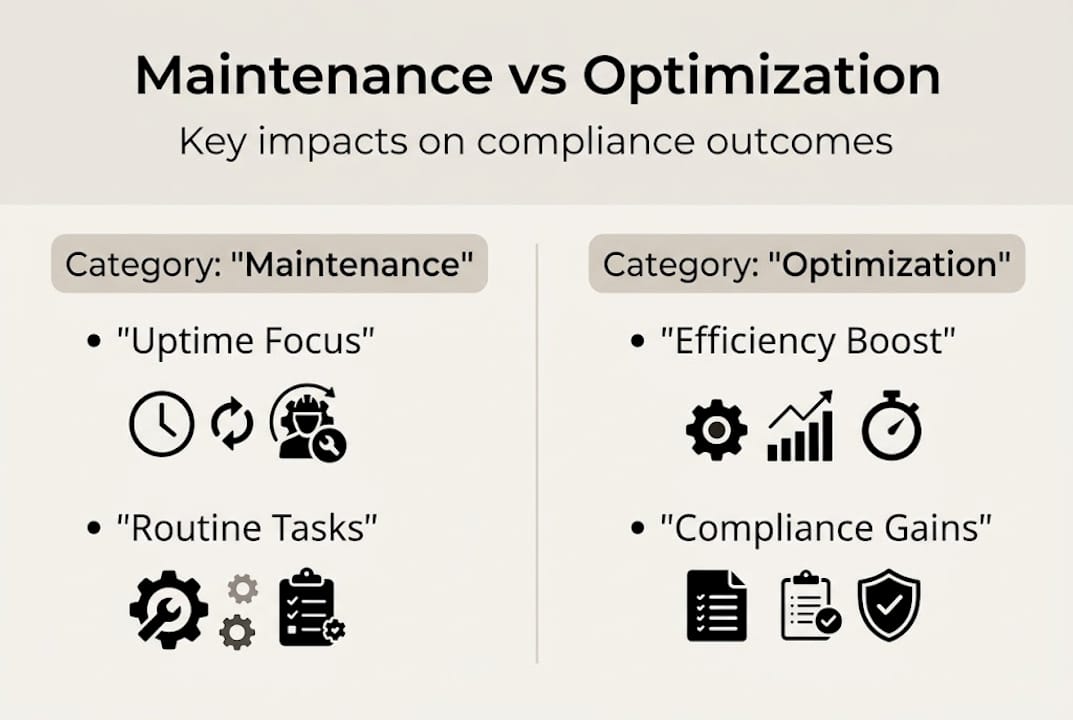
The distinction matters. Maintenance keeps systems running. Upgrades replace outdated components. Optimization asks a more demanding question: are your controls actually reducing risk in proportion to the resources you spend on them? In regulated industries, that question carries legal and financial weight.
For organizations subject to HIPAA, PCI DSS, FISMA, or NIST frameworks, optimization directly affects audit outcomes, liability exposure, and operational continuity. A misconfigured access control system or an unmonitored log aggregator is not just a technical gap. It is a compliance finding waiting to happen.
Core methodologies in this space include risk-based control selection and tailoring from NIST SP 800-53 baselines using the RMF Select step, which is the phase in the Risk Management Framework where organizations choose which controls apply to their specific environment. Tailoring allows you to add, remove, or modify controls based on your organization's mission, threat environment, and operational constraints.
Key elements that define true security system optimization include:
- Risk-based control selection: Choosing controls based on actual threat exposure, not just regulatory minimums
- Continuous monitoring: Replacing periodic audits with real-time visibility into control effectiveness
- Automation of evidence generation: Reducing manual labor required to demonstrate compliance
- Performance benchmarking: Measuring security posture changes over time with quantifiable metrics
- Documentation alignment: Ensuring system security plans and control documentation reflect actual configurations
Exploring advanced system optimization approaches can reveal specific gaps in your current program that standard maintenance cycles miss entirely.
Pro Tip: When starting an optimization program, map every existing control to a specific regulatory requirement before making any changes. This baseline mapping prevents accidental compliance gaps during improvement cycles.
For broader context on how optimization fits within the security management lifecycle, reviewing security industry insights can help you stay current with evolving best practices.
Frameworks and controls: Building blocks of optimization
Now that we've defined optimization, understanding the frameworks and controls in play is critical. No optimization effort succeeds without a structured framework to guide control selection, prioritization, and documentation.
The most widely used framework in U.S. regulated industries is NIST SP 800-53, which provides a catalog of security and privacy controls organized into families such as Access Control, Incident Response, and System and Information Integrity. Organizations select a baseline, Low, Moderate, or High impact, based on the potential consequences of a security failure. Tiered baselines and tailoring align directly with an organization's risk categories and mission requirements.
Beyond NIST, frameworks like NIST SI, CISA CPGs, and NERC CIP-[CIO-IT-Security-12-63-Rev-4].pdf) are commonly leveraged for optimization and compliance in sectors including energy, healthcare, and federal government. NERC CIP governs bulk electric system cybersecurity. CISA's Cybersecurity Performance Goals provide a prioritized set of baseline practices applicable across critical infrastructure sectors.
| Framework | Primary sector | Key focus area |
|---|---|---|
| NIST SP 800-53 | Federal, healthcare, finance | Comprehensive control catalog |
| NERC CIP | Energy, utilities | Operational technology security |
| CISA CPGs | All critical infrastructure | Baseline cybersecurity practices |
| HIPAA Security Rule | Healthcare | Patient data protection |
| PCI DSS | Finance, retail | Cardholder data security |
Here is a practical sequence for applying the RMF Select step within an optimization program:
- Categorize your system using FIPS 199 to determine the impact level (Low, Moderate, or High)
- Select the appropriate baseline from NIST SP 800-53 that corresponds to your impact level
- Apply tailoring guidance to add organization-specific controls or remove those that do not apply
- Document control parameters and assign responsibility for each control to a specific team or system owner
- Review overlays for sector-specific requirements such as healthcare or defense that modify the baseline further
- Finalize the System Security Plan to capture all selected, tailored, and allocated controls
Understanding regulatory compliance explained in depth helps teams avoid the common mistake of treating framework selection as a box-checking exercise rather than a genuine risk reduction activity.
From compliance to resilience: Automation and benchmarking
With frameworks set, let's explore how automation and benchmarking take optimization and compliance to the next level. Meeting a compliance threshold is a starting point, not a destination. The organizations that sustain strong security postures are the ones that automate evidence collection and measure their performance continuously.
The NIST SI family, CISA CPGs, and NERC CIP-[CIO-IT-Security-12-63-Rev-4].pdf) frameworks all support automated evidence generation as a best practice. Automation tools can pull configuration data, log records, and vulnerability scan results directly into compliance dashboards, eliminating the manual effort that traditionally consumes hundreds of audit preparation hours each year.
Real-world results confirm the value. One organization improved its SecurityScorecard rating from 76 to 94 through governance mapping and automated assessment processes, while also achieving significant time and cost savings across audit cycles.

| Metric | Before optimization | After optimization |
|---|---|---|
| Security posture score | 76 | 94 |
| Evidence preparation time | Baseline | 82% reduction |
| NERC CIP assessment speed | Baseline | 50% faster |
| Cyber insurance premium | Higher | Reduced |
Steps to implement automation in your environment:
- Integrate your SIEM (Security Information and Event Management system) with your compliance management platform to create automated evidence trails
- Schedule continuous vulnerability scans and map findings directly to control gaps in your security plan
- Use configuration management tools to enforce and verify baseline settings across endpoints and network devices
- Automate reporting workflows so audit evidence is generated on demand rather than assembled manually before each review
For practical guidance on sustaining these gains, reviewing security compliance tips and a solid risk management strategy guide will help you build a repeatable process. Organizations looking to accelerate this work can also explore custom automation solutions tailored to their specific compliance environment.
Pro Tip: Before deploying any automation tool, document your current manual evidence collection process in detail. This baseline lets you measure actual time savings and justify the investment to leadership with real numbers.
Compliance-centric vs. Security by Design: Moving the needle
The path from compliance to true resilience demands a shift in mindset and practice. Many organizations optimize for audit success rather than actual risk reduction. That approach has measurable costs.
Research comparing compliance-centric vs. risk-based approaches shows that organizations relying on manual audits and checkbox compliance consistently underperform those using continuous Automated Security Control Assessment (ASCA). ASCA refers to technology-driven, ongoing evaluation of whether security controls are functioning as intended, rather than point-in-time reviews.
"Risk-based optimization reduces costs 20-40% and lowers critical vulnerabilities by 54% compared to compliance-centric approaches."
Security by Design (SbD) is the alternative framework. It integrates security requirements into system architecture from the beginning rather than layering controls on afterward. The key principles include:
- Threat modeling during design: Identifying likely attack vectors before systems are built or reconfigured
- Least privilege by default: Ensuring users and systems have only the access they need, reducing the blast radius of any breach
- Continuous assurance: Replacing annual audits with ongoing monitoring that surfaces control failures in real time
- Residual risk acceptance: Formally documenting what risk remains after controls are applied, rather than assuming compliance equals safety
To shift your organization from compliance-centric to resilience-focused, start with these action steps. First, review your current control set and identify which controls exist only to satisfy auditors versus which ones actively reduce risk. Second, introduce continuous monitoring tools that provide daily or weekly visibility into control status. Third, conduct threat modeling exercises before any major system change. Fourth, formalize residual risk documentation so leadership understands what gaps remain.
Reviewing risk management strategies and resources on consulting for integrators can accelerate this transition, especially for organizations managing both IT and physical security systems simultaneously.
Our take: Optimization is iterative, not a one-off checklist
As we've uncovered, the most effective organizations approach optimization as a continuous journey. The most common mistake we see is treating optimization as a project with a defined end date. Teams complete a control gap assessment, close the findings, and move on. Six months later, the environment has changed but the security posture has not kept pace.
Real optimization is a cycle. Controls degrade. Threat landscapes shift. Regulatory requirements evolve. The organizations that maintain strong postures are the ones that build review and improvement into their operational rhythm, not their project calendar.
Automation is what makes continuous optimization sustainable. Without it, the manual burden of ongoing assessment simply overwhelms security teams. With it, monitoring becomes a background process that surfaces issues before they become audit findings or incidents.
We consistently see that organizations investing in ongoing system optimization as a managed process, rather than a periodic project, achieve compounding improvements in both compliance scores and actual risk reduction over time. The data supports this. The operational experience confirms it.
Ready to optimize? How Stonos Solutions can help
If you're ready to put optimization strategies into action, here's how you can get started with expert support.
Stonos Solutions works directly with IT and security managers in regulated industries to close the gap between compliance requirements and operational security performance. Our team brings CISSP, PSP, and RCDD-certified expertise to every engagement, whether you need a full assessment of your current security services portfolio, custom automation built around your specific compliance framework, or targeted penetration testing to validate that your optimized controls actually hold under pressure.
We serve healthcare, government, industrial, and enterprise commercial clients across the United States and internationally. Contact Stonos Solutions to schedule a consultation and start building a security optimization program that delivers measurable, sustained results.
Frequently asked questions
What is security system optimization in regulated industries?
Security system optimization is the process of enhancing controls, processes, and automation to improve compliance, resilience, and cost-effectiveness within regulatory frameworks. It involves risk-based control selection and tailoring from NIST SP 800-53 baselines to match each organization's specific risk environment.
How does automation help with security compliance?
Automation streamlines evidence collection, reduces manual errors, and enables continuous compliance monitoring, making audits faster and more reliable. In practice, it has delivered an 82% reduction in evidence preparation time and a 50% faster NERC CIP assessment cycle for real-world organizations.
What frameworks are commonly used for optimization?
Key frameworks include NIST SP 800-53, NERC CIP, CISA CPGs, and the NIST System and Information Integrity family. Industry optimization aligns-[CIO-IT-Security-12-63-Rev-4].pdf) these frameworks to specific sector requirements and risk categories.
Compliance or Security by Design: which is better?
Security by Design is generally more effective, reducing both vulnerabilities and costs, while compliance alone can leave critical gaps. Research shows 54% fewer critical vulnerabilities and 20-40% lower costs with risk-based Security by Design approaches compared to compliance-centric methods.
Recommended
- Top 7 security compliance tips for 2026 success - Stonos Solutions Blog
- Regulatory Compliance Explained: Build Stronger Security - Stonos Solutions Blog
- Security Consulting for Integrators: Enabling Resilience - Stonos Solutions Blog
- Blog - Security Insights & Industry News - Stonos Solutions
- Secure AI Systems for Compliance: Minimizing Regulatory Risks | Ailerons IT Consulting
Louis Romano
Need Security Consulting?
Our expert team is ready to help you enhance your security posture.
Contact Us Today Download Capability StatementRelated Articles
Enterprise Security Checklist for Healthcare Compliance Success
Explore an actionable enterprise security checklist tailored for healthcare organizations. Follow a step-by-step process to ensure HIPAA compliance and risk management.
Read MoreSecurity gap analysis: steps, benefits, and best practices
Learn how to conduct a security gap analysis to identify hidden risks, close compliance gaps, and build a stronger security posture in regulated industries.
Read More7 Key Benefits of Penetration Testing for Healthcare IT
Discover 7 essential benefits of penetration testing for healthcare IT security managers and learn actionable strategies to protect data and ensure compliance.
Read More