Regulatory Compliance Explained: Build Stronger Security
Regulatory Compliance Explained: Build Stronger Security

TL;DR:
- Regulatory compliance is a strategic framework that ensures organizations follow applicable laws and standards.
- Managing compliance involves a recurring cycle of obligation identification, risk assessment, control implementation, monitoring, and continuous improvement.
- Beyond risk avoidance, organizations should view compliance as a resilience tool that builds trust, institutional knowledge, and competitive advantage.
Regulatory compliance is widely misunderstood. Many organizations treat it as a legal obligation to satisfy auditors and move on. That view is costly. Regulatory compliance is an organization's adherence to laws, regulations, rules, and standards set by government agencies and industry bodies, and when approached strategically, it becomes a framework for security, trust, and competitive advantage. This article walks compliance officers and decision-makers through what regulatory compliance actually means, how the management cycle works, where real-world conflicts arise, and what seasoned experts recommend for building programs that last.
Table of Contents
- What is regulatory compliance and why does it matter?
- Core mechanics: The compliance management cycle
- Navigating challenges: Regulatory overlap, conflicts, and edge cases
- Expert insights: Nuanced compliance, safe harbors, and best practices
- Why real compliance is about resilience, not just risk avoidance
- Get expert help with compliance and security
- Frequently asked questions
Key Takeaways
| Point | Details |
|---|---|
| Compliance is ongoing | Following regulations is a recurring cycle, not a one-time event. |
| Navigating complexity is crucial | Organizations face overlapping and sometimes conflicting rules, requiring careful strategy. |
| Best practices go beyond rules | Combining expert insights and practical approaches builds lasting compliance resilience. |
| Compliance enables trust | Strong regulatory adherence boosts security and strengthens stakeholder trust. |
What is regulatory compliance and why does it matter?
Regulatory compliance is not a single rule or law. It is a category of obligations that organizations must satisfy to operate legally and responsibly within their industry and jurisdiction. These obligations come from three main sources: statutory requirements (laws passed by legislatures), regulatory requirements (rules issued by agencies like the FDA, FTC, or SEC), and industry standards (frameworks like ISO 27001, HIPAA, or PCI DSS that may be contractually or legally mandated).
Understanding why compliance matters goes beyond avoiding fines. Non-compliance can trigger enforcement actions, damage customer trust, disqualify organizations from government contracts, and expose leadership to personal liability. Conversely, organizations with strong compliance postures are better positioned to win enterprise clients, enter regulated markets, and demonstrate governance maturity to investors and partners.
Common regulatory frameworks that compliance teams manage include:
- HIPAA: Protects patient health information in healthcare settings
- PCI DSS: Governs payment card data security for any organization processing card transactions
- GDPR: Regulates personal data handling for organizations serving EU residents
- NIST CSF: A voluntary cybersecurity framework widely adopted by federal contractors
- FISMA: Mandates information security programs for federal agencies and their contractors
- ISO 27001: An international standard for information security management systems
These frameworks often overlap, and managing them in silos creates gaps. Review security compliance tips to see how leading organizations coordinate across multiple frameworks without duplicating effort.
"The demands of compliance have evolved from static checklists to dynamic, risk-informed programs that require continuous attention and cross-functional ownership." This shift reflects how regulators now expect organizations to demonstrate ongoing diligence, not just point-in-time adherence.
Compliance also protects reputation in ways that are hard to quantify but easy to lose. A single data breach tied to a known compliance gap can erode years of brand trust. Organizations that treat compliance as foundational, not optional, build the kind of credibility that sustains long-term relationships with clients, regulators, and partners.
Core mechanics: The compliance management cycle
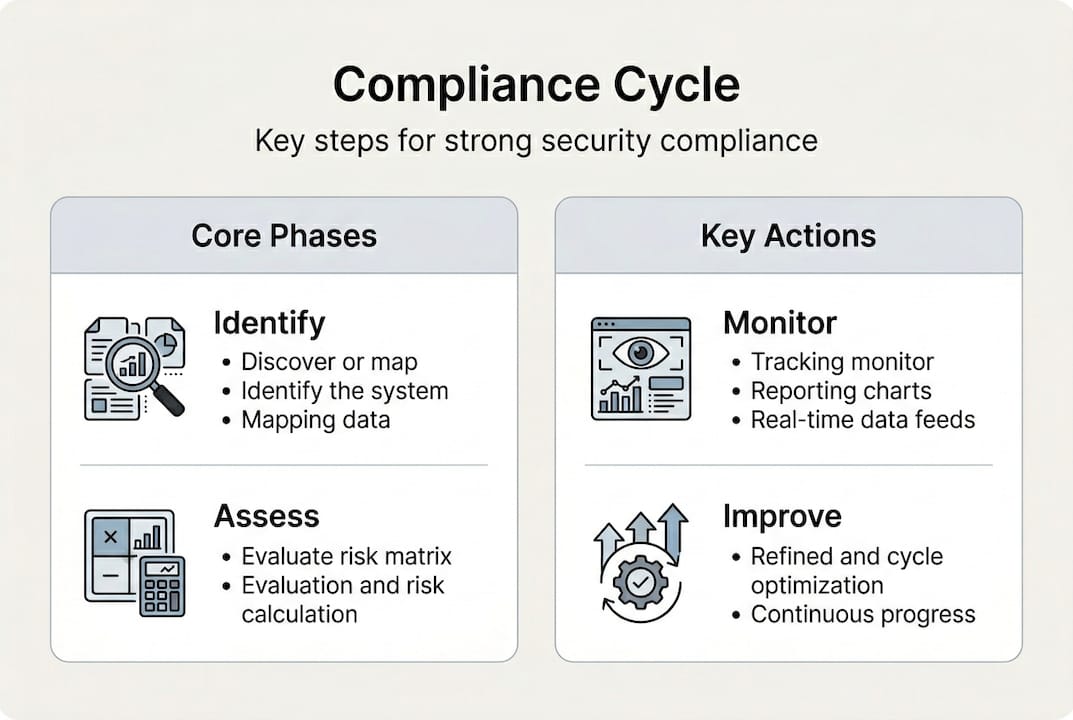
With an understanding of why compliance matters, let's get practical about how it's managed within organizations. Compliance is not a project with a start and end date. It is a recurring cycle, and each phase informs the next.
The compliance process framework outlines the core mechanics as a cycle: obligation identification, risk assessment, policy and control design, implementation and training, monitoring and auditing, remediation, and continuous improvement. Here is how each phase works in practice:
- Obligation identification: Map all applicable laws, regulations, and standards to your organization's operations, geography, and data types.
- Risk assessment: Evaluate where gaps exist between current practices and required controls. Prioritize by likelihood and impact.
- Policy and control design: Develop written policies and technical or administrative controls that close identified gaps.
- Implementation and training: Deploy controls and ensure staff understand their roles. Training is not optional; regulators look for evidence of it.
- Monitoring and auditing: Continuously check that controls are working. Automated monitoring tools reduce the burden significantly.
- Remediation: When gaps or violations are found, fix them quickly and document the corrective action.
- Continuous improvement: Use audit findings and incident data to refine your program over time.
| Phase | Objective | Key action |
|---|---|---|
| Obligation identification | Know what applies | Regulatory mapping |
| Risk assessment | Know your gaps | Gap analysis |
| Policy design | Close the gaps | Control documentation |
| Implementation | Activate controls | Training and deployment |
| Monitoring | Verify performance | Automated auditing |
| Remediation | Fix failures fast | Corrective action plans |
| Continuous improvement | Strengthen over time | Program review cycles |
Strong IT security risk strategies integrate directly into the risk assessment and monitoring phases, ensuring that technical and compliance teams share data rather than operate independently. Similarly, risk management tactics at the program level help compliance leaders prioritize remediation efforts when resources are limited. A thorough security risk assessment anchors the entire cycle.
Pro Tip: Do not treat compliance as an annual event. Regulators increasingly expect continuous monitoring. Organizations that only review compliance during audit season are already behind, and they tend to face larger remediation costs when issues surface.
Navigating challenges: Regulatory overlap, conflicts, and edge cases
The process sounds straightforward until regulatory environments collide. Let's explore what happens when compliance isn't black and white.
One of the most common challenges compliance teams face is regulatory overlap, where two or more frameworks impose requirements on the same system, process, or data set. Sometimes those requirements align. Often, they do not. A healthcare organization processing payment card data, for example, must satisfy both HIPAA and PCI DSS simultaneously, even where their technical requirements differ.

More complex are direct federal-state regulatory conflicts, such as DEI executive orders conflicting with state civil rights laws, immigration enforcement directives conflicting with state sanctuary policies, and AI governance rules that vary by jurisdiction. In these cases, compliance with one level of regulation can create exposure at another. The dormant commerce clause adds another layer, potentially invalidating state laws that burden interstate commerce.
| Scenario | Single-jurisdiction compliance | Conflicting-mandate compliance |
|---|---|---|
| Complexity | Moderate | High |
| Risk of violation | Lower | Elevated |
| Legal exposure | Contained | Multi-directional |
| Strategy needed | Standard controls | Dual compliance or escalation |
| Documentation burden | Standard | Significantly higher |
Practical strategies for navigating these situations include:
- Risk mapping: Document all applicable requirements and flag where they conflict before designing controls
- Dual compliance: Design controls that satisfy the stricter of two conflicting requirements where possible
- Escalation preparedness: Have legal counsel and a clear escalation path ready before a conflict becomes a crisis
- Jurisdictional monitoring: Track regulatory changes at both the federal and state level continuously, not reactively
- Scenario planning: Run tabletop exercises for likely conflict scenarios specific to your industry
Organizations in regulated sectors like healthcare, manufacturing, and government contracting benefit from security consulting guidance that maps technical controls to multiple frameworks simultaneously, reducing redundancy and closing gaps that single-framework approaches miss.
Expert insights: Nuanced compliance, safe harbors, and best practices
Complex regulatory issues demand not just awareness but advanced tactics and practical wisdom from seasoned experts.
One distinction that separates experienced compliance teams from reactive ones is understanding the difference between material compliance and procedural compliance. Material compliance means meeting the actual substance of a rule: your data is encrypted, your access controls are enforced, your incident response plan is tested. Procedural compliance means following the required steps: submitting reports on time, maintaining documentation, completing mandatory training. Both matter. But material vs. procedural compliance carry different risk profiles. Failing on substance is typically treated more seriously by regulators than missing a procedural step.
Safe harbor provisions are another tool that compliance teams often underutilize. These are legal protections built into regulations that reduce or eliminate penalties for organizations that demonstrate good-faith compliance efforts. HIPAA's breach notification rule, for example, offers reduced enforcement exposure when organizations can show they had reasonable safeguards in place. Knowing where safe harbors exist in your regulatory landscape is a legitimate risk reduction strategy.
Essential best practices for compliance teams include:
- Centralize obligation tracking: Use a compliance management platform to map requirements, owners, and deadlines in one place
- Align compliance with security operations: Compliance gaps are often security gaps. Treat them as the same problem
- Document everything: Regulators cannot credit what they cannot see. Documentation is evidence of diligence
- Test your controls: Policy without verification is assumption. Regular testing confirms controls actually work
- Engage leadership: Compliance programs without executive sponsorship stall. Frame compliance in terms of business risk, not legal obligation
Review compliance best practices for a structured approach to building these habits into your program. Organizations in regulated production environments will also find that security in manufacturing offers sector-specific guidance on aligning physical and cyber compliance requirements.
Pro Tip: Compliance can be a competitive differentiator. When your organization can demonstrate a mature, auditable compliance program to prospective clients, it shortens procurement cycles and builds trust faster than any sales pitch.
Why real compliance is about resilience, not just risk avoidance
Conventional wisdom frames regulatory compliance as a defensive activity. Avoid fines. Pass audits. Satisfy legal counsel. That framing is limiting, and it leaves significant value on the table.
Organizations that treat compliance as a resilience framework, rather than a legal checkbox, build something more durable. They develop institutional knowledge about their own risk landscape. They create feedback loops that catch problems before regulators do. They build cultures where employees understand why controls exist, not just that they are required.
The security compliance mindset that separates high-performing organizations from reactive ones is simple: compliance is not the ceiling. It is the floor. The organizations that outpace competitors in regulated markets are the ones that use compliance requirements as a baseline and then build adaptive, intelligence-driven security programs on top of them.
Compliance leaders who champion this perspective earn more than audit sign-offs. They earn organizational trust, board-level visibility, and the credibility to drive security investment decisions. That is a position worth building toward.
Get expert help with compliance and security
Moving beyond the basics requires more than good intentions. It requires a structured program, tested controls, and expert guidance aligned to your specific regulatory environment.

Stonos Solutions helps organizations across healthcare, government, manufacturing, and enterprise sectors build compliance programs that actually hold up under scrutiny. From penetration testing services that validate your technical controls to full-spectrum security services that align with HIPAA, PCI DSS, NIST, and FISMA requirements, we bring certified expertise to every engagement. Need a tailored solution? Our custom development team builds compliance-aligned tools and workflows specific to your environment. Contact us to start the conversation.
Frequently asked questions
What is regulatory compliance in simple terms?
Regulatory compliance means following the laws, rules, and standards that apply to your organization based on your industry, location, and the type of data or services you handle.
What are the main steps in the regulatory compliance process?
The compliance cycle includes identifying requirements, assessing risks, designing controls, implementing and training staff, monitoring performance, remediating issues, and continuously improving the program.
How should organizations handle conflicting compliance requirements?
Map out all applicable requirements first, then pursue dual compliance where the stricter standard satisfies both, and have a legal escalation plan ready for situations where true conflicts cannot be resolved through control design alone.
What is the difference between material and procedural compliance?
Material compliance means meeting the actual substance of a rule, such as encrypting data or enforcing access controls, while procedural compliance means completing required steps like submitting reports and maintaining documentation on schedule.
Recommended
- Top 7 security compliance tips for 2026 success - Stonos Solutions Blog
- Role of security in manufacturing: protect assets now - Stonos Solutions Blog
- Risk management strategy guide 2026: advanced tactics - Stonos Solutions Blog
- Security Consulting for Integrators: Enabling Resilience - Stonos Solutions Blog
- Compliance Platforms: Streamlining Security and Trust
- Compliance Risk Meaning: Impact on Security Reviews
Louis Romano
Need Security Consulting?
Our expert team is ready to help you enhance your security posture.
Contact Us Today Download Capability StatementRelated Articles
Why regulatory compliance matters: reduce risk, protect your org
Learn why regulatory compliance matters for healthcare, government, and industrial sectors. Discover frameworks and strategies to reduce risk and protect your organization.
Read MoreWhy Use Vulnerability Analysis—Ensuring Security Compliance
Vulnerability analysis helps organizations prevent breaches, meet regulatory standards, and prioritize risks. Learn benefits, requirements, and key processes.
Read MoreWhy assess industrial security risks for compliance
Learn why industrial security risk assessment differs from IT risk management and how IEC 62443 methodology protects regulated industries from operational and compliance threats.
Read More