CISSP certification: value, requirements, and career impact
CISSP certification: value, requirements, and career impact

CISSP is widely misread as a credential for deep technical specialists, but that framing misses its real purpose. The Certified Information Systems Security Professional designation is built for professionals who bridge security operations and organizational leadership. It signals that you can manage risk, align security programs with business goals, and satisfy the compliance demands that regulators increasingly enforce. For IT professionals and security managers in regulated industries, CISSP is not just a resume line. It is a strategic career move that directly affects your organization's security posture and your own earning potential.
Table of Contents
- What is CISSP certification and who is it for?
- CISSP requirements, exam details, and maintaining your credential
- CISSP's powerful role in regulated industry compliance
- Career impact: Roles, salaries, and strategic advantages of CISSP
- CISSP vs. other certifications: Strategic positioning and common questions
- The real value of CISSP: What most guides won't tell you
- How Stonos Solutions supports your CISSP journey and compliance needs
- Frequently asked questions
Key Takeaways
| Point | Details |
|---|---|
| Strategic credential | CISSP demonstrates both technical expertise and leadership readiness for cybersecurity management roles. |
| Compliance alignment | CISSP is a key credential for meeting requirements in regulated industries and frameworks. |
| Career advantage | Holding a CISSP significantly increases salary potential and opens doors to senior IT security roles. |
| Rigorous requirements | Achieving and maintaining CISSP requires substantial experience, ongoing education, and ethical standards. |
What is CISSP certification and who is it for?
CISSP is widely recognized as the gold standard for cybersecurity management credentials. CISSP validates expertise across eight security domains for strategic cybersecurity roles, making it one of the broadest certifications available in the field. It is governed by ISC2 and is designed for professionals who manage, design, and oversee security programs rather than those who primarily execute technical tasks.
The eight domains covered by CISSP are:
- Security and risk management
- Asset security
- Security architecture and engineering
- Communication and network security
- Identity and access management (IAM)
- Security assessment and testing
- Security operations
- Software development security
This breadth is intentional. CISSP is not trying to make you a better penetration tester or a faster incident responder. It is designed to give you the vocabulary, frameworks, and judgment to lead security programs across an entire organization. That makes it ideal for IT professionals targeting management roles, security managers in healthcare, government, finance, or manufacturing, and anyone responsible for regulatory compliance.
"CISSP is not a technical certification. It is a management certification that requires technical literacy." This distinction matters when you are deciding whether CISSP fits your career stage.
Pro Tip: If your current role involves communicating security risks to non-technical stakeholders or aligning security decisions with business objectives, CISSP is almost certainly the right credential. Building risk management strategies into your daily thinking before you sit for the exam will accelerate both your preparation and your post-certification effectiveness.
CISSP requirements, exam details, and maintaining your credential
Understanding the path toward certification and keeping it active is essential before you invest time and money into preparation.
Eligibility is straightforward but firm. Five years of paid experience in two or more CISSP domains is required, though you can waive one year with a qualifying four-year college degree or an approved credential. If you do not yet have the full five years, the Associate of ISC2 path lets you pass the exam first and fulfill the experience requirement within six years.
The exam itself uses Computerized Adaptive Testing (CAT). Key exam details:
- Format: CAT, adaptive to your performance
- Questions: 100 to 150 items
- Time limit: Three hours
- Passing score: 700 out of 1,000
- Domains tested: All eight, weighted by ISC2's published outline
Here is a quick reference for the ongoing maintenance requirements:
| Requirement | Detail |
|---|---|
| Annual CPE credits | 40 per year (120 over 3-year cycle) |
| Annual maintenance fee (AMF) | $125 per year |
| Ethics obligation | Adherence to ISC2 Code of Ethics |
| Recertification cycle | Every three years |
Maintaining your credential is not optional. ISC2 audits CPE submissions, and failure to meet the requirements results in suspension or revocation. You can explore IT security risk strategies that double as CPE-eligible professional development activities.
Pro Tip: Do not wait until year three to gather CPE credits. Log qualifying activities as they happen, including webinars, conference sessions, and security publications you contribute to. Catching up at renewal is stressful and avoidable.
CISSP's powerful role in regulated industry compliance
For organizations subject to strict compliance, CISSP is not just a preferred credential. It is often a baseline requirement.
CISSP aids compliance in regulated industries including DoD 8140, FISMA/NIST, SEC, FINRA, PCI DSS, and HIPAA. Each of these frameworks demands that security programs be managed by qualified professionals, and CISSP is one of the most consistently recognized qualifications across all of them.
Practical situations where CISSP is cited or required include:
- DoD contractors needing to meet 8140 workforce requirements
- Healthcare organizations demonstrating HIPAA security rule compliance
- Financial institutions satisfying SEC and FINRA cybersecurity governance expectations
- Federal agencies and contractors operating under FISMA and NIST 800-53
- Payment processors and merchants meeting PCI DSS control requirements
Here is how CISSP compares to two other major management certifications:
| Certification | Primary focus | Compliance use case | Ideal background |
|---|---|---|---|
| CISSP | Technical depth plus strategic management | DoD, FISMA, HIPAA, PCI DSS | IT professionals, security managers |
| CISM | Information risk management | Enterprise governance, ISACA frameworks | Risk and compliance managers |
| CISA | Audit and assurance | SOX, audit-heavy environments | Internal auditors, compliance officers |
Employers in regulated sectors use CISSP as a filter for management and compliance-focused roles because it signals that the candidate understands both the technical controls and the governance structures that surround them. For more on building security compliance in 2026, the intersection of certification and framework alignment is a recurring theme. Organizations that invest in CISSP-certified staff consistently report stronger audit outcomes and fewer compliance gaps, which is why the security consulting role increasingly lists CISSP as a minimum qualification.
Career impact: Roles, salaries, and strategic advantages of CISSP
The financial case for CISSP is clear. Median CISSP salaries range from approximately $128,000 to $157,000 USD annually, with high demand driven by persistent workforce gaps across the industry.

Here is a snapshot of common CISSP job titles and their market positioning:
| Job title | Typical salary range | Demand level |
|---|---|---|
| Security manager | $110k to $145k | High |
| Security architect | $130k to $165k | Very high |
| Security analyst (senior) | $105k to $135k | High |
| Chief Information Security Officer (CISO) | $160k to $250k+ | Growing |
Roles such as security manager, architect, and CISO consistently list CISSP as a signal of management-track readiness. Employers are not just paying for the credential. They are paying for the judgment and governance fluency that CISSP preparation builds.
Strategic career advantages of becoming CISSP certified:
- Positions you for CISO and director-level roles faster than most other credentials
- Increases your credibility in board-level and executive security conversations
- Makes you a stronger candidate for federal and defense contractor positions
- Expands your ability to lead cross-functional security initiatives
- Provides a recognized framework for evaluating penetration testing tools and vendor risk
"CISSP holders are not just more employable. They are more promotable. The credential signals that you think about security the way executives need to think about it."
For IT professionals considering their next move, exploring security services careers that require CISSP gives you a realistic view of where the market is heading.
CISSP vs. other certifications: Strategic positioning and common questions
Many professionals weigh CISSP against CISM and CISA before committing. The distinctions matter.
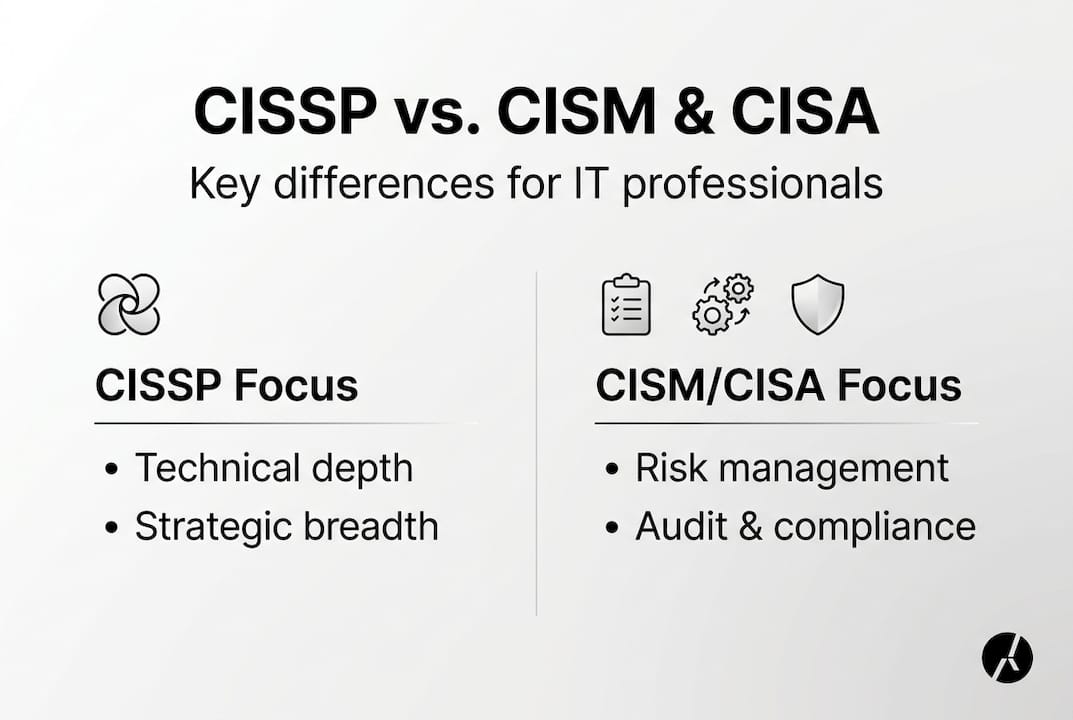
CISSP offers broader technical and strategic coverage compared to CISM, which focuses on information risk management, and CISA, which centers on audit and assurance. For professionals with a technical background who want to move into management, CISSP is almost always the right first choice.
Here is a more detailed comparison:
| Factor | CISSP | CISM | CISA |
|---|---|---|---|
| Technical depth | High | Moderate | Low |
| Management focus | High | Very high | Moderate |
| Audit focus | Low | Low | Very high |
| Best for | IT managers, architects | Risk managers | Auditors, compliance officers |
| Exam difficulty | High | Moderate to high | Moderate |
Common questions answered directly:
- Can I take the exam without five years of experience? Yes. The Associate of ISC2 path lets you pass first and fulfill experience within six years.
- How many CPE credits do I need each year? Forty CPE credits per year, with a $125 annual maintenance fee and mandatory ethics code adherence.
- Is CISSP recognized internationally? Yes, it holds ANSI/ISO/IEC 17024 accreditation and is recognized across government and private sectors globally.
- What happens if I fail the ethics code? ISC2 can revoke your certification, which is a binding obligation, not a formality.
- Should I pursue CISM after CISSP? Many senior professionals hold both, but CISSP first makes sense for technical backgrounds moving into management.
The real value of CISSP: What most guides won't tell you
Most CISSP guides focus on pass rates, study hours, and domain breakdowns. That information is useful, but it misses the more important point.
The professionals who gain the most from CISSP are not the ones who studied hardest for the exam. They are the ones who internalized the managerial mindset that the credential is built around. CISSP changes how you frame security decisions, how you communicate risk to leadership, and how you evaluate tradeoffs between security controls and operational needs.
Chasing CISSP purely as a resume boost or a compliance checkbox is a mistake. The certification's real return on investment comes from applying its frameworks daily, not from displaying the letters after your name. Organizations that treat CISSP as a hiring filter without building a culture of security governance around it see limited results.
Pro Tip: Before you sit for the exam, invest time in developing your stakeholder communication skills. Practice translating technical findings into business risk language. That skill, reinforced by security compliance wisdom, is what separates CISSP holders who lead from those who simply hold the credential.
The credential is a door. What you do after you walk through it determines the actual value.
How Stonos Solutions supports your CISSP journey and compliance needs
For IT professionals and security managers working toward CISSP or managing compliance programs in regulated industries, expert guidance accelerates results.
Stonos Solutions brings CISSP-certified expertise to security assessments, vulnerability analyses, and regulatory compliance programs across healthcare, government, and enterprise sectors. Whether your team needs support aligning with HIPAA, PCI DSS, FISMA, or NIST frameworks, or you need penetration testing services to validate your security controls, Stonos Solutions provides the strategic and technical depth that compliance-driven organizations require. Explore the full range of comprehensive security services and connect with a team that understands both the credential and the real-world security challenges behind it.
Frequently asked questions
Is CISSP certification worth it for IT managers in 2026?
Yes. CISSP is highly valued for management-track roles, boosts earning potential significantly, and is often required for regulated industry compliance. Median salaries for CISSP holders range from $128,000 to $157,000 annually, with strong demand across sectors.
What are the eight CISSP security domains?
The eight domains are security and risk management, asset security, security architecture and engineering, communication and network security, identity and access management, security assessment and testing, security operations, and software development security. CISSP validates expertise across all eight for strategic cybersecurity roles.
How does CISSP help with regulatory compliance?
CISSP aligns with requirements from frameworks including DoD 8140, PCI DSS, HIPAA, and FISMA, making it a key credential for organizations in regulated industries. CISSP aids compliance across government, healthcare, and financial sectors.
Can I get CISSP without full experience?
Yes. The Associate of ISC2 path allows you to pass the exam before completing the experience requirement. The associate path gives you six years to fulfill the five-year experience requirement after passing.
Recommended
- Security Consulting for Integrators: Enabling Resilience - Stonos Solutions Blog
- Blog - Security Insights & Industry News - Stonos Solutions
- Top 7 security compliance tips for 2026 success - Stonos Solutions Blog
- Stonos Solutions - Leading Security & Technology Consulting
- Impatti certificazione ISMS: guida completa 2026 - Security Hub
Louis Romano
Need Security Consulting?
Our expert team is ready to help you enhance your security posture.
Contact Us Today Download Capability StatementRelated Articles
Why Use Vulnerability Analysis—Ensuring Security Compliance
Vulnerability analysis helps organizations prevent breaches, meet regulatory standards, and prioritize risks. Learn benefits, requirements, and key processes.
Read MoreWhy assess industrial security risks for compliance
Learn why industrial security risk assessment differs from IT risk management and how IEC 62443 methodology protects regulated industries from operational and compliance threats.
Read MoreWhy follow cybersecurity trends 2026 for compliance
Discover why tracking cybersecurity trends in 2026 is essential for regulatory compliance and risk management across AI, quantum computing, and supply chain threats.
Read More