Why follow cybersecurity trends 2026 for compliance
Why follow cybersecurity trends 2026 for compliance

Organizations still separating cybersecurity from compliance are operating with an outdated model that no longer reflects the reality of 2026. The boundary between security and regulatory requirements has collapsed, creating an integrated landscape where emerging threats like AI vulnerabilities, quantum computing risks, and supply chain breaches directly impact compliance posture. For cybersecurity professionals managing risk across regulated sectors, staying current with these trends is not optional. It is the foundation of effective risk management and regulatory adherence in an environment where 42% of security investments now focus on compliance.
Table of Contents
- Regulatory Compliance As The Cornerstone Of 2026 Security Strategies
- Emerging Technology Risks: AI And Quantum Computing Challenges
- Supply Chain Vulnerabilities And The Business Risk Paradigm
- Adopting And Evolving Cybersecurity Frameworks For 2026
- Discover Effective Solutions With Stonos Solutions
Key takeaways
| Point | Details |
|---|---|
| Compliance drives strategy | Regulatory requirements now shape security investments, with compliance second only to zero trust in planned budgets. |
| AI and quantum present gaps | 78% of organizations ignore quantum risks, while AI policies lack enforcement. |
| Supply chains create exposure | Third-party breaches like Conduent demonstrate systemic business continuity risks requiring continuous monitoring. |
| Frameworks must evolve | NIST CSF and ISO 27001 remain critical, but static compliance no longer protects against real-time threats. |
| Cross-functional collaboration wins | Boards demand actionable security data, requiring coordination beyond technical teams. |
Regulatory compliance as the cornerstone of 2026 security strategies
The integration of security and compliance is no longer aspirational. It has become the operational reality driving cybersecurity investment decisions across regulated industries. Compliance now drives security strategy as the primary motivator for how organizations allocate resources, design controls, and measure success. This shift reflects a fundamental recognition that regulatory demands and security effectiveness are inseparable.
Consider the investment priorities emerging in 2026. Organizations are directing 42% of planned security spending toward risk and compliance initiatives, trailing only zero trust architecture at 49%. This allocation signals that boards and executives view compliance not as a checkbox exercise but as the framework for comprehensive security.
The demands from leadership have evolved beyond technical dashboards. Boards now require specific compliance metrics, breach cost projections, and risk quantification that connects security posture directly to business outcomes. This creates pressure on security teams to deliver insights that traditional alert systems cannot provide.
Organizations attempting to maintain separate security and compliance functions face mounting operational gaps. When security teams operate independently from compliance programs, the result is duplicated effort, inconsistent controls, and blind spots where regulatory violations emerge. The most effective risk management strategies for 2026 recognize this convergence and build unified programs.
"Security without compliance context is reactive. Compliance without security integration is performative. Organizations need both perspectives merged into a single strategic framework that addresses regulatory requirements through effective security controls."
Pro Tip: Map every security control to specific regulatory requirements in your industry. This dual-purpose approach ensures investments satisfy both security effectiveness and compliance documentation needs while reducing redundant efforts.
The practical implication is clear. Security leaders must now speak the language of compliance to secure budget and demonstrate value. At the same time, compliance officers need technical security expertise to build programs that actually reduce risk rather than simply document it. Organizations succeeding in 2026 are those that have eliminated the artificial boundary between these disciplines and created unified security risk assessment processes.
Emerging technology risks: AI and quantum computing challenges
Technology evolution is outpacing the compliance frameworks designed to govern it. Two specific developments present immediate challenges for organizations trying to maintain regulatory adherence while managing emerging threats. Quantum computing and artificial intelligence each create vulnerabilities that traditional security controls and compliance checklists fail to address.
Quantum computing represents an existential threat to current cryptographic standards. The asymmetric encryption protecting sensitive data today will become vulnerable when quantum computers reach sufficient processing power, an event many experts project by 2030. Yet 78% of organizations have taken no formal action regarding quantum risks. This gap between known threat and organizational response creates a compliance exposure that will only grow.

The lack of quantum preparedness stems partly from the challenge's perceived distance. Organizations focused on immediate threats deprioritize risks that feel theoretical. However, data encrypted today remains vulnerable tomorrow when quantum decryption becomes feasible. This means sensitive information collected under current compliance regimes could be compromised retroactively, creating liability under regulations requiring long-term data protection.
Artificial intelligence presents a different but equally pressing challenge. While 70% of organizations now have AI policies, technical enforcement of those policies remains minimal. The result is a compliance framework that exists on paper but fails in practice. Employees deploy AI tools without security oversight, creating unauthorized data exposures and compliance violations that security teams discover only after the fact.
The specific risk comes from unmanaged AI agents operating outside IT governance. These tools often connect to corporate data sources, process sensitive information, and create outputs that may violate data handling regulations. Without technical controls to enforce policy, organizations cannot demonstrate compliance even when policies exist.
To address these emerging risks, cybersecurity leaders should take specific actions:
- Inventory all AI tools in use across the organization, including unsanctioned applications accessed by employees
- Develop quantum-resistant cryptography migration plans even if implementation remains years away
- Implement technical controls that enforce AI policies rather than relying on user compliance alone
- Create incident response procedures specific to AI-related data exposures and quantum decryption scenarios
- Engage with industry working groups developing advanced risk management tactics for emerging technologies
Pro Tip: Establish an AI governance committee that includes legal, compliance, and security stakeholders. This cross-functional team can evaluate new AI tools against regulatory requirements before deployment rather than discovering violations after they occur.
The regulatory landscape is beginning to catch up with these technologies. AI governance regulations are emerging in multiple jurisdictions, while standards bodies are developing post-quantum cryptography requirements. Organizations that wait for complete regulatory clarity before acting will find themselves behind compliance curves and exposed to risks their peers have already mitigated. Proactive engagement with these challenges through security consulting can position organizations ahead of regulatory requirements.
Supply chain vulnerabilities and the business risk paradigm
Supply chain security has moved from technical concern to board-level business risk. Recent breaches demonstrate how third-party vulnerabilities create systemic threats to operations, customer trust, and regulatory compliance. The paradigm shift is recognizing that your security posture extends far beyond your own infrastructure to include every vendor, service provider, and integration point in your business ecosystem.
The Conduent SafePay ransomware breach exemplifies this systemic risk. The incident exposed 26 million individuals' personal information, disrupted critical government payment services, and resulted in $2 million in direct response costs. More revealing than the breach itself was the 84-day dwell time before detection. This extended exposure period highlights fundamental monitoring failures that allowed attackers persistent access to sensitive systems.
Dwell time metrics reveal how traditional compliance approaches fail. Organizations conducting annual audits and quarterly reviews cannot detect threats that establish persistence between assessment cycles. The gap between compliance verification and continuous security monitoring creates windows where attackers operate undetected while the organization remains technically compliant with regulatory requirements.
The financial and reputational consequences extend well beyond immediate response costs. Organizations face regulatory fines, customer compensation, legal settlements, and long-term brand damage. For government contractors and healthcare providers, breaches can result in contract termination and exclusion from future opportunities. The business continuity impact compounds when critical services remain offline during remediation.
| Breach Impact Category | Conduent SafePay Example | Organizational Implication |
|---|---|---|
| Exposure scope | 26+ million individuals | Massive notification and monitoring obligations |
| Detection delay | 84-day dwell time | Traditional monitoring insufficient |
| Direct costs | $2 million response | Substantial unplanned expenditure |
| Service disruption | Government payment systems offline | Business continuity failure |
| Regulatory consequences | State and federal investigations | Compliance violations and potential penalties |
Moving beyond checklist compliance requires implementing continuous security monitoring that detects behavioral anomalies in real time. This means deploying tools that baseline normal activity and alert on deviations rather than waiting for scheduled assessments to identify vulnerabilities. It also requires extending monitoring to third-party connections and data flows.
Organizations must develop specific exit strategies for vendor outages and breaches. When a critical service provider experiences a security incident, you need predetermined alternatives and transition procedures. Waiting until a breach occurs to identify backup options leaves you dependent on compromised systems or facing service gaps.
Pro Tip: Require third-party vendors to provide evidence of continuous security monitoring and incident response capabilities. Request specific metrics on detection times, dwell time averages, and remediation speed rather than accepting annual compliance certifications alone.
The most effective approach integrates supply chain security into broader risk management strategies. This includes contractual requirements for vendor security standards, regular third-party assessments using penetration testing tools, and business continuity planning that accounts for vendor failures. Organizations that treat supply chain security as an extension of their own security program rather than a separate vendor management function achieve better outcomes.
Adopting and evolving cybersecurity frameworks for 2026
Security frameworks provide the structured foundation for building comprehensive programs that satisfy regulatory requirements while reducing risk. However, the effectiveness of any framework depends on how organizations implement and maintain it. Static, document-based compliance approaches that dominated previous years no longer provide adequate protection in 2026's threat landscape.
NIST CSF leads adoption at 33%, followed by ISO 27001 at 20% and CIS Controls at 18%. These frameworks remain relevant because they provide risk-based approaches rather than prescriptive checklists. Their flexibility allows organizations to tailor controls to specific threats and business contexts.
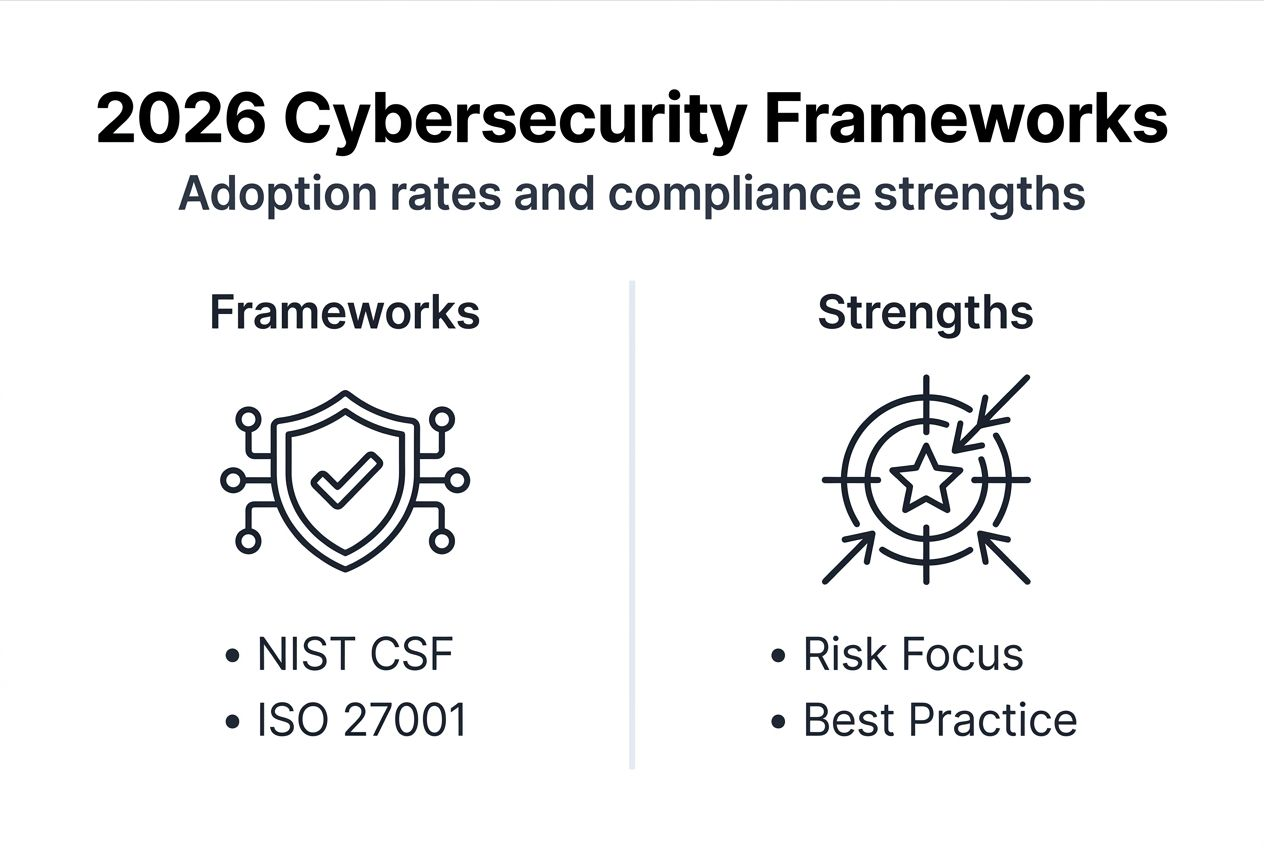
| Framework | Adoption Rate | Primary Strength | Best Use Case |
|---|---|---|---|
| NIST CSF | 33% | Risk-based flexibility and widespread recognition | Organizations needing regulatory alignment across multiple standards |
| ISO 27001 | 20% | International certification and comprehensive scope | Global organizations requiring formal certification |
| CIS Controls | 18% | Prioritized, actionable security measures | Organizations building programs from foundational security |
| Industry-specific | Various | Tailored regulatory compliance | Regulated sectors with mandatory frameworks |
The critical distinction in 2026 is between using frameworks as documentation exercises versus operational security drivers. Document-based compliance creates false security. Organizations that treat frameworks as annual audit preparation miss real-time threats emerging between assessments. This approach satisfies minimum regulatory requirements while leaving systems vulnerable to attacks that exploit the gap between compliance verification and continuous protection.
Continuous security monitoring transforms frameworks from static documentation into dynamic security programs. This means:
- Implementing automated controls that enforce framework requirements in real time rather than verifying compliance retrospectively
- Establishing metrics that track control effectiveness continuously instead of during scheduled reviews
- Integrating threat intelligence feeds that identify emerging risks requiring control adjustments
- Creating feedback loops where security incidents inform framework updates and control improvements
Cross-functional collaboration enhances framework effectiveness by connecting security controls to business processes. When security teams work in isolation, frameworks address technical requirements without considering operational impact or business risk context. Involving stakeholders from legal, compliance, operations, and business units ensures controls align with actual risk priorities and regulatory obligations.
Boards increasingly demand actionable cybersecurity insights that go beyond audit results. They want to understand residual risk after controls are implemented, cost-benefit analysis of security investments, and how security posture compares to peer organizations. Risk management frameworks for 2026 must provide these business-oriented metrics alongside technical compliance verification.
The evolution required is moving from compliance theater to operational security. This means using frameworks as the foundation for building security into business processes rather than as separate compliance programs that exist parallel to operations. Organizations achieving this integration embed security requirements into system design, vendor selection, change management, and incident response rather than treating them as afterthoughts verified during audits.
Pro Tip: Map your chosen framework to specific regulatory requirements in your industry. This creates a single control set that satisfies multiple compliance obligations rather than maintaining separate programs for each regulation. The efficiency gain allows deeper investment in control effectiveness.
Selecting and implementing an effective framework requires understanding your regulatory landscape, threat profile, and operational constraints. Security risk assessment processes should inform framework selection by identifying specific controls needed to address your highest risks. Generic framework adoption without customization leaves gaps where your unique risks remain unaddressed.
Discover effective solutions with Stonos Solutions
Translating cybersecurity trends into practical security improvements requires expertise and resources that many organizations struggle to maintain internally. The convergence of compliance and security, emergence of AI and quantum risks, and complexity of supply chain monitoring demand specialized capabilities.
Stonos Solutions delivers the penetration testing services that identify vulnerabilities before attackers exploit them, providing the continuous validation frameworks require. Our custom development and automation capabilities build security controls tailored to your specific compliance obligations and risk profile. The comprehensive security services we provide help organizations navigate emerging threats while maintaining regulatory compliance across healthcare, government, and enterprise sectors. Partner with experts who understand how 2026 trends impact your security posture and can implement solutions that address both technical risks and compliance requirements.
Frequently asked questions
Why is it critical for organizations to follow cybersecurity trends in 2026?
Staying current with cybersecurity trends directly impacts regulatory compliance and threat prevention capabilities. Emerging risks like AI vulnerabilities and quantum computing threats are not addressed by legacy security controls, creating compliance gaps as regulations evolve to cover these technologies. Organizations that wait for complete regulatory clarity before adapting their security programs will find themselves behind compliance requirements and exposed to threats their competitors have already mitigated.
How do AI and quantum computing impact cybersecurity compliance?
Quantum computing threatens to break current encryption standards by 2030, potentially compromising data protected under long-term retention requirements. Most organizations lack formal strategies to address this risk despite its known timeline. AI presents immediate compliance challenges because policy frameworks exist but technical enforcement remains minimal, allowing unauthorized AI tool usage that violates data handling regulations.
What lessons does the Conduent SafePay breach offer for supply chain risk management?
The 84-day dwell time before detection demonstrates that annual compliance audits cannot protect against persistent threats. Organizations must implement continuous behavioral monitoring for third-party connections rather than relying on vendor certifications alone. The breach also highlights the need for documented exit strategies and alternative service providers, since critical business functions can be disrupted when vendors experience security incidents.
Which cybersecurity frameworks are most relevant for 2026 compliance?
NIST CSF maintains the highest adoption rate at 33% because its risk-based approach aligns with multiple regulatory requirements simultaneously. However, framework selection matters less than implementation approach. Continuous monitoring and cross-functional collaboration determine framework effectiveness more than which specific standard an organization chooses, since all major frameworks provide adequate coverage when properly implemented and maintained.
Recommended
- Top risk management strategies for IT security 2026 - Stonos Solutions Blog
- Risk management strategy guide 2026: advanced tactics - Stonos Solutions Blog
- Top 7 Penetration Testing Tools for Small Business 2026 - Stonos Solutions Blog
- Security Consulting for Integrators: Enabling Resilience - Stonos Solutions Blog
- Varför Övervaka Nätverk – Ökad IT-säkerhet 2026
- Product Compliance Amazon: Protecting Seller Accounts - Searchoneers
Louis Romano
Need Security Consulting?
Our expert team is ready to help you enhance your security posture.
Contact Us Today Download Capability StatementRelated Articles
Why Use Vulnerability Analysis—Ensuring Security Compliance
Vulnerability analysis helps organizations prevent breaches, meet regulatory standards, and prioritize risks. Learn benefits, requirements, and key processes.
Read MoreWhy assess industrial security risks for compliance
Learn why industrial security risk assessment differs from IT risk management and how IEC 62443 methodology protects regulated industries from operational and compliance threats.
Read MoreCISSP certification: value, requirements, and career impact
Discover how CISSP certification drives career growth, supports regulatory compliance, and positions IT professionals for leadership roles in regulated industries.
Read More