Government risk management: cybersecurity & compliance guide
Government risk management: cybersecurity & compliance guide

Risk management in government is frequently misread as a compliance exercise, a stack of forms to file before an audit. That framing is costly. Federal agencies face an average of thousands of cyberattacks each year, and a single breach can disrupt critical services, expose citizen data, and trigger regulatory consequences that take years to resolve. This guide cuts through the noise to explain what risk management actually means for U.S. government agencies, which frameworks matter most, how to build a program that holds up under real pressure, and why treating it as a checklist is one of the most dangerous mistakes an agency leader can make.
Table of Contents
- Defining risk management in the government context
- Key frameworks and regulatory requirements for government risk management
- Implementing risk management: Steps and best practices for agencies
- Integrating cybersecurity and technology for effective risk management
- Why true risk management requires more than compliance
- How Stonos Solutions can help you modernize risk management
- Frequently asked questions
Key Takeaways
| Point | Details |
|---|---|
| Risk management vs. compliance | True risk management is strategic and proactive—not just checking boxes for regulations. |
| Follow proven frameworks | Agencies should use NIST CSF, FISMA, and sector-specific strategies to frame and guide risk programs. |
| Integrate cybersecurity at every stage | Effective risk management combines cyber defense, automation, and real-time monitoring for lasting protection. |
| Move beyond the status quo | Leaders must embed analytics and oversight into decision-making, not treat risk management as a one-time event. |
Defining risk management in the government context
To build a foundation for effective strategies, let's clarify the meaning and purpose of risk management in government.
Many agency leaders use the terms risk assessment and risk management interchangeably. They are not the same thing. Risk assessment is the process of identifying and evaluating potential threats, estimating their likelihood, and measuring their potential impact. Risk management is what happens next. It takes those findings and weighs them against legal obligations, budget realities, mission priorities, and operational constraints to decide what action to take.
As the EPA clearly distinguishes, risk management integrates assessment results with legal, economic, and operational considerations to shape mitigation activities, which is distinct from risk assessment itself. In government, that distinction carries real weight. An agency cannot simply patch every vulnerability or adopt every recommended control. Leaders must triage, prioritize, and allocate resources where risk reduction is most critical to mission continuity.
Federal agencies operate under a unique set of pressures that private organizations do not face to the same degree. Public accountability, congressional oversight, interagency coordination, and strict regulatory mandates all shape how risk must be managed. A risk decision that might be acceptable in a commercial setting could be politically or legally untenable in a federal context.
Core activities in government risk management include:
- Setting and enforcing cybersecurity maturity thresholds across systems and personnel
- Evaluating mission-critical assets to determine which failures would cause the most damage
- Coordinating risk responses across departments, contractors, and partner agencies
- Establishing discharge limits and quality standards for operational systems and infrastructure
- Documenting decisions to satisfy oversight requirements and support future audits
"Risk management is not about eliminating all risk. It is about making informed decisions so that residual risk stays within acceptable bounds for the mission."
Regulatory standards like FISMA and NIST provide the framework, but the best agencies go further. They treat risk management strategies as a living discipline, not a one-time deliverable. That mindset shift is what separates agencies that survive incidents from those that are defined by them.
Key frameworks and regulatory requirements for government risk management
Once you understand what risk management is, it's critical to see how regulations and best practices shape the process.
The U.S. government operates within a layered framework of cybersecurity and risk management requirements. No single document covers everything, which means agency leaders must understand how these standards connect and reinforce each other.
Core frameworks at a glance:
| Framework | Scope | Key process steps | Regulatory basis |
|---|---|---|---|
| NIST CSF | All federal and critical infrastructure | Identify, Protect, Detect, Respond, Recover | Voluntary but FISMA-aligned |
| FISMA | Federal agencies | Risk categorization, control selection, monitoring | Federal law (44 U.S.C. § 3551) |
| GSA Risk Management Strategy | GSA systems and data | Frame, Assess, Respond, Monitor | NIST SP 800-37 |
| Treasury FS-RMP | Financial sector agencies | Threat analysis, mitigation, coordination | NSM-22, sector directives |
GSA's risk management strategy involves framing, assessing, responding, and monitoring risk, with strong integration of cybersecurity and privacy mandates. That four-step model mirrors NIST SP 800-37 and gives agencies a repeatable structure they can adapt to their specific mission context.

FISMA metrics, updated for FY2024 and FY2025, reflect NIST CSF maturity levels across federal agencies, breaking performance into quantifiable categories aligned with the Identify, Protect, Detect, Respond, and Recover functions. These scores are not just internal benchmarks. They inform congressional reporting and budget justifications.
Key regulatory considerations for agency leaders include:
- CISA Known Exploited Vulnerabilities (KEV): Mandatory patching timelines for federal civilian agencies
- Enterprise Risk Management (ERM): OMB Circular A-11 requires agencies to integrate ERM into strategic planning
- CISA and DHS coordination: Agencies must align with national directives and participate in information sharing
- Privacy overlays: FISMA compliance must account for privacy controls under NIST SP 800-53
For practical guidance on staying current with these requirements, the security compliance tips outlined by Stonos Solutions provide a strong operational starting point. For leaders who want to go deeper, the advanced tactics guide covers program maturation in detail.
Compliance is the floor, not the ceiling. The agencies that perform best treat regulatory requirements as a baseline and invest in capabilities that go well beyond what any checklist demands.
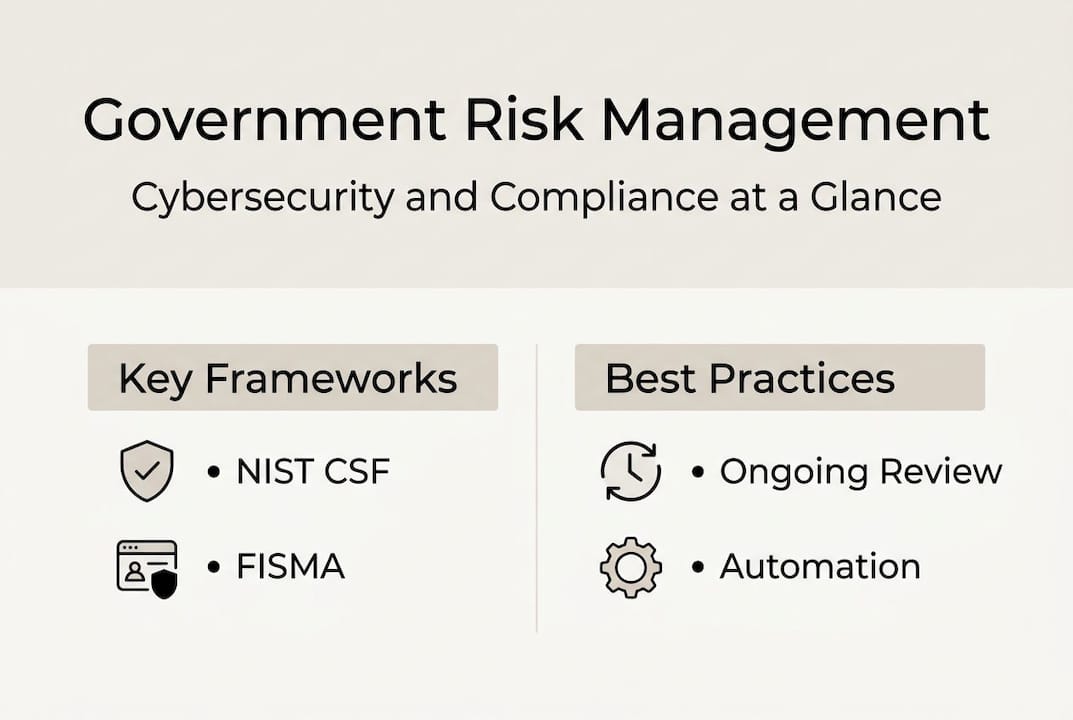
Implementing risk management: Steps and best practices for agencies
Now let's turn frameworks into reality. Here's how federal agencies can translate guidance into effective action.
Building or maturing a risk management program requires more than policy documents. It demands governance structures, trained personnel, clear processes, and consistent execution. The following steps provide a practical blueprint:
- Establish governance and accountability. Designate a Chief Risk Officer or equivalent role. Define who owns risk decisions at each level of the organization.
- Inventory and classify assets. Identify all systems, data types, and operational dependencies. Prioritize based on mission criticality and sensitivity.
- Conduct structured risk assessments. Evaluate threats, vulnerabilities, and potential impacts using a consistent methodology. Document findings formally.
- Design and implement controls. Select controls from NIST SP 800-53 or equivalent catalogs. Tailor them to your environment and risk tolerance.
- Respond to identified risks. Choose from four response options: accept, avoid, transfer, or mitigate. Every decision must be documented and approved at the appropriate level.
- Monitor continuously. Automate where possible. Use dashboards, alerts, and regular reviews to catch drift before it becomes a breach.
- Improve iteratively. After incidents, exercises, or audits, update your program. Risk management is a cycle, not a project.
For guidance on building a structured assessment process, conducting security risk assessments is a practical resource for agency teams.
Treasury's Financial Services Sector Risk Management Plan aligns mitigation with sector best practices and national security directives, demonstrating how a large federal entity operationalizes these steps at scale.
Unique public-sector considerations include coordinating risk decisions across multiple agencies, managing contractor risk, and maintaining transparency with oversight bodies. Centralizing risk oversight through an ERM function helps avoid siloed decisions that create gaps.
Pro Tip: Embed risk management into your agency's budget cycle. When risk data informs resource allocation decisions, you stop reacting to threats and start preventing them.
For agencies working with system integrators, security consulting for integrators explains how to align third-party work with your internal risk program.
Integrating cybersecurity and technology for effective risk management
Modern threats demand modern responses. Let's explore how cybersecurity and advanced tools transform risk management outcomes.
Cybersecurity is not a subset of risk management. It is one of its most critical dimensions. Agencies that treat cybersecurity as a separate function, or as purely an IT concern, create structural blind spots that adversaries exploit.
Cybersecurity maturity and technology integration:
| Capability area | Low maturity indicator | High maturity indicator |
|---|---|---|
| Threat detection | Manual log review | Automated SIEM with real-time alerts |
| Vulnerability management | Annual scans | Continuous scanning with KEV integration |
| Incident response | Ad hoc procedures | Tested playbooks, tabletop exercises |
| Risk reporting | Static annual reports | Live dashboards tied to risk register |
Federal agencies report high cybersecurity maturity per FISMA and NIST CSF standards, but must continually integrate new technology and threat intelligence to maintain that standing. High scores today do not guarantee resilience tomorrow.
The GAO High Risk List identifies persistent IT and cybersecurity issues across the federal government, noting that better portfolio management and mature practices are needed to close longstanding gaps. This is not a minor concern. It reflects systemic vulnerabilities that adversaries actively target.
Key technology practices for agency risk programs include:
- CISA KEV integration: Automate alerts when a new exploited vulnerability affects your asset inventory
- Threat intelligence feeds: Subscribe to sector-specific feeds through CISA and ISACs
- Security orchestration and automation: Reduce manual workload and response time for common threat scenarios
- Zero trust architecture: Shift from perimeter-based defense to identity and data-centric controls
Pro Tip: Do not wait for your next FISMA audit to discover gaps. Run quarterly internal reviews using your KEV feed and asset inventory together. The overlap between what you have and what attackers are exploiting is where your real risk lives.
For deeper coverage of technology-driven approaches, IT security risk strategies and security in asset protection offer relevant frameworks adaptable to the government context.
Why true risk management requires more than compliance
Frameworks and regulations give agencies a starting point. But the agencies that actually reduce risk do something different. They build a culture where risk thinking is embedded in daily decisions, not reserved for annual reports.
The uncomfortable reality is that most federal risk programs still operate closer to compliance theater than genuine risk reduction. Experts note the difference between compliance theater and data-driven risk reduction, emphasizing the need for common analytic models that connect risk data to real decisions. Checking boxes satisfies auditors. It does not stop breaches.
Budget constraints make this harder. When resources are tight, agencies often cut risk program investments first, treating them as overhead rather than as operational infrastructure. That logic is backwards. A mature risk program reduces the cost of incidents, accelerates recovery, and protects mission continuity in ways that reactive spending never can.
The shift requires moving beyond static reports and toward advanced risk management tactics that leverage automation, centralized data, and real-time monitoring. Agencies that make this transition stop managing risk on paper and start managing it in practice. That is where lasting resilience comes from.
How Stonos Solutions can help you modernize risk management
Ready to put these practical strategies into action?
Stonos Solutions works directly with government agencies to close the gap between compliance requirements and real-world security outcomes. Our team brings CISSP, PSP, and PMP-certified expertise to every engagement, covering everything from regulatory alignment to hands-on technical execution.

Our security services span the full risk management lifecycle, including structured assessments, control design, and ongoing monitoring support. For agencies that need to test their defenses under realistic conditions, our penetration testing services identify exploitable gaps before adversaries do. We also offer custom automation solutions that reduce manual workload and improve the speed and accuracy of your risk monitoring program. As an SDVOSB-certified firm, we understand the public sector environment and the accountability standards that come with it.
Frequently asked questions
What is the difference between risk management and risk assessment in government?
Risk assessment identifies threats and vulnerabilities, while risk management decides how to address those risks through proactive strategies, resource allocation, and documented response decisions.
Which frameworks guide risk management in federal agencies?
Key frameworks include NIST Cybersecurity Framework, FISMA, and agency-specific strategies. GSA and Treasury integrate NIST CSF and FISMA into structured, four-step risk management approaches tailored to their missions.
How mature are federal agencies' cybersecurity and risk management efforts?
As of FY2024, most agencies report high maturity levels across FISMA composite scores, but ongoing threats and evolving technology require continuous improvement rather than static achievement.
What are common pitfalls when implementing risk management in government?
Relying solely on compliance checklists and failing to adapt to new threats are the most common failures. Experts warn against compliance theater and stress the importance of integrated, data-driven practices that connect risk data to real operational decisions.
Recommended
- Risk management strategy guide 2026: advanced tactics - Stonos Solutions Blog
- Top risk management strategies for IT security 2026 - Stonos Solutions Blog
- Top 7 security compliance tips for 2026 success - Stonos Solutions Blog
- Role of security in manufacturing: protect assets now - Stonos Solutions Blog
- What are cyber threats? A 2026 guide for IT security pros
Louis Romano
Need Security Consulting?
Our expert team is ready to help you enhance your security posture.
Contact Us Today Download Capability StatementRelated Articles
Security gap analysis: steps, benefits, and best practices
Learn how to conduct a security gap analysis to identify hidden risks, close compliance gaps, and build a stronger security posture in regulated industries.
Read MoreEnterprise Security Checklist for Healthcare Compliance Success
Explore an actionable enterprise security checklist tailored for healthcare organizations. Follow a step-by-step process to ensure HIPAA compliance and risk management.
Read More7 Key Types of Cybersecurity Assessments for Healthcare
Learn about 7 essential types of cybersecurity assessments for healthcare organizations and get actionable tips to boost compliance and security.
Read More