Security audit step by step: A complete guide for 2026
Security audit step by step: A complete guide for 2026

TL;DR:
- Structured security audits consist of multiple phases: planning, evidence collection, testing, reporting, and follow-up.
- Properly scoping and documenting each phase ensures compliance and improves organizational security posture.
- Continuous monitoring and iterative improvements are essential for effective security management beyond a one-time audit.
A healthcare organization passes its annual review, then suffers a ransomware breach three months later. Investigators find that critical access controls were never tested, logs were incomplete, and remediation from the prior audit was never verified. The audit happened, but the process was broken. For security managers and IT professionals in regulated industries, a structured security audit is not optional. Security audits follow a structured lifecycle with defined phases, and skipping any one of them creates gaps that attackers and regulators will both find. This guide walks you through every step.
Table of Contents
- Understand the security audit lifecycle
- Step 1: Planning and scoping
- Step 2: Evidence collection and testing
- Step 3: Analyzing controls and reporting results
- Continuous monitoring and follow-up actions
- Why most organizations fail at audits: What experts wish you knew
- Take the next step: Secure your organization with Stonos Solutions
- Frequently asked questions
Key Takeaways
| Point | Details |
|---|---|
| Use a structured process | Follow clear phases—planning, evidence, testing, reporting, follow-up—for audit success. |
| Choose the right framework | Select NIST, ISO, PCI, or other frameworks based on your regulatory needs. |
| Document every step | Maintain detailed records for each audit action to support compliance and remediation. |
| Continuous improvement matters | Monitor remediation and risks after the audit to ensure lasting security benefits. |
| Integrate and adapt | Combine relevant frameworks and update processes to stay ahead of evolving threats. |
Understand the security audit lifecycle
Before you schedule interviews or pull log files, you need to understand the full shape of the process. A security audit is not a single event. It is a repeatable cycle that, when followed correctly, produces measurable improvements in your security posture and compliance standing.
Security audits follow 4-6 structured phases: Planning and Scoping, Evidence Collection, Control Testing, Reporting, and Follow-up. Each phase has a distinct goal and feeds directly into the next. Skipping or rushing any phase weakens the entire output.
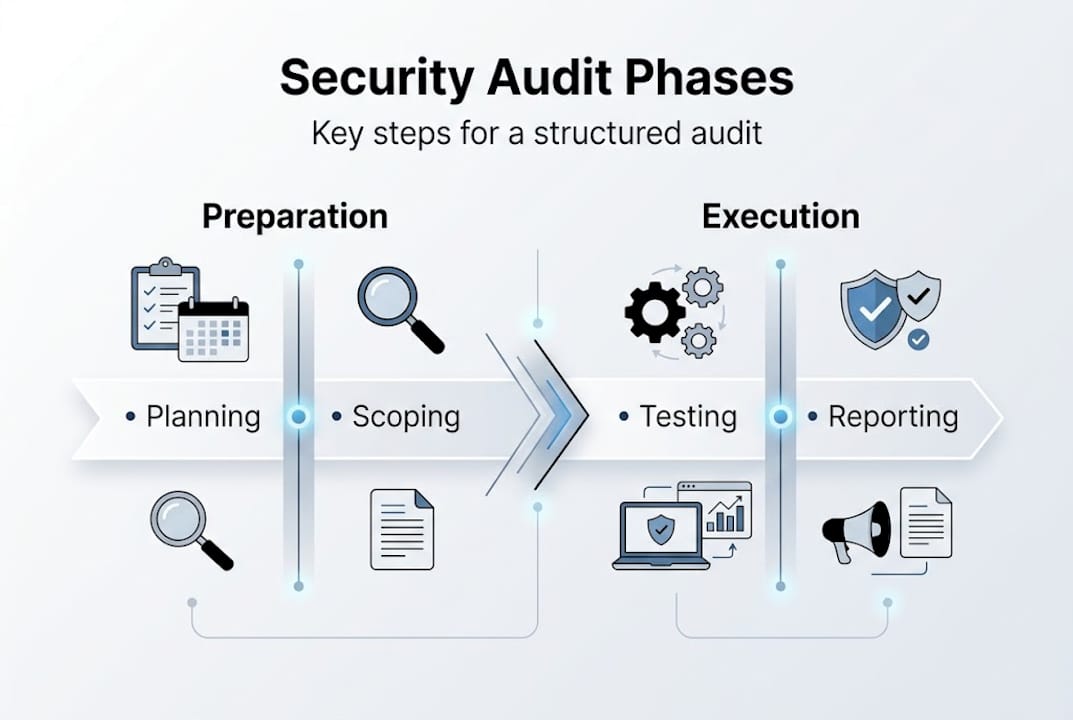
Here is a quick overview of each phase and what it demands:
| Phase | Primary goal | Key question |
|---|---|---|
| Planning and scoping | Define what will be audited | What assets and controls are in scope? |
| Evidence collection | Gather facts and documentation | Do controls exist and are they documented? |
| Control testing | Verify controls actually work | Are controls operating effectively? |
| Reporting | Communicate findings and risk | What must be fixed and when? |
| Follow-up | Validate remediation | Were gaps actually closed? |
This structure supports both compliance and risk management. Regulators under HIPAA, PCI DSS, and FISMA expect documented evidence of each phase. Without it, your audit report is just a document, not a defensible record.
A solid risk assessment methodology should inform your scoping decisions from the start. Pair that with proven IT risk management strategies to prioritize where you focus audit resources.
Pro Tip: Document every action taken during each phase, including decisions not to test certain controls and the rationale behind them. These records form your audit trail and are often the first thing regulators request.
Use the audit lifecycle checklist as a reference to confirm you have covered each phase before moving forward.
Step 1: Planning and scoping
Effective planning is the foundation of every successful audit. Without a clear scope, you waste resources testing the wrong systems and miss the ones that matter most to regulators and risk owners.

Start by defining your audit objectives. Are you assessing compliance with a specific regulation, evaluating the effectiveness of technical controls, or preparing for a third-party review? Your objective shapes everything that follows.
Next, identify the assets in scope. This includes systems, applications, data repositories, third-party integrations, and the people who manage them. Missing a critical asset at this stage is one of the most common and costly mistakes in the process.
Common scoping steps:
- Define audit objectives and success criteria
- Identify in-scope systems, data types, and locations
- Map applicable regulatory requirements to control domains
- Assign stakeholder roles and responsibilities
- Set the audit timeline and key milestones
Framework selection is equally important. Aligning audits with NIST 800-53 is critical in regulated industries, particularly for federal contractors and healthcare organizations. Here is a comparison of common frameworks and where they apply:
| Framework | Best fit | Regulatory alignment |
|---|---|---|
| NIST SP 800-53 | Federal agencies, contractors | FISMA, FedRAMP |
| CIS Controls v8 | All sectors | General best practice |
| PCI DSS | Payment card environments | Card brand mandates |
| ISO 27001 | Enterprise, international | Global compliance |
| HIPAA Security Rule | Healthcare | HHS enforcement |
Scope creep is a real threat. When stakeholders keep adding systems mid-audit, timelines slip and evidence collection becomes inconsistent. Lock the scope in writing before fieldwork begins.
For a deeper look at how regulations map to control requirements, review understanding regulatory compliance as a foundation for your planning work. Your risk-based audit planning approach should also reflect the threat landscape specific to your sector.
The CISA CPGs reference provides cross-sector performance goals that can help you prioritize control areas during scoping, especially if you operate in critical infrastructure.
Step 2: Evidence collection and testing
Once your scope is locked, you move into the most labor-intensive phase: gathering the facts that will support or challenge your control assessments.
Evidence collection uses three main methods as defined by NIST SP 800-53A: inquiry, observation, and inspection. Each method serves a different purpose and produces different types of evidence.
- Inquiry: Interview system owners, administrators, and end users to understand how controls are implemented and whether staff follow documented procedures.
- Observation: Watch processes in real time. Verify that access control procedures, change management workflows, and incident response steps are actually followed, not just written down.
- Inspection: Review documentation, configuration files, audit logs, policy documents, and system records to confirm controls exist and are maintained.
For audits like SOC 2 Type II, evidence must cover the full 12-month observation period. That means you cannot rely on a single screenshot or a one-week log sample. You need evidence that demonstrates consistent control operation across the entire audit window.
"The quality of your audit output is only as strong as the evidence you collect. Gaps in documentation are gaps in your defense."
Common mistakes at this stage include relying on verbal confirmations without written backup, pulling log samples that do not cover the full audit period, and failing to verify that automated controls actually triggered as intended.
For top compliance best practices that support efficient evidence gathering, structured templates and audit management tools make a significant difference. They reduce the chance of missing a control and create consistent, reviewer-ready documentation.
Pro Tip: Build an evidence request list before fieldwork begins. Assign each item to a specific owner with a due date. This keeps collection on schedule and ensures nothing falls through the cracks.
Reference the evidence collection checklist to confirm your methods align with audit standards before you begin testing.
Step 3: Analyzing controls and reporting results
With evidence in hand, you now evaluate whether your controls are actually working and communicate what you find to decision-makers.
Control testing follows a structured approach for each control in scope:
- Examine: Review documentation and configuration records to confirm the control is designed correctly.
- Interview: Ask control owners to explain how the control operates and how exceptions are handled.
- Test: Execute technical tests, such as attempting unauthorized access or reviewing system-generated alerts, to verify the control performs as intended.
Once testing is complete, assign a risk rating to each finding. Most frameworks use a four-tier scale:
- Critical: Immediate exploitation risk or regulatory violation
- High: Significant exposure requiring prompt remediation
- Moderate: Meaningful risk with a defined remediation window
- Low: Minor gap with limited impact
Reporting should include risk ratings, remediation plans, and root cause analysis to drive real improvement rather than just document problems. A finding without a root cause is a finding that will likely recur.
The remediation plan takes the form of a POA&M, which stands for Plan of Action and Milestones. Each POA&M entry should include the finding description, assigned owner, remediation steps, target completion date, and current status. This is the document that keeps accountability visible across teams and gives regulators a clear picture of your response.
For effective risk management strategies that connect audit findings to broader organizational risk, ensure your reporting process feeds directly into your risk register. Findings that sit in a report but never reach the risk register are findings that never get fixed.
The IT audit methodology framework provides additional guidance on structuring your testing and reporting workflow for consistency across audit cycles.
Continuous monitoring and follow-up actions
Auditing never truly ends. Once findings are reported and remediation begins, the next responsibility is verification.
Continuous monitoring approaches like CTEM differ from point-in-time audits by providing ongoing visibility into control effectiveness rather than a single annual snapshot. Both models have a role depending on your risk environment.
Effective follow-up includes:
- Validating that each remediation was completed as documented
- Re-testing previously failed controls after fixes are applied
- Tracking trend data across audit cycles to identify recurring weaknesses
- Updating your risk register to reflect closed findings
Integrating multiple frameworks into a single audit program saves significant time and reduces duplication. Benchmarks from CIS Controls v8 and NIST RMF provide measurable targets that support ongoing compliance without requiring separate audit programs for each regulation.
For organizations building long-term audit maturity, security consulting strategies can help align your monitoring program with both technical and operational goals.
Why most organizations fail at audits: What experts wish you knew
The steps above are necessary. But following them mechanically is not enough. Most audit programs that fail do not fail because the team skipped a phase. They fail because the audit is treated as a compliance event rather than a security improvement process.
The most common pattern is this: an organization runs an annual audit, produces a report, closes a few findings before the next review, and repeats the cycle without ever asking whether their security posture is actually improving. The audit becomes a ritual rather than a tool.
Integrated, multi-framework audits are more efficient and reduce duplication across control domains. Organizations that run separate HIPAA, NIST, and PCI audits with no shared evidence or common control mapping are wasting significant resources and missing cross-framework insights.
The teams that build genuinely mature audit programs do a few things differently. They treat findings as inputs to a continuous improvement process. They conduct peer reviews of audit methodology, not just findings. They bring in real-world audit experience through third-party validation at regular intervals.
Pro Tip: After each audit cycle, hold a retrospective focused on the audit process itself, not just the findings. Ask what evidence was hardest to collect, which controls were most often misunderstood, and where the process broke down. That feedback loop is what separates a mature program from a compliance checkbox.
Take the next step: Secure your organization with Stonos Solutions
Following a structured audit process is the right foundation. But building and maintaining that process internally, while managing day-to-day security operations, is a significant challenge for most teams.
Stonos Solutions works with security managers and IT professionals in regulated industries to design and execute audit programs that meet compliance requirements and strengthen real security outcomes. From penetration testing services that validate your control effectiveness to full-cycle security consulting, our team brings CISSP-certified expertise to every engagement. Explore the full security services portfolio and connect with our team to discuss where your audit program needs the most support.
Frequently asked questions
What are the main phases of a security audit?
Security audits follow 4-6 main phases: planning, evidence collection, control testing, reporting, and follow-up monitoring. Each phase builds on the last and must be completed in sequence.
Which audit frameworks are important for regulated industries?
Key frameworks include NIST 800-53, ISO 27001, PCI DSS, and CIS Controls. Regulated industries align with FISMA using NIST 800-53, while healthcare organizations follow HIPAA Security Rule requirements.
How often should we conduct a security audit?
Annual or risk-driven audit cycles are standard, but high-impact environments or those subject to continuous monitoring requirements may need more frequent reviews throughout the year.
What's the difference between internal and external audits?
Internal audits are conducted by your own team and are cost-effective for routine assessments. External audits offer independent verification and carry greater credibility with regulators and third parties.
What evidence is required for a SOC 2 Type II audit?
SOC 2 Type II requires evidence spanning a full 12-month observation period, including access reviews, change management records, and documented operational processes.
Recommended
- Top 7 security compliance tips for 2026 success - Stonos Solutions Blog
- Risk management strategy guide 2026: advanced tactics - Stonos Solutions Blog
- How to Conduct Security Risk Assessment for HIPAA Compliance - Stonos Solutions Blog
- Security Consulting for Integrators: Enabling Resilience - Stonos Solutions Blog
- The essential technology upgrade checklist for mid-sized businesses - BizDev Strategy
Louis Romano
Need Security Consulting?
Our expert team is ready to help you enhance your security posture.
Contact Us Today Download Capability StatementRelated Articles
Enterprise Security Checklist for Healthcare Compliance Success
Explore an actionable enterprise security checklist tailored for healthcare organizations. Follow a step-by-step process to ensure HIPAA compliance and risk management.
Read MoreSecurity gap analysis: steps, benefits, and best practices
Learn how to conduct a security gap analysis to identify hidden risks, close compliance gaps, and build a stronger security posture in regulated industries.
Read More7 Key Benefits of Penetration Testing for Healthcare IT
Discover 7 essential benefits of penetration testing for healthcare IT security managers and learn actionable strategies to protect data and ensure compliance.
Read More