Why regulatory compliance matters: reduce risk, protect your org
Why regulatory compliance matters: reduce risk, protect your org

TL;DR:
- Noncompliance costs have tripled since 2020, causing billions in penalties across sectors.
- Effective compliance reduces risks, enhances security, and delivers measurable operational savings.
- Advanced, risk-based, and tech-enabled frameworks improve audit readiness and organizational resilience.
The cost of noncompliance has tripled since 2020, contributing billions in penalties across healthcare, government, and industrial sectors. For compliance officers and risk managers, this is not a distant warning. It is a present operational reality. Regulatory compliance is no longer just a legal checkbox. It is a core driver of organizational security, reputation, and continuity. This article breaks down what compliance truly means, why it matters across your sector, and what advanced frameworks and expert strategies you can apply to reduce risk and protect your organization in 2026 and beyond.
Table of Contents
- What is regulatory compliance and who does it protect?
- Risks of noncompliance: Data, reputation, and operational threats
- How compliance powers business resilience and security
- Advanced frameworks: Risk-based and tech-enabled compliance
- A pragmatic view: Why compliance is more than a burden
- Partnering for effective compliance and risk reduction
- Frequently asked questions
Key Takeaways
| Point | Details |
|---|---|
| Prevents costly risks | Strong compliance programs help avoid fines, lawsuits, and major operational disruptions. |
| Protects safety and reputation | Compliance safeguards people, strengthens public trust, and maintains organizational reputation across all regulated industries. |
| Enables resilience | Integrating compliance with risk management and new technologies makes organizations more secure and agile. |
| Smart frameworks drive value | Risk-based, tech-enabled compliance approaches balance efficiency, ROI, and regulatory effectiveness. |
What is regulatory compliance and who does it protect?
Regulatory compliance refers to the process by which organizations follow laws, regulations, guidelines, and specifications relevant to their operations. In healthcare, that means standards like HIPAA and the False Claims Act. In industrial settings, it includes OSHA safety requirements and EPA environmental rules. For government contractors, frameworks like FISMA and NIST govern how data and systems must be protected.
Understanding regulatory compliance explained at a foundational level is critical before building any compliance program. The scope is broad. Compliance protects patients from unsafe care, employees from hazardous conditions, end-users from data breaches, and the public from environmental or safety failures.
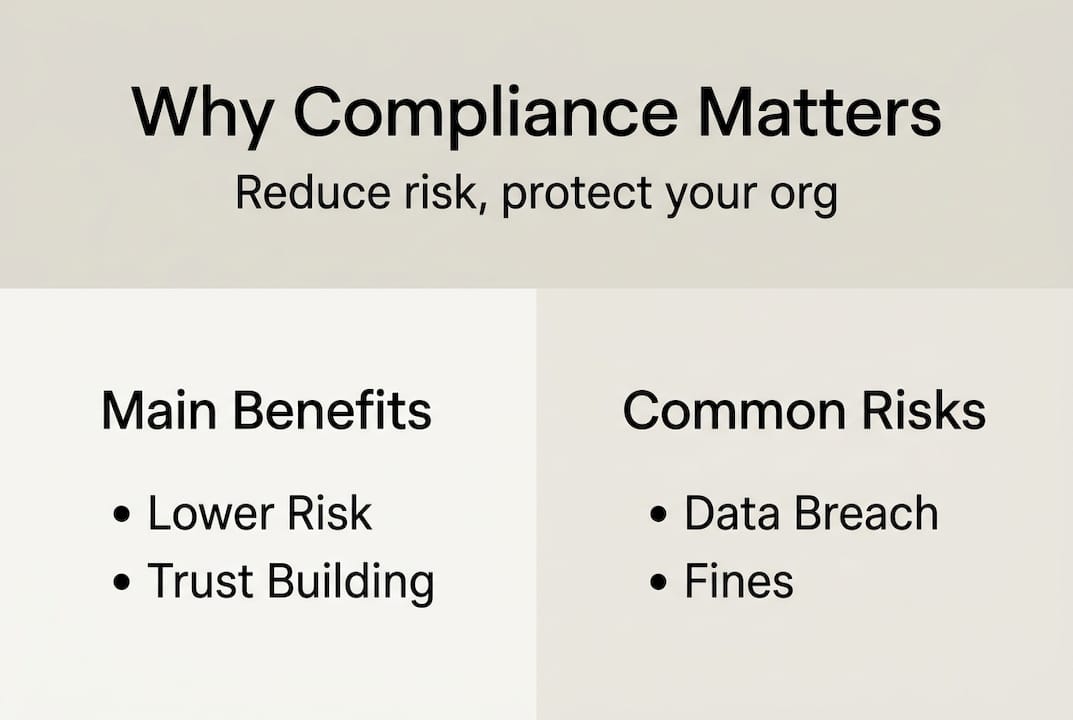
Healthcare compliance directly mitigates risks to patient safety, organizational finances, and institutional reputation. That triple impact is what makes it so strategically important. When compliance fails, the damage is rarely contained to a single area.
The direct consequences of noncompliance include:
- Civil and criminal penalties from regulatory agencies
- Lawsuits and class-action litigation from affected parties
- Loss of operating licenses or government contracts
- Reputational damage that erodes patient, client, and public trust
- Operational disruptions from mandatory audits, investigations, or shutdowns
In 2023, the U.S. Department of Justice recovered over $2.68 billion in False Claims Act settlements, the majority tied to healthcare fraud and noncompliance. That figure alone illustrates the scale of financial exposure organizations face when compliance programs fall short.
Compliance is also the foundation of operational trust. When patients know their data is protected, when employees know safety rules are enforced, and when regulators see a functioning compliance program, the entire organization operates with greater stability and confidence.
Risks of noncompliance: Data, reputation, and operational threats
With the groundwork for compliance's protective role set, we need to dig deeper into the concrete risks organizations actually face when falling short. These risks are not theoretical. They are documented, sector-specific, and often catastrophic.
In healthcare, top noncompliance risks include clinical safety failures, sentinel events, and cybersecurity threats. A single unaddressed vulnerability can result in a data breach affecting thousands of patients and triggering multi-million dollar settlements. In industrial environments, 73% of FDA 483 observations are maintenance-related, meaning most regulatory citations trace back to preventable equipment and process failures.
| Sector | Primary noncompliance risk | Financial impact | Operational impact |
|---|---|---|---|
| Healthcare | Data breaches, HIPAA violations | Fines up to $1.9M per violation category | Patient safety failures, license risk |
| Government | FISMA/NIST gaps, data exposure | Contract loss, federal penalties | Mission-critical system downtime |
| Industrial | OSHA/EPA violations, equipment failures | Fines, litigation, shutdown orders | Production halts, supply chain disruption |
The cascading effect is what makes noncompliance so dangerous. A regulatory fine is painful. But the reputational damage that follows, combined with operational disruption and increased audit scrutiny, can take years to recover from. Organizations that apply strong risk management strategies understand this compounding dynamic and build systems to interrupt it early.

Pro Tip: Build an early-warning system for risk escalation by mapping your top 10 compliance obligations to real-time KPIs. When a metric dips below threshold, it triggers an internal review before a regulator ever gets involved. Review these security compliance tips to sharpen your monitoring approach.
Risk mitigation in this context goes well beyond rule-following. It requires a proactive posture, continuous monitoring, and the organizational will to act on early signals before they become reportable incidents.
How compliance powers business resilience and security
After outlining the major risks, let's flip the script. How does good compliance empower organizations and create sustainable advantages? The answer lies in what a well-run compliance program actually builds over time.
Proactive compliance delivers measurable ROI. ERM and PM benchmarks above 95% compliance thresholds are linked to billions in operational savings annually, particularly in government and industrial sectors where equipment downtime and regulatory fines carry enormous cost. Safety improves. Efficiency improves. And the organization becomes more predictable and auditable.
| Benchmark | Target | Benefit |
|---|---|---|
| Preventive maintenance (PM) compliance | >95% | Reduced downtime, fewer violations |
| Audit readiness score (ARS) | >95% | Faster regulatory reviews, lower fine risk |
| Government risk reduction rate | Measurable annual improvement | Fewer high-risk program failures |
| Industry-wide compliance savings | $40B+ per year | Reduced litigation, operational efficiency |
GRC integration, which stands for governance, risk, and compliance, improves patient safety and operational efficiency when implemented with clear ownership and measurable outcomes. GRC is not just a software category. It is a management philosophy that aligns compliance activity with business objectives.
Organizational resilience drivers that strong compliance programs share include:
- Continuous internal audits that surface issues before external reviews
- KPI-driven monitoring tied to regulatory thresholds
- Enterprise risk management (ERM) prioritization at the leadership level
- GRC platform adoption for unified visibility across departments
- Technology integration including AI-assisted anomaly detection and digital audit trails
Cultural commitment matters just as much as process. When leadership treats compliance as a strategic priority rather than a legal obligation, teams respond with greater diligence and accountability. Explore IT security risk strategies to see how this translates into technical program design.
Advanced frameworks: Risk-based and tech-enabled compliance
To unlock maximum value and efficiency from compliance efforts, organizations are moving beyond basic frameworks to more advanced, risk-driven, and technology-enabled approaches. The traditional checklist model is showing its limits.
Checklists treat every control as equal. But not every risk is equal. A missed HIPAA training log is not the same as an unpatched electronic health record system. Risk-based approaches, including qualitative and quantitative risk assessments, differential monitoring, and compliance-by-design, allocate resources where they matter most.
Here is a practical framework for integrating advanced compliance methods:
- Conduct a baseline risk assessment using both qualitative (likelihood/impact scoring) and quantitative (financial exposure) methods to rank your compliance obligations by actual risk.
- Integrate GRC tools that connect your risk register, control library, and audit schedule into one visible system.
- Define KPIs for each major compliance domain so that performance is measurable and reportable to leadership on a regular cadence.
- Implement differential monitoring, applying higher-frequency checks to your highest-risk processes and lighter-touch reviews to lower-risk areas.
- Adopt unified digital controls that create audit-ready documentation automatically, reducing manual burden and error.
Pro Tip: Apply compliance-by-design when evaluating new technologies or supply chain partners. Before onboarding any new vendor or platform, assess its regulatory footprint. This prevents compliance gaps from entering your environment through third parties.
Edge cases including AI adoption and international supply chains require unified digital controls to maintain audit readiness across jurisdictions. As regulatory environments shift faster, organizations that have built adaptive, tech-enabled compliance programs respond more quickly and at lower cost. Use a thorough security risk assessment guide and consider security consulting for integrators to strengthen your technical compliance posture.
A pragmatic view: Why compliance is more than a burden
Even with all the frameworks and ROI data available, many compliance teams still feel overwhelmed. That frustration is real and worth acknowledging directly.
Annual compliance administrative costs reach $39 billion in healthcare alone, and physician turnover driven by regulatory burnout costs an estimated $5 billion per year. Over-regulation and complexity are not abstract complaints. They are measurable forces that drain talent and resources from organizations that can least afford it.
The organizations that struggle most with compliance are rarely those with the worst intentions. They are often those with the most complex environments and the least integrated systems.
The contrarian view worth holding is this: the burden of compliance is largely a symptom of poor program design, not regulation itself. When compliance is treated as a series of disconnected tasks rather than an integrated risk management function, the workload multiplies and morale suffers.
Risk-based, tech-enabled compliance programs reduce that burden. They focus effort where it matters, automate what can be automated, and give leadership clear visibility. Cultural change is the real force multiplier here, not the volume of regulations. When leadership champions building stronger security as a business value, compliance stops feeling like overhead and starts functioning as a competitive asset.
Partnering for effective compliance and risk reduction
Whether you see compliance as a cost, a safeguard, or both, getting the right expert support can make all the difference.
Stonos Solutions helps compliance officers and risk managers across healthcare, government, and industrial sectors turn complex regulatory requirements into actionable security programs. From vulnerability assessments and security services to sector-specific penetration testing services, the team brings CISSP-certified expertise and deep regulatory knowledge to every engagement. If your organization needs to close compliance gaps, validate existing controls, or build a risk-based program from the ground up, Stonos Solutions is equipped to support you at every stage. Connect with the team today to take the next step.
Frequently asked questions
What are the primary benefits of regulatory compliance?
Regulatory compliance helps avoid legal penalties, protects organizational reputation, ensures operational continuity, and enhances data and patient safety across all regulated sectors.
How does technology improve compliance effectiveness?
Digital audit trails and predictive tools enable continuous monitoring, real-time risk detection, and stronger audit readiness, reducing both manual effort and regulatory exposure.
Can regulatory compliance create a competitive business advantage?
Yes. Proactive compliance programs deliver measurable operational and financial advantages, strengthen stakeholder trust, and support faster, safer adoption of new technologies.
What is risk-based compliance?
Risk-based compliance tailors controls and monitoring intensity to the greatest organizational risks rather than applying uniform checklists across all processes, improving both efficiency and outcomes.
Recommended
- Regulatory Compliance Explained: Build Stronger Security - Stonos Solutions Blog
- Top 7 security compliance tips for 2026 success - Stonos Solutions Blog
- Risk management strategy guide 2026: advanced tactics - Stonos Solutions Blog
- Top risk management strategies for IT security 2026 - Stonos Solutions Blog
- Why security compliance matters: efficiency and risk reduction
- Compliance Risk Meaning: Impact on Security Reviews
Louis Romano
Need Security Consulting?
Our expert team is ready to help you enhance your security posture.
Contact Us Today Download Capability StatementRelated Articles
Why Use Vulnerability Analysis—Ensuring Security Compliance
Vulnerability analysis helps organizations prevent breaches, meet regulatory standards, and prioritize risks. Learn benefits, requirements, and key processes.
Read MoreRegulatory Compliance Explained: Build Stronger Security
Learn what regulatory compliance really means, how the management cycle works, and how to navigate conflicts to build stronger security and organizational trust.
Read MoreWhy assess industrial security risks for compliance
Learn why industrial security risk assessment differs from IT risk management and how IEC 62443 methodology protects regulated industries from operational and compliance threats.
Read More