Cybersecurity frameworks for secure compliance in 2026
Cybersecurity frameworks for secure compliance in 2026

TL;DR:
- Cybersecurity frameworks provide structured risk management and compliance guidance for regulated sectors.
- Choosing the right framework depends on industry, regulatory requirements, and infrastructure type, often requiring a hybrid approach.
- Integrating automation and cross-department collaboration enhances framework effectiveness and sustainment.
Regulatory pressure on healthcare, government, and industrial organizations has never been more intense. Many decision-makers know they need a cybersecurity framework but struggle to choose one that fits their sector, risk profile, and compliance obligations. The result is either costly over-engineering or dangerous gaps in coverage. Cybersecurity frameworks provide structured methodologies for risk management, compliance, and protection of sensitive data across these regulated sectors. This article breaks down the leading frameworks, compares their strengths, and gives you a practical path from selection to implementation.
Table of Contents
- Why cybersecurity frameworks matter for sensitive sectors
- Comparing leading frameworks: NIST, FISMA, and IEC/ISA 62443
- How frameworks guide risk management and compliance
- Best practices for leveraging frameworks: integration, automation, and audits
- A critical perspective: Why the right framework choice is only the beginning
- Next steps: Expert guidance for practical framework implementation
- Frequently asked questions
Key Takeaways
| Point | Details |
|---|---|
| Frameworks provide structure | Cybersecurity frameworks offer a clear roadmap for managing threats and compliance responsibilities. |
| Risk-based, not one-size-fits-all | Matching frameworks to industry needs and risks ensures practical and effective implementation. |
| Ongoing monitoring is essential | Continuous assessment and improvement keep security controls relevant as threats evolve. |
| Hybrid and automation boost success | Combining frameworks and automation tools covers gaps and supports sustainable compliance. |
Why cybersecurity frameworks matter for sensitive sectors
A cybersecurity framework is a structured set of guidelines, standards, and best practices that helps organizations manage security risk systematically. In regulated industries, operating without one is not just risky; it is often a compliance violation. Frameworks give security teams a common language, a measurable baseline, and a roadmap for continuous improvement.
For healthcare organizations, frameworks support HIPAA compliance by mapping security controls to patient data protection requirements. For federal agencies, they are the backbone of audit readiness under FISMA (Federal Information Security Modernization Act). For industrial operators, they protect operational technology (OT) environments where a breach can have physical consequences.
Understanding regulatory compliance basics is the first step toward selecting a framework that aligns with your obligations. The NIST Cybersecurity Framework (CSF) 2.0, released in 2024, organizes security activities into six core functions: Govern, Identify, Protect, Detect, Respond, and Recover. Each function maps directly to real-world security outcomes, making it easier to assign ownership and measure progress.
The Cybersecurity Performance Goals (CPGs), updated in December 2025, extend this structure specifically for critical infrastructure operators. They translate broad framework principles into prioritized, measurable actions.
"Frameworks provide structured methodologies for risk management, compliance, and data protection across sectors including healthcare, government, and industry."
Key benefits of adopting a recognized framework include:
- Risk reduction: Structured controls address the most likely and impactful threats first.
- Maturity benchmarking: Organizations can measure current security posture against defined tiers or levels.
- Resource prioritization: Frameworks help direct limited budgets toward the highest-risk areas.
- Audit readiness: Documented controls and evidence trails simplify regulatory reviews.
- Continuous improvement: Built-in review cycles ensure security keeps pace with evolving threats.
Following top compliance tips alongside a recognized framework accelerates this maturity curve significantly.
Comparing leading frameworks: NIST, FISMA, and IEC/ISA 62443
Not every framework fits every organization. Sector, regulatory environment, and the nature of your infrastructure all influence which framework or combination of frameworks is appropriate. Here is how the major options compare.
NIST CSF 2.0 is the most broadly applicable framework. It is sector-agnostic, scalable for organizations of any size, and widely recognized by regulators. Its six core functions provide a flexible structure that supports both initial assessments and long-term security program management. The NIST CSF overview is a strong starting point for any organization new to formal frameworks.
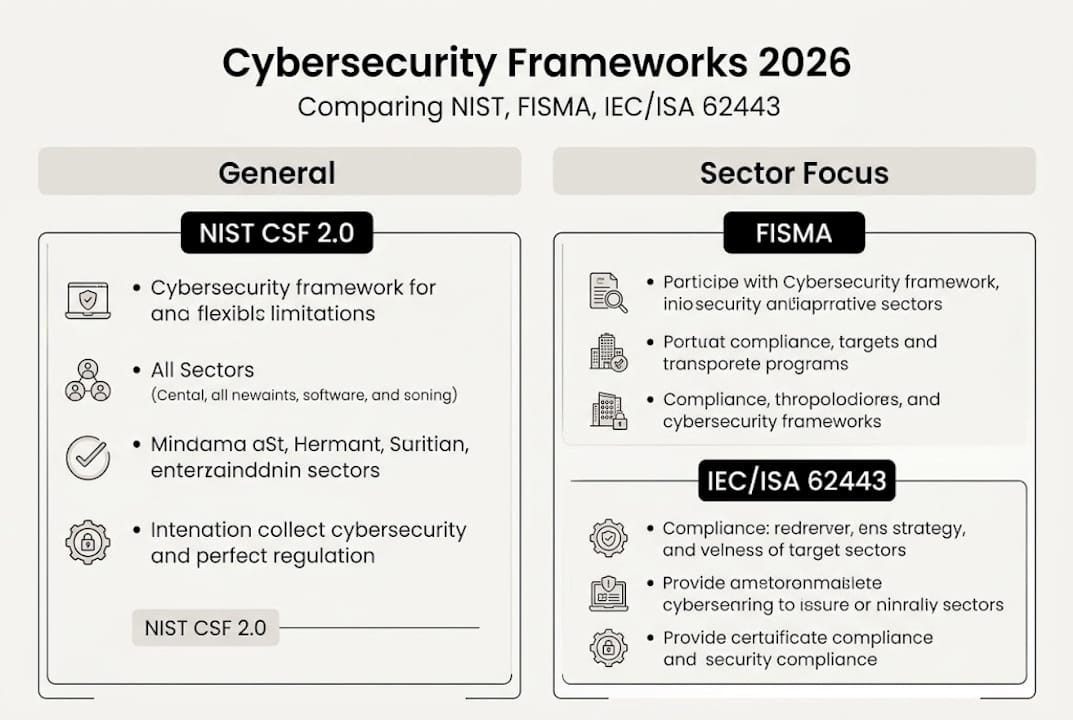
FISMA and NIST SP 800-53 apply specifically to federal agencies and their contractors. Government organizations use FISMA with NIST SP 800-53 and CSF 2.0 for security via the Risk Management Framework (RMF). SP 800-53 provides an extensive catalog of security and privacy controls organized into families such as access control, incident response, and system integrity.
IEC/ISA 62443 is the leading standard for industrial control systems (ICS) and operational technology environments. Industrial organizations apply NIST SP 800-82, IEC/ISA 62443 for ICS, OT, and SCADA security. The standard uses a zone-and-conduit model to segment industrial networks and assigns Security Levels (SL 1 through SL 4) based on threat sophistication.
| Framework | Primary sector | Key focus | Compliance driver |
|---|---|---|---|
| NIST CSF 2.0 | All sectors | Risk management, governance | Broad regulatory alignment |
| NIST SP 800-53 / FISMA | Federal government | Control catalog, RMF | FISMA mandate |
| IEC/ISA 62443 | Industrial, OT/ICS | Zone segmentation, SL tiers | ICS/SCADA security |
| NIST SP 800-82 | Industrial, OT | OT-specific guidance | Critical infrastructure |
Many organizations find that no single framework covers all their obligations. A healthcare system with industrial HVAC controls, for example, may need HIPAA-aligned controls from NIST CSF alongside IEC/ISA 62443 for its building automation systems. Exploring advanced risk tactics and security in manufacturing environments reveals how complex these overlaps can become.
Also consider ICS/OT security standards when evaluating industrial environments, as the threat landscape for operational technology continues to evolve rapidly.
Pro Tip: Use framework mapping tables to identify where two frameworks share control requirements. Overlapping controls mean you can satisfy multiple compliance obligations with a single implementation effort, reducing cost and complexity.
How frameworks guide risk management and compliance
Frameworks are most valuable when they translate abstract security goals into concrete, repeatable processes. The NIST risk framework describes a risk-based approach that begins with asset and threat identification and moves through risk analysis, control selection, and continuous monitoring.
Here is a practical step-by-step flow for implementing risk management within a framework:
- Inventory assets and data flows: Catalog all systems, devices, and data repositories. Include OT assets if applicable.
- Identify threats and vulnerabilities: Map known threat actors and attack vectors to your specific environment.
- Assess risk: Score each risk by likelihood and potential impact to prioritize remediation efforts.
- Select and implement controls: Choose controls from your framework that address the highest-priority risks.
- Document and communicate: Record control decisions and assign ownership across business units.
- Monitor continuously: Use automated tools and periodic reviews to detect control failures or new risks.
- Review and improve: Schedule formal framework reviews at least annually or after significant incidents.
The table below maps framework elements to risk process outcomes:
| Framework element | Risk process stage | Expected outcome |
|---|---|---|
| Identify function | Asset and threat inventory | Complete asset register |
| Protect function | Control implementation | Reduced attack surface |
| Detect function | Continuous monitoring | Faster threat detection |
| Respond function | Incident management | Contained breach impact |
| Recover function | Business continuity | Reduced downtime |
A security risk assessment guide walks through this process in detail for organizations starting from scratch. For industrial environments, 62443-3-2 ZCR 5 provides detailed risk assessment steps specific to zone and conduit analysis in OT networks.
"The risk-based approach requires organizations to identify assets and threats, assess impact and likelihood, select controls, and monitor security posture on an ongoing basis."
Reviewing IT risk management strategies alongside your framework adoption ensures that IT and OT risk processes stay aligned rather than operating in separate silos.
Best practices for leveraging frameworks: integration, automation, and audits
Selecting a framework is only the first decision. Getting lasting value from it requires deliberate integration into your organization's daily operations, procurement processes, and audit cycles.

No single framework suffices; hybrid use and automation are essential for organizations with overlapping regulatory obligations. A hybrid approach means formally mapping your controls across two or more frameworks, identifying shared requirements, and building a unified control library that satisfies all applicable standards simultaneously.
Automation plays a critical role in making compliance sustainable. Manual evidence collection and control testing are time-consuming and error-prone at scale. NIST automation guidance supports the use of automated assessment tools to continuously validate control effectiveness. Key areas where automation adds value include:
- Continuous control monitoring: Automated tools flag deviations from baseline configurations in real time.
- Evidence collection: Systems automatically log access events, patch status, and configuration changes for audit trails.
- Vulnerability scanning: Scheduled scans identify new exposures before auditors or attackers do.
- Compliance reporting: Dashboards aggregate control status across frameworks, reducing manual reporting effort.
Integrating frameworks with business processes requires cross-functional collaboration. Security teams alone cannot sustain a framework. Procurement, HR, legal, and operations all own controls relevant to their functions. Exploring security consulting for integration provides practical guidance on aligning security frameworks with operational workflows.
Custom automation solutions for compliance can accelerate this integration significantly, especially for organizations managing complex, multi-site environments. Additionally, penetration testing tools provide a practical way to validate that implemented controls actually work under simulated attack conditions.
Pro Tip: Before any audit, build an evidence map that links each required control to specific documentation, system logs, or test results. Auditors spend less time searching, and your team spends less time scrambling.
A critical perspective: Why the right framework choice is only the beginning
Frameworks are powerful tools. They provide structure, accountability, and a shared vocabulary for security teams and leadership. But treating framework adoption as a destination rather than a starting point is one of the most common and costly mistakes organizations make.
Checklist compliance, where teams focus on passing audits rather than reducing real risk, creates a false sense of security. An organization can score perfectly on a framework assessment and still suffer a significant breach because the controls were documented but not genuinely embedded in daily operations.
The organizations that build lasting resilience share a few traits that no framework mandates. Leadership treats security as a business priority, not just an IT function. Security posture is reviewed regularly, not just at audit time. And cross-functional teams, including operations, legal, and HR, participate in maintaining and improving controls.
Deeper regulatory insights reinforce this point: compliance and security are related but not identical goals. A framework gives you the map. Culture, leadership, and adaptability determine whether you actually follow it.
Next steps: Expert guidance for practical framework implementation
Understanding frameworks is valuable. Implementing them correctly under real-world constraints is where most organizations need support.
Stonos Solutions works directly with healthcare, government, and industrial organizations to select, implement, and validate cybersecurity frameworks tailored to their specific risk environments and compliance obligations. From penetration testing support that validates your control effectiveness to custom development and automation that makes compliance sustainable at scale, the team brings certified expertise across NIST, FISMA, HIPAA, and IEC/ISA 62443. Explore the full list of security services to find the right engagement model for your organization.
Frequently asked questions
What is the NIST Cybersecurity Framework, and who should use it?
The NIST CSF is a flexible, risk-based approach for managing cybersecurity that is recommended for healthcare, government, and industrial organizations of any size. Its six core functions provide a scalable structure adaptable to both simple and complex security environments.
How do organizations choose the right cybersecurity framework?
Selection depends on sector, risk profile, and applicable compliance standards. Because no single framework suffices for organizations with overlapping obligations, many adopt a hybrid approach that maps controls across multiple standards to achieve broad coverage efficiently.
What are the main steps in framework-driven risk management?
Organizations identify assets and threats, assess risk by likelihood and impact, apply appropriate controls, and monitor their security posture on an ongoing basis. Formal reviews at least annually ensure the process stays current with evolving threats.
Can automation help with cybersecurity framework compliance?
Yes. Automation aids framework implementation by streamlining control assessments, collecting audit evidence continuously, and generating compliance reports that reduce the manual burden on security teams.
Recommended
- Top 7 security compliance tips for 2026 success - Stonos Solutions Blog
- Regulatory Compliance Explained: Build Stronger Security - Stonos Solutions Blog
- Top risk management strategies for IT security 2026 - Stonos Solutions Blog
- Role of security in manufacturing: protect assets now - Stonos Solutions Blog
- Top 5 IT Security Essentials Every Business Needs in 2026 - Carsonix Inc.
- Cyber Security - IT Start
Louis Romano
Need Security Consulting?
Our expert team is ready to help you enhance your security posture.
Contact Us Today Download Capability StatementRelated Articles
Enterprise Security Checklist for Healthcare Compliance Success
Explore an actionable enterprise security checklist tailored for healthcare organizations. Follow a step-by-step process to ensure HIPAA compliance and risk management.
Read MoreSecurity gap analysis: steps, benefits, and best practices
Learn how to conduct a security gap analysis to identify hidden risks, close compliance gaps, and build a stronger security posture in regulated industries.
Read More7 Key Benefits of Penetration Testing for Healthcare IT
Discover 7 essential benefits of penetration testing for healthcare IT security managers and learn actionable strategies to protect data and ensure compliance.
Read More